
Explore Zodiac Signs
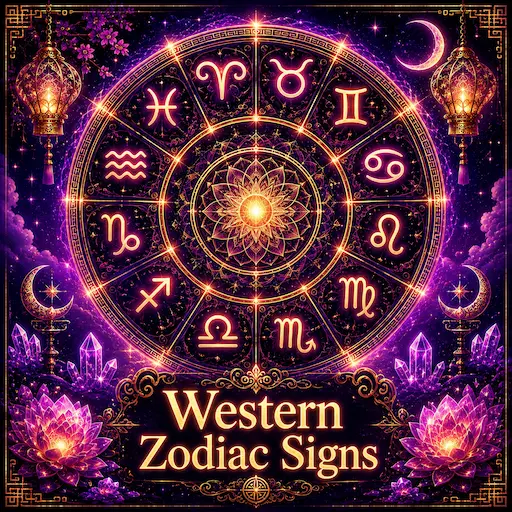
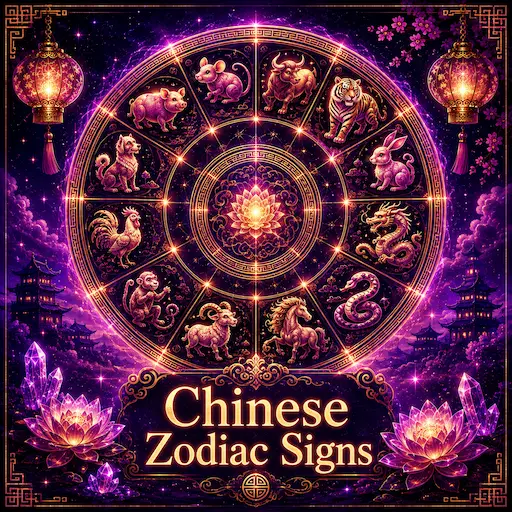
Western and Chinese Zodiac Signs
Astrology uses several zodiac traditions, and two of the best known are the Western zodiac and the Chinese zodiac. Both organize signs into repeating systems and use them to describe traditional personality patterns, strengths, challenges, relationships, and symbolic qualities, but they are built on different calendars and astrological frameworks.
The Western zodiac contains twelve signs from Aries to Pisces. Your familiar Western zodiac sign is usually your Sun sign, determined by the Sun’s position in the tropical zodiac at the time of your birth. Each sign belongs to one of four elements—Fire, Earth, Air, or Water—and one of three modalities: Cardinal, Fixed, or Mutable.
The Chinese zodiac uses a twelve-animal cycle: Rat, Ox, Tiger, Rabbit, Dragon, Snake, Horse, Goat, Monkey, Rooster, Dog, and Pig. The familiar birth-year animal changes at Chinese New Year rather than January 1, which makes the exact birth date especially important for people born in January or February. Chinese zodiac interpretation also connects the animal cycle with Yin and Yang, the Five Elements, and the twelve Earthly Branches.
How Western and Chinese Zodiac Signs Are Different
The most important difference is how the two systems determine a person’s sign. Western Sun signs follow the Sun’s annual movement through twelve zodiac signs, so the sign usually changes around the third week of each month. The popular Chinese zodiac assigns an animal to a lunar year, producing a repeating twelve-year animal cycle.
The two traditions also organize their symbolism differently. Western astrology combines zodiac signs with planets, houses, aspects, elements, and modalities. Chinese astrology places the twelve animals within a larger system that includes the Five Elements, Yin and Yang, Heavenly Stems, Earthly Branches, and more detailed systems such as the Four Pillars of Destiny.
Because the systems are independent, one person has both a Western zodiac sign and a Chinese zodiac animal. Someone might be a Western Taurus and a Chinese Dragon, for example. Neither sign replaces the other; they come from different astrological traditions and describe personality through different symbolic frameworks.
Choose the Zodiac System You Want to Explore
If you want to find a sign from your month and day of birth, start with the Western zodiac. You can explore all twelve signs, their date ranges, personality traits, elements, modalities, ruling planets, strengths, weaknesses, and traditional meanings.
If you want to find your animal sign from your year and exact birth date, explore the Chinese zodiac. Each animal page covers verified birth-year boundaries, personality characteristics, Yin-Yang and elemental associations, relationships, work style, traditional lucky symbolism, and the Five Element versions of that animal.
These sign systems are best understood as traditional astrological frameworks rather than scientific measures of personality. Their value lies in the symbolic language they use to describe different patterns of temperament, motivation, relationships, and human behavior.
FAQ
Can I have both a Western zodiac sign and a Chinese zodiac sign?
Yes. The two systems are independent, so everyone can have both. Your Western Sun sign is based on the Sun’s position at your birth, while your familiar Chinese zodiac animal is based on the Chinese zodiac year that included your birth date.
Are Western and Chinese zodiac elements the same?
No. Although both traditions use elemental terminology, they use different systems. Western astrology traditionally works with Fire, Earth, Air, and Water. Chinese astrology uses the Five Elements, or Five Phases: Wood, Fire, Earth, Metal, and Water. The meanings and relationships between the elements also differ between the two traditions.