Do Tarot Readings Really Work? Accuracy, Psychology, and Why They Feel Real
Tarot doesn’t “work” as a scientific way to predict specific future events. But it can work as an interpretive tool that helps people clarify feelings, spot patterns, and think through choices.
In this article, you’ll learn why tarot readings often feel real, what “accuracy” can (and can’t) mean in tarot, where readings can go wrong, and how to use tarot in a safer, more grounded way.
If you’re skeptical but curious, that’s a sensible place to start. The key is defining what you’re actually testing: prediction vs. insight.
What People Mean When They Say “Tarot Works”
When someone says a tarot reading “worked,” they usually mean one of three things:
- It felt accurate — the reading matched their situation or emotional state.
- It offered clarity — it helped them reflect or see options differently.
- It felt validating — it put words to feelings they already had.
Less often, people mean tarot predicted a specific outcome with certainty. That’s where expectations and reality often diverge.
What Tarot Is (and Isn’t)
Tarot is a symbolic interpretive system built around images, archetypes, and narrative themes. A traditional deck includes:
- Major Arcana — big life themes (change, choice, growth, challenge).
- Minor Arcana — everyday situations, emotions, and practical concerns.
Tarot is not:
- a scientific instrument,
- a method with measurable predictive accuracy,
- a substitute for medical, legal, or financial advice.
Instead, tarot “works” through interpretation: you look at symbols, connect them to context, and explore meaning. That process can be useful — but it’s not the same thing as prediction. If you’re coming at this from a faith perspective, you may also want to read is tarot reading a sin?
Why Tarot Readings Often Feel Accurate
Even when tarot isn’t predicting facts, it can still feel surprisingly on-point. A few well-known psychological mechanisms help explain why.
The Forer (Barnum) Effect
People tend to find broad, relatable statements personally meaningful — especially when they’re framed as “about you.” In tarot, symbolic language can feel specific because it maps easily onto common human experiences.
Confirmation Bias and Selective Memory
We naturally notice “hits” more than “misses.” If part of a reading resonates, it stands out — while the parts that don’t fit are often forgotten or reinterpreted later.
Subjective Validation
If a message matches what you already feel or fear, it can feel true even without objective proof. Tarot can amplify this because it invites you to project your personal context onto the imagery.
Pattern-Seeking (Making Meaning Under Uncertainty)
When life feels unclear, the brain searches for patterns and narratives. Tarot provides a structured set of symbols, which can make uncertainty feel more organized — and therefore more “accurate.”
Are Tarot Readings Actually Accurate?
That depends on how you define accuracy — as factual prediction or as useful insight.
If you’re specifically wondering about the online format, here’s a practical guide on whether online tarot readings are accurate and what to watch out for.
If accuracy means “this specific thing will happen,” tarot has clear limitations. There’s no reliable way to prove a reading consistently forecasts exact outcomes.
If accuracy means “this helps me understand what’s going on and what I want to do,” tarot can be genuinely useful. In that sense, tarot often functions less like a forecast and more like a mirror — reflecting concerns, options, and inner states.
A Quick Example: Why a Reading Can Feel Accurate (and Where It Can Go Wrong)
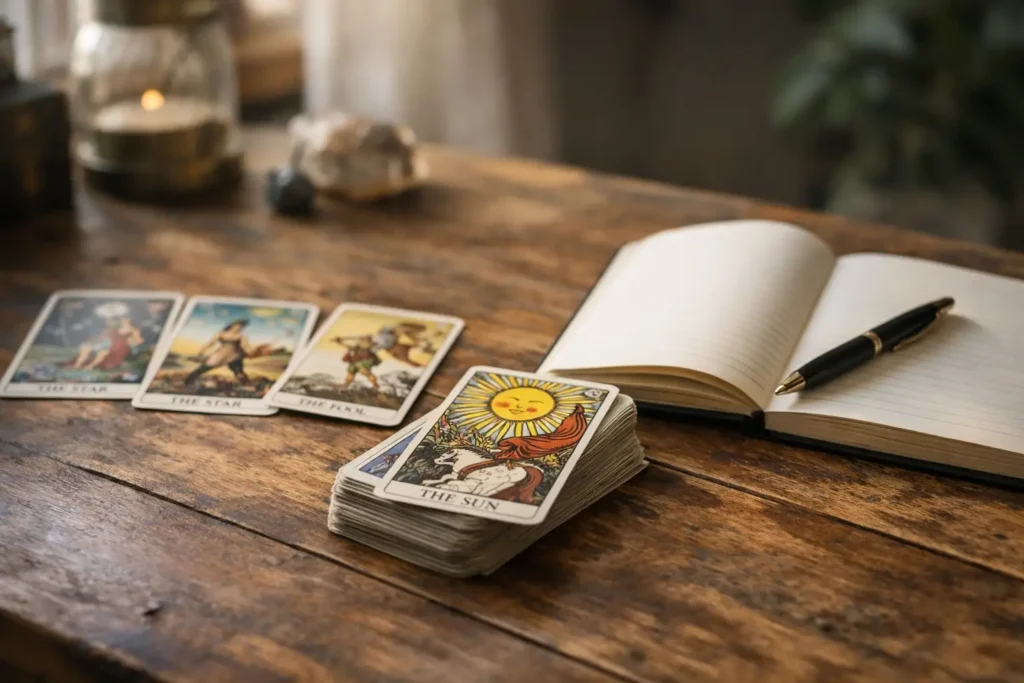
Imagine someone asks: “Should I change jobs?” A simple three-card spread might be interpreted like this:
- Card 1 (Current situation): feeling stuck, underused, or craving growth.
- Card 2 (What to consider): trade-offs — stability vs. learning curve, values vs. comfort.
- Card 3 (Possible direction): a next step that tests confidence and requires planning.
Why this can resonate: most career decisions involve tension between security and growth, and tarot symbols naturally express that. Where it can go wrong: if the reading is treated as a guarantee (“you will succeed” / “you will fail”) rather than a prompt to reflect, research, and choose intentionally.
Can Tarot Readings Be Wrong?
Yes. Tarot readings can be misleading or unhelpful when:
- interpretations are taken literally,
- the reader projects personal bias,
- questions are vague or emotionally loaded,
- readings are treated as fixed outcomes rather than possibilities.
Tarot doesn’t remove uncertainty, and it shouldn’t replace decision-making or personal responsibility. For a specifically Christian lens on when tarot is treated as divination, see this article on whether tarot reading is a sin.
How to Spot a Good Reader vs a Manipulator
A grounded tarot experience depends a lot on ethics and communication. Here are practical signs to watch for.
Red Flags
- Guaranteed outcomes: “This will definitely happen.”
- Fear tactics: “You’re cursed,” “someone hexed you,” or dramatic claims meant to scare you.
- Pay-to-remove pressure: insisting you must pay more to “fix” or “cleanse” something.
- Isolation or control: discouraging you from talking to friends, professionals, or getting second opinions.
- Medical/legal/financial claims: telling you to ignore professional advice.
Green Flags
- Transparency: explains the process and invites questions.
- Consent and boundaries: checks what you’re comfortable discussing.
- Encourages agency: treats the reading as input, not orders.
- Clear limitations: avoids absolute predictions and high-stakes directives.
- Respectful tone: no shame, no fear, no pressure.
Expectation vs Reality in Tarot Readings
What People Expect
- Exact predictions
- Guaranteed answers
- Fixed outcomes
- External authority
What Tarot Often Offers
- Symbolic insight
- Interpretive perspectives
- Reflection and choice
- Personal meaning
Final Perspective
Tarot doesn’t “work” in the same way a scientific test works. But it can work as a reflective tool that helps people make sense of feelings, choices, and uncertainty — especially when it’s used responsibly.
If you want to approach tarot in a grounded way, treat readings as perspectives, not guarantees. Use them to clarify what matters to you — then follow up with real-world thinking, research, and support.
Disclaimer: Tarot readings are interpretive and symbolic in nature. They are not a substitute for professional psychological, medical, legal, or financial advice.
Frequently Asked Questions
Can tarot work without a reader?
Yes—many people use tarot solo as a journaling or reflection tool. The value usually comes from interpreting symbols in context, not from any “psychic” certainty.
What does “accuracy” mean in tarot?
In tarot, “accuracy” often means relevance: the reading mirrors what you’re dealing with emotionally or situationally. That’s different from predicting specific events.
How should I ask better tarot questions?
Ask open-ended questions focused on choices and next steps. For example: “What should I consider before changing jobs?” instead of “Will I get the job?”
Why do tarot readings sometimes feel specific?
Symbols are broad enough to fit many real-life situations, and people naturally map them onto personal context. Timing, emotion, and selective memory can make a reading feel unusually precise.
Is tarot the same as cold reading?
Not necessarily. Cold reading often relies on broad statements plus feedback cues to sound specific, while tarot uses visible symbols and interpretation. Still, a manipulative reader can use tarot in a cold-reading style.
How do I tell if a tarot reader is trustworthy?
Look for transparency, respectful boundaries, and a focus on your agency. Avoid anyone who guarantees outcomes, uses fear tactics, or pressures you to pay more to “fix” something.
Is tarot compatible with religion or atheism?
It depends on personal beliefs. Some people treat tarot as spiritual guidance; others use it as a symbolic reflection tool without supernatural claims.
When is it better not to use tarot?
Avoid relying on tarot for medical diagnosis, legal decisions, or urgent mental health situations. In high-stakes cases, professional support is the safer choice.