
Is Tarot Reading a Sin? A Clear Christian View (With Catholic Notes)
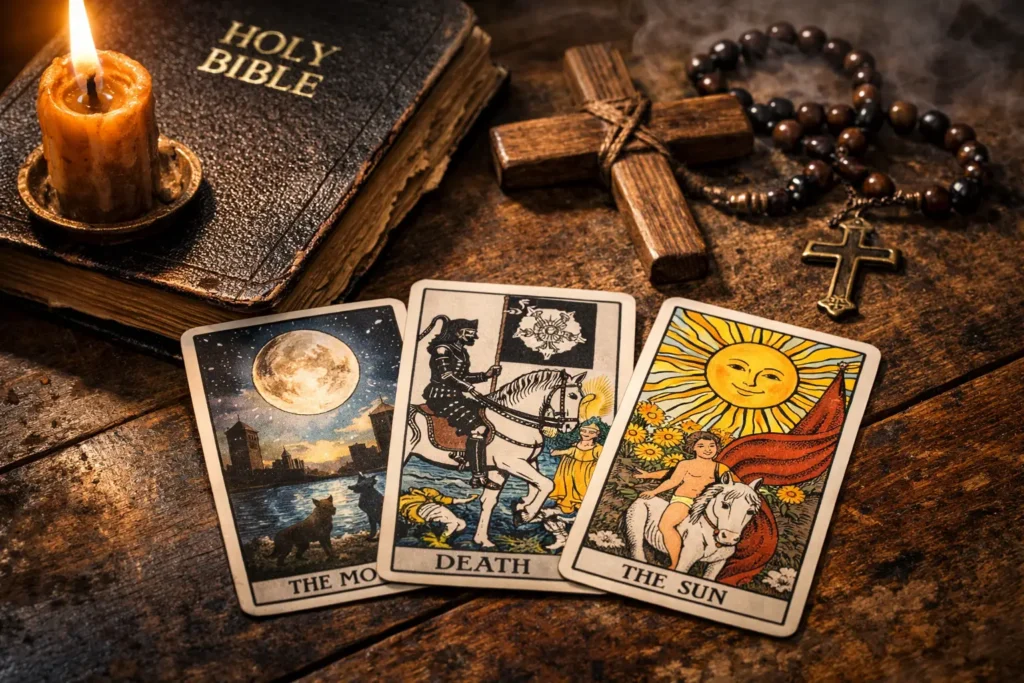
Is tarot reading a sin? Many Christian churches consider it a sin when tarot functions as divination—seeking predictions, hidden knowledge, or spiritual guidance apart from God. In practice, that covers most “readings” aimed at answers, reassurance, or direction.
If you’re Catholic: the Catechism explicitly rejects divination (CCC 2116–2117).
Source: Catechism of the Catholic Church (CCC 2116–2117)
If you’re Protestant: many churches treat tarot as divination and advise avoiding it.
If you’re not sure: focus on what you’re using tarot for—prediction, guidance, reassurance, or reflection—and choose a safer path if your conscience is uneasy. If you want a clearer, non-religious breakdown of what “tarot works” can mean (prediction vs. insight) and why readings can feel accurate, see do tarot readings really work?
Quick takeaways
- Tarot is usually treated as divination, not neutral entertainment.
- Catholic teaching rejects divination (CCC 2116–2117).
- Many Protestant churches advise avoidance, with tone differences by tradition.
- If you want guidance, use prayer, Scripture, and wise counsel.
- If anxiety or scrupulosity is involved, get pastoral support—plus professional help if needed.
Important note: This article is general information, not pastoral counseling. If you’re experiencing scrupulosity, anxiety, or obsessive reassurance-seeking, consider speaking with a priest/pastor—and a licensed professional if needed.
What the Bible says (and why tarot is discussed under “divination”)
The Bible does not mention tarot cards by name. Christian objections usually come from the broader category of divination—attempting to access hidden knowledge, predict outcomes, or obtain spiritual guidance through forbidden means.
Three passages commonly cited in these discussions:
- Deuteronomy 18:10–12 warns against practices like divination, sorcery, interpreting omens, and consulting the dead. (Read)
- Leviticus 19:31 warns against turning to mediums/spiritists for guidance. (Read)
- Acts 16:16 describes a “spirit of divination” linked to fortune-telling. (Read)
A useful precision point: verses sometimes cited about “sorcery” (for example in lists of vices) are not about tarot specifically; they’re used to argue that certain categories of occult practice are incompatible with Christian life. The application to tarot depends on whether tarot is being used as prediction/guidance rather than as a neutral prompt. If you’re trying to separate “prediction” claims from reflective use, this companion guide explains the difference in a grounded way: do tarot readings really work?
Catholic teaching on tarot (CCC 2116–2117) — what is actually condemned
Catholic sources don’t merely “discourage” tarot in a vague way; they reject divination as a practice. The Catechism states that all forms of divination are to be rejected, including practices that claim to “unveil” the future (and it explicitly lists examples like horoscopes, astrology, and similar forms of fortune-telling).
In the same section, the Catechism also condemns magic or sorcery aimed at taming occult powers to place them at one’s service—because this conflicts with the honor and trust owed to God.
Primary source: Catechism of the Catholic Church, CCC 2116–2117
Two clarifications that keep this accurate and non-judgmental:
- The Church’s teaching targets the practice (divination/occult reliance), not a blanket declaration about any individual’s heart.
- Personal culpability depends on knowledge and consent—so it’s not wise to label someone else’s interior guilt from the outside.
If you’re Catholic and unsure, the simplest next step is to speak with a priest and describe how you used tarot (prediction, decision guidance, reassurance-seeking, or “reflection”).
Protestant views: evangelical/charismatic vs mainline
Protestant approaches vary in tone, but many still evaluate tarot through the divination lens.
Evangelical / charismatic (common framing)
In many evangelical and charismatic settings, tarot is treated as divination and often grouped with occult practices. Pastoral advice tends to be direct: avoid tarot, especially when readings are used for “messages,” predictions, relationship outcomes, or decisions.
Mainline Protestant (more variability)
Mainline communities can be more varied in emphasis—sometimes focusing on conscience, pastoral context, and spiritual formation. You may hear “spiritually unwise” more than “demonic.” Even so, divination remains contested because of how it can shift trust from prayer, Scripture, wisdom, and community toward a ritual source of guidance.
Common scenarios: “Is it a sin if…?” (PAA-style, no repeats)
Below are short answers in the same shape readers expect from People Also Ask.
- Is it a sin if it’s just for fun? Many pastors still discourage it because it normalizes a divination framework and can form habits of reliance. If it bothers your conscience or becomes a comfort ritual, that’s a strong signal to stop.
- Is it a sin if I don’t believe tarot works? Some Christians still object because the practice can train you to seek guidance through a ritual rather than through God and wisdom. The concern is formation and reliance, not whether the cards are “powerful.”
- Is it a sin if I use tarot like journaling or self-reflection? This is debated, but many churches still advise against it because the framework is historically divinatory and can subtly imply “this reveals what I need.” If your goal is reflection, neutral prompts can give the same benefit without the divination context.
- Is it a sin if I did it once? One-time use is not a reason to panic. A healthy response is to be honest, stop if you believe it crossed a line, and reset your habits toward prayer, counsel, and grounded discernment.
- Is it a sin if I paid a reader or used tarot for decisions/predictions? This is the scenario most clearly aligned with divination concerns. Paying for readings or using tarot to make decisions tends to increase reliance and is the case most churches are most likely to warn against.
What to do instead (faith-aligned alternatives)
If tarot is filling a real need—clarity, comfort, direction—you can meet that need without divination.
Three practical options:
- Pray for wisdom in plain language (be specific about your decision).
- Seek wise counsel (priest/pastor, mature mentor, trusted friend).
- Take one concrete next step you can justify with integrity.
Optional (short) discernment callout:
If you want a quick structure, ask:
What decision am I actually making?
What values/commitments should guide it?
What is one step I can take this week?
When not to use tarot (quick safety boundary)
If tarot is fueling anxiety, compulsive checking, or costly reassurance-seeking, it’s wise to stop and get support. Also, don’t outsource major decisions to tarot—especially in high-stakes areas. This is general information, not medical/legal/financial advice.
Note: This article summarizes common Christian and Catholic perspectives on tarot and divination. Denominational views vary, so personal guidance is best discussed with a priest or pastor.
Frequently Asked Questions
Can Christians use tarot for spiritual growth?
Most churches would say spiritual growth should come from prayer, Scripture, community, and disciplined discernment—not divination practices. If tarot becomes a spiritual authority, that conflicts with how many Christians understand faith formation.
What if tarot “helped” me feel calmer?
Short-term relief can still create dependence. If you notice compulsion or reassurance-seeking, replace the ritual with healthier supports—pastoral guidance, practical steps, and (if needed) professional help.
Is owning tarot cards a sin?
Many Christians focus less on ownership and more on use. If the cards are used for divination or become a reliance tool, the concern is stronger; if you’re convicted, the cleanest path is to remove them.
Is it possible to be forgiven if I’ve used tarot?
Christian teaching centers on repentance and grace. If you believe it was wrong, respond with honesty, stop the practice, and return to prayer, counsel, and healthier ways of seeking guidance.
How do I know whether this is conviction or scrupulosity?
Conviction tends to lead to clear next steps and peace after action; scrupulosity often leads to looping anxiety and compulsive checking. If you’re stuck in fear, talk to a priest/pastor—and consider professional support if it’s impacting daily life.