
How Does Tarot Work Psychologically?
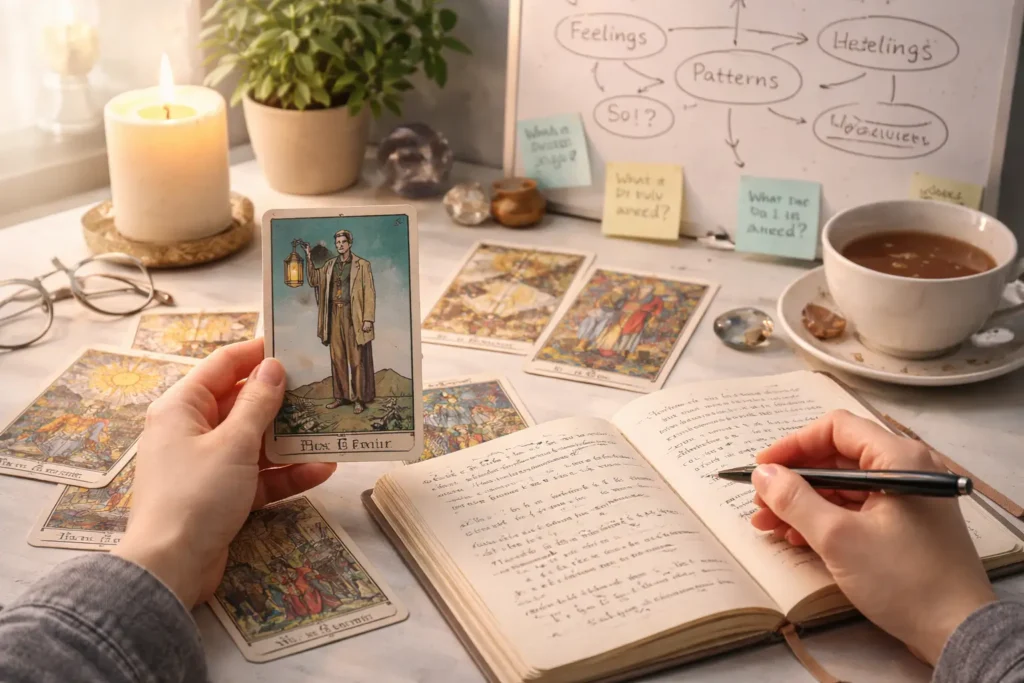
Tarot can feel helpful psychologically because it uses symbolic images as prompts for meaning-making. When you interpret a card, you connect what you see to your emotions, memories, values, and current dilemmas. For many people, that process supports clarity, reframing, and next-step planning—without relying on guaranteed outcomes.
This article uses these concepts as non-clinical, educational lenses—not as diagnosis or therapy.
- Tarot can structure symbolic thinking and organize uncertainty.
- Interpretation shifts with context, so meanings are not one-size-fits-all.
- Grounded readings end with one testable action, not endless checking.
- Writing two interpretations reduces tunnel vision and overattachment.
What “psychologically” means in tarot
A psychological lens doesn’t try to prove or debunk anything mystical. It asks: What happens in your mind when you engage with symbolic images in a structured way?
From that angle, tarot is closer to a reflection tool than a fortune-telling device. It gives your attention a clear target (the image) and gives your thoughts a format (cards, positions, themes), which can make uncertainty easier to work with.
The core mechanism: symbols create meaning through interpretation
Tarot images contain broad human themes—conflict, desire, boundaries, change, fear, hope. They are specific enough to evoke emotion, yet open enough to hold more than one “true enough” angle.
When you look at a card, you don’t interpret it in a vacuum. You bring:
- what you care about most right now
- what you fear or avoid
- what you suspect is true
- what you want to be true
- what past experiences taught you
Many people experience tarot as a “mirror” because it can make inner thoughts easier to examine. Instead of looping in your head, you respond to a concrete symbol and ask: “What might this be pointing to in my situation?”
A grounded way to think about a reading
- The card gives you a lens.
- You test whether that lens fits the facts of your life.
- You choose one next step and observe what changes.
Why the same card can mean different things to different people
Meaning shifts because interpretation is shaped by your situation, goals, history, values, and emotional state. That’s why psychologically grounded tarot is not memorizing “the right meaning”—it’s learning how to work with meaning responsibly.
Same symbol, different context (mobile-friendly)
To keep this easy to read on mobile, here are a few quick examples in list form:
-
The Tower — burnout/overload vs stale routine
Grounded question: “What structure needs updating?” -
The Lovers — commitment decision vs values conflict
Grounded question: “What choice aligns with my values?” -
The Hermit — healthy recovery vs avoidance pattern
Grounded question: “Is this rest or withdrawal?” -
Death — ending a chapter vs fear of change
Grounded question: “What am I ready to release?”
Common psychological effects involved (non-clinical)
These are not proofs of fate or guaranteed outcomes. They’re practical lenses for understanding why symbolic readings can feel meaningful—and how to stay grounded while using them.
-
Projection: You may “see” a need or fear you already carry.
Example: A boundary-themed card makes you realize you’ve been saying yes out of guilt.
Grounding move: Write a second interpretation that challenges your first story. -
Confirmation bias: You may notice meanings that fit what you already believe.
Example: You focus on the interpretation that justifies staying stuck because it feels safer.
Grounding move: Ask: “What would disprove this interpretation?” and name one alternative. -
Pattern recognition (apophenia): Humans are built to connect dots, especially under uncertainty.
Example: You link unrelated events into a single “sign” when you’re anxious.
Grounding move: Separate “emotionally true” from “factually confirmed,” then check evidence. -
Priming: A theme can increase your attention to related cues in daily life.
Example: After a card about communication, you notice where you avoid clarity at work.
Grounding move: Treat it as awareness, then test with one small behavioral change. -
Narrative identity: Story-making can help some people feel less overwhelmed and choose direction.
Example: A “transition” card helps you frame a confusing month as a normal season of change.
Grounding move: Translate the story into a concrete plan: one decision and one step. -
Interpretive flexibility: One symbol can hold multiple “useful enough” angles.
Example: The same card could point to rest, avoidance, or a values reset depending on context.
Grounding move: Test interpretations by outcomes: “Which one leads to more grounded action?”
Why tarot can feel surprisingly relevant
A reading can feel personally relevant because symbolic images are emotionally rich and easy to connect to real situations. Your mind is also skilled at noticing patterns and building narratives that organize messy realities. This can be useful as a starting point for reflection—as long as you treat it as a prompt to think, not an authority. Relevance is not the same as prediction—treat it as a prompt for reflection.
Grounded Tarot: a practical method that keeps you in control
If you want tarot to be psychologically useful (not dramatic), use a method that produces reflection and action. The aim is not certainty. The aim is a clearer next step you can evaluate in real life.
The Grounded Tarot 5-step process
-
Ask a bounded question
Choose something you can influence and add a timeframe.
Example: “What should I focus on this week to improve my relationship with work?” -
Pull one card (or a simple 3-card spread)
Fewer cards reduce over-interpretation. -
Write two interpretations
- Supportive: “What helps me grow here?”
- Challenging: “What am I avoiding or rationalizing?”
-
Reality-check with evidence
Ask: “What in my actual life supports this?” and “What else could be true?” -
Pick one testable next step
Choose a small action you can do within 24–72 hours.
Reality Check (3 questions)
- What are the facts? What evidence in my life supports (or contradicts) this interpretation?
- What else could be true? What is a plausible alternative story for the same card?
- What would I do if I felt 10% calmer? What one action would a calmer version of me take next?
Copy-and-paste journal template (one card → two meanings → one action)
Card: ________
My situation (2–3 lines): ________
Supportive interpretation (growth): ________
Challenging interpretation (avoidance): ________
Facts/evidence in my real life: ________
Alternative explanation (what else could be true?): ________
One testable step in the next 24–72 hours: ________
Check-in date: ________
Better question prompts
These keep tarot in the self-reflection lane:
- “What am I not acknowledging about this situation?”
- “What pattern am I repeating—and what would interrupt it?”
- “What boundary would protect my energy this week?”
- “What would a calmer version of me do next?”
- “What’s one step I can take before I ask for more signs?”
Avoid questions that outsource agency:
- “What will definitely happen?”
- “What is this person thinking?”
- “Should I do X, yes or no?”
Two mini-cases (more action, less theory)
Mini-case 1: Relationship uncertainty
Question: “Why do I feel unsettled in this relationship lately?”
Card example: The Hermit
- Supportive meaning: “I need space to regulate and hear myself clearly.”
- Challenging meaning: “I may be withdrawing to avoid a specific conversation.”
Reality-check: What have I avoided saying? What is the smallest honest request I can make?
Next step (24–72 hours): Write one sentence that names your need + one concrete request. Then have one short conversation and note the response.
Mini-case 2: Career crossroads
Question: “What should I consider before making a job change?”
Card example: The Lovers
- Supportive meaning: “This is a values-based choice; alignment matters.”
- Challenging meaning: “I’m postponing a decision and hoping clarity appears without action.”
Reality-check: What are my non-negotiables? What tradeoff am I unwilling to make?
Next step (24–72 hours): Write 3 non-negotiables (pay, schedule, growth). Then take one action: update your resume or apply to two roles that match.
Do/Don’t checklist for psychologically grounded tarot
Do
- Use “may/could/suggests” language.
- Limit readings: one draw → one action → then reassess.
- Write two interpretations to reduce tunnel vision.
- Choose a next step you can test in real life.
- Re-read only after you’ve done something.
Don’t
- Pull repeatedly until you get the answer you want.
- Use tarot to control, pressure, or “decode” another person.
- Treat a reading as permission to ignore evidence or boundaries.
- Read when you’re spiraling and seeking certainty.
Stop rule: If you feel the urge to pull again, pause and do the Reality Check first. If you still want to read, set a clear limit (one more card) and write the action you’ll take before you ask for more.
Safety note (brief)
Tarot is best used for reflection, not as an authority for high-stakes decisions. If you feel unsafe, are in a crisis situation, or are making urgent medical, legal, or major financial decisions, pause tarot and seek real-world support. This page is not medical, legal, financial, or mental health advice.
Frequently Asked Questions
Is tarot basically a form of projection?
Often, yes in a practical sense. The cards can surface feelings and assumptions you already carry, making them easier to notice and work with. That doesn’t make tarot useless—it describes one way it can support self-reflection.
Why do different readers interpret the same card differently?
Because meaning depends on context, personal associations, values, and emotional state. Tarot isn’t a fixed code; it’s an interpretive practice where the same symbol can point to different themes in different lives.
Can tarot help with decision-making without predicting the future?
Yes—if you use it to clarify priorities and identify next steps. A grounded approach ends with one small action you can test, then you evaluate what changes.
What if I pull a scary card?
Pause and translate it into possibility language (“this could reflect…”). Write one supportive meaning and one challenging meaning, then choose one practical step that improves clarity or safety.
How often should I read about the same issue?
A helpful guideline is: read once, take one step, then revisit. If you’re pulling repeatedly to feel calmer or more certain, it’s usually a sign to pause.