
What Are Tarot Cards Based On? Origins, Deck Structure, and Meaning Traditions
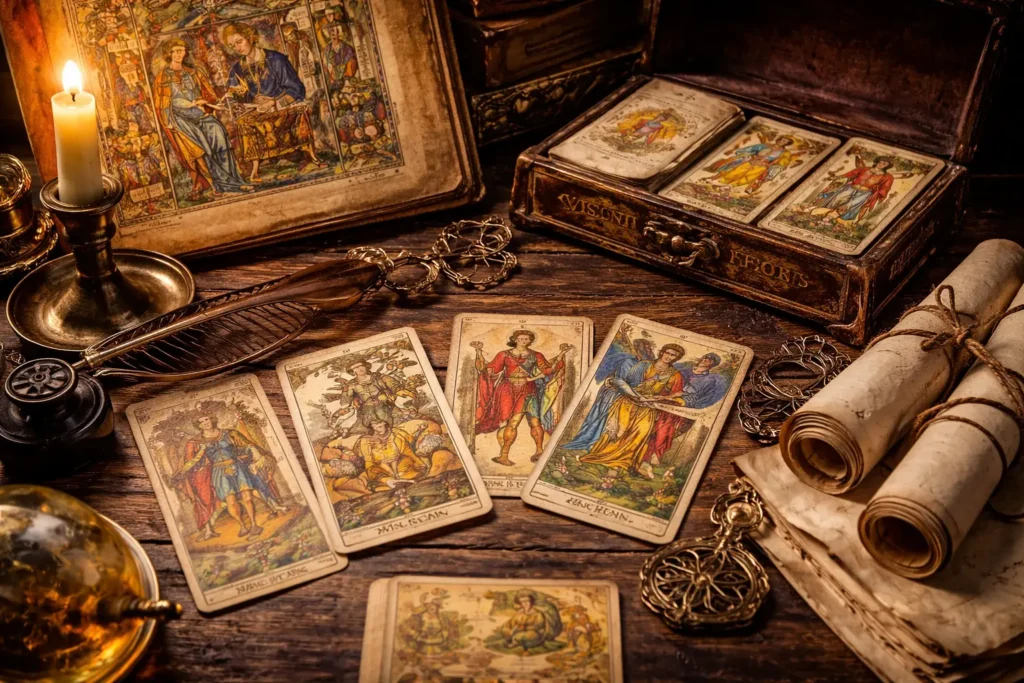
Tarot cards are based on a European playing-card tradition that developed in northern Italy in the 15th century. The “tarot” most people mean today is a structured 78-card deck (Major + Minor Arcana) whose interpretations are based on imagery, cultural symbolism, and established reading traditions—not on a single scientifically proven mechanism for predicting specific future events.
- Historical base: a Renaissance-era card game (not originally fortune-telling).
- System base: a repeatable deck structure (trumps + suits + courts).
- Meaning base: interpretive traditions learned through guidebooks, teaching lineages, and communities of practice.
- Practical base: a consistent method a reader applies (how suits, courts, context, and questions are handled).
- Important: “based on” explains roots and frameworks, not proof that readings predict outcomes.
What “based on” usually means
When someone asks “What are tarot cards based on?” they usually mean one (or more) of these: where tarot came from historically, why the deck has its structure, what the imagery draws from, and how meanings became shared within particular traditions.
Quick map: the main “bases” of tarot
- Origin: Renaissance Italy and early European card games.
- Structure: trumps + four suits + court ranks within a 78-card system.
- Symbol sources: allegory, cultural motifs, recurring archetypes.
- Traditions: meaning ranges shaped by schools, manuals, and reader communities.
- Method: consistent rules a reader follows so interpretations don’t drift.
Where tarot cards came from
Historians commonly trace tarot to 15th-century Italy, where it developed as an expanded version of the standard four-suited playing-card pack. By the mid-15th century, makers added a separate set of illustrated “triumph” cards—often called trionfi—plus a distinct “Fool” card, creating what became tarot.
In Italy, tarot was also known as tarocchi, a term still connected to the game tradition. Later, Marseille-style decks became a prominent regional standard in parts of Europe—reflecting a later phase of widespread production and recognizable patterning, rather than the earliest Italian court origins.
Tarot as a game vs. tarot as divination
First: tarot functioned primarily as a card game in Europe from the 15th century onward. Later: divinatory and occult interpretations expanded notably in the 18th century, when writers promoted speculative origin theories and tarot began to be used more systematically for cartomancy.
Mini timeline (high-level)
- 15th century (Italy): a fifth “triumph” suit + the Fool added to a four-suited pack.
- Mid-1400s: Italian suit symbols commonly include Cups, Swords, Batons, and Coins.
- 15th–17th centuries: tarot spreads across Europe as a family of games and regional deck styles.
- Late 1700s: occult and divinatory uses accelerate; tarot is reframed as a symbolic system for readings.
- 1900s onward: modern “reading-first” decks and guidebooks popularized more consistent meaning traditions for mass audiences.
The tarot deck as a system
Modern tarot is typically a structured 78-card deck:
- 22 Major Arcana (historically: the “trumps” / trionfi) — see a full guide here: Major Arcana meanings.
- 56 Minor Arcana (four suits with numbered cards and court cards).
Why “trumps” became the Major Arcana
Historically, the extra illustrated cards were a separate trump suit added to the standard pack—one reason the Major Arcana feel like a distinct “layer” today. The modern term “Major Arcana” is newer, but it maps onto that older structural reality: a special set of allegorical trump cards plus the Fool.
Why the Minor Arcana resemble ordinary playing cards
The Minor Arcana preserve the four-suit logic of European playing cards: suit symbols, numbered “pip” cards, and court figures. In Italian patterns, those suits were commonly Cups, Swords, Batons, and Coins—an anchor for why tarot’s suits look the way they do.
The four suits (quick orientation)
- Cups: feelings, relationships, receptivity
- Swords: thoughts, conflict, clarity, decisions
- Wands: drive, growth, creativity, momentum
- Pentacles: resources, work, body, stability
Court cards: people, roles, or inner parts
Court cards are where consistency matters most. Readers commonly choose one primary approach so readings stay stable:
- A person (someone involved)
- A role (how someone acts in this context)
- An inner part (a mindset or strategy being embodied)
How tarot meanings formed
Tarot meanings are primarily based on tradition plus method—not a single universal rulebook. In practice, meanings are commonly learned and transmitted through:
- Card imagery (what is depicted)
- Shared cultural symbolism (recurring motifs and allegory)
- Teaching lineages and communities (how people learn interpretive norms)
- Guidebooks and manuals (keyword ranges, examples, context)
- Optional correspondence systems (used in some schools; not required for basic tarot literacy)
Are tarot cards based on astrology, Kabbalah, or numerology?
Some modern schools overlay tarot with correspondences from astrology, Kabbalah, and numerology, but these frameworks are generally optional and historically later than tarot’s origin as a Renaissance card game. Many readers use tarot without any occult correspondence system at all.
One short example (meaning comes from method, not “fate”)
If someone asks about a relationship and draws mostly emotion-themed suit cards with one conflict-themed card, many readers would commonly frame that as “strong feelings with a communication tension to address.” The value is a reflective prompt (notice patterns, choose actions), not a guaranteed prediction.
A practical starter checklist (kept minimal)
- Choose one deck tradition to start and stick with it long enough to learn its “language.”
- Use one primary guidebook (avoid mixing multiple meaning systems early on).
- Decide how you’ll read court cards (person, role, or inner part).
- Keep interpretations specific: “What theme or behavior does this suggest in context?”
Safety note
Tarot is best used as a reflective tool alongside real-world information. It should not be relied on for medical diagnosis, urgent legal decisions, immediate safety situations, or high-risk financial choices.
Editorial transparency
- Prepared by: the Editorial Team
- Reviewed for accuracy by: the Editorial Team
- What this is: an evidence-based overview of tarot’s origins, structure, and how meaning traditions form.
- What this isn’t: proof of predictive claims or a substitute for professional advice.
- Last updated: January 20, 2026
Sources (selected)
- Encyclopaedia Britannica — Tarot
- The Metropolitan Museum of Art — Before Fortune-Telling The History and Structure of Tarot Cards
- Victoria and Albert Museum — A history of tarot cards
- The Morgan Library and Museum — Visconti-Sforza Tarot Cards
- MIT French Playing Cards — A Brief History of Cartomancy
Frequently Asked Questions
Are tarot cards based on playing cards?
Yes. Tarot developed from European playing-card traditions. In Italy, a four-suited pack was expanded with an additional set of illustrated trump cards plus the Fool.
Where did tarot cards originate?
Tarot is commonly traced to 15th-century northern Italy, with early luxury decks associated with elite patrons and court culture.
Why does a tarot deck have 78 cards?
Modern tarot is organized into 22 trump cards (Major Arcana) plus 56 suited cards (Minor Arcana). This reflects the historical structure of an expanded playing-card deck: a standard four-suited pack plus a distinct trump suit and the Fool.
Are tarot meanings the same in every deck?
Not exactly. Many decks share the 78-card structure, but interpretations vary across traditions, imagery styles, and guidebooks. Consistency usually comes from learning one approach deeply rather than mixing systems randomly.
What’s the difference between Tarot de Marseille and Rider–Waite–Smith?
Marseille-style decks often emphasize pip reading and pattern logic in the Minor Arcana, while Rider–Waite–Smith-style decks use illustrated scenes—especially in the Minor Arcana—making narrative interpretation easier for many beginners.
Does “based on” mean tarot predictions are scientifically proven?
No. “Based on” explains tarot’s historical roots and interpretive frameworks. It does not establish a scientific mechanism that proves specific future predictions.