
How do Tarot Cards Work Spiritually?
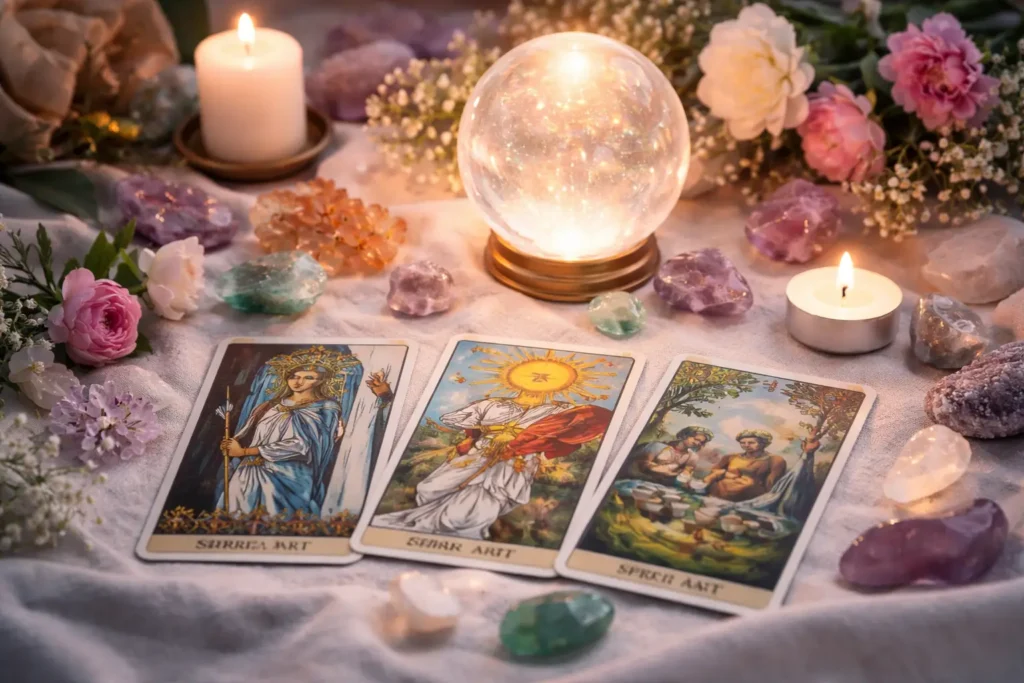
Tarot cards “work spiritually” for many people as a symbolic guidance practice: you ask a question, draw archetypal images, and interpret them through frameworks like intuition, synchronicity, archetypes, and spiritual guidance. Rather than proving a fixed future, spiritual tarot is often used to clarify feelings, reveal patterns, and choose next steps with more awareness and ethics.
Short answer
Spiritually, tarot works for many people by turning a question into a focused reflection: the cards offer symbolic images, and you interpret them through intuition, archetypes, and meaningful timing (synchronicity). The value usually comes from the insights you name and the actions you choose afterward—not from guaranteed predictions or proof that the cards control outcomes.
Quick takeaways
- Tarot is symbolism + interpretation, not guaranteed prediction.
- Common spiritual models: intuition, synchronicity, archetypes, guidance.
- Your question shapes what you get from a reading.
- Rituals can focus attention; they don’t “force” outcomes.
- Keep agency and boundaries, especially around high-stakes topics.
A simple spiritual explanation in 5 lines
- Your question sets attention.
- Symbols provide a structured mirror.
- Intuition and archetypes help you name patterns.
- Synchronicity frames timing and meaning.
- You leave with an action step—agency stays with you.
This is the core of “spiritual tarot” for many practitioners: meaning-making that supports choice, not proof that the cards control reality.
What “working spiritually” usually means (and what it doesn’t)
When people say tarot works spiritually, they usually mean it provides meaningful guidance—a way to listen inward, reflect, and make sense of what’s unfolding. The cards become a structured language for exploring your situation.
It typically does not mean:
- the cards can prove a supernatural cause,
- every reading is literal or certain,
- you should outsource major decisions to a spread.
A grounded spiritual approach treats tarot as interpretive, context-based, and choice-centered.
The 4 spiritual frameworks people use
Different practitioners explain spiritual tarot differently. You don’t have to pick one “true” model—many people blend them.
1) Intuition model: the cards as a mirror for inner knowing
In this framework, the cards help you access what you already sense beneath the surface. The images act like prompts: they surface emotions, priorities, blind spots, and values that may be hard to name directly.
Best for: self-reflection, relationships, crossroads, personal growth
Watch-out: don’t confuse anxiety with intuition—pause if you feel dysregulated.
2) Synchronicity model: meaningful coincidence
Synchronicity is the idea that a random draw can still feel timely and resonant. Spiritually, people interpret the “right card at the right time” as meaningful alignment—less about control, more about noticing patterns and timing.
Best for: “What theme is active?” “What am I being invited to notice?”
Watch-out: treat it as insight, not a command or fate.
3) Archetype model: symbolic language for life patterns
Tarot is packed with archetypes (the seeker, the caretaker, the challenger, the rebuilder). In a spiritual reading, archetypes become a map: they help you name the role you’re in, the lesson emerging, and the kind of choice being asked of you.
Best for: identity shifts, recurring dynamics, gentle shadow work
Watch-out: avoid rigid labels like “I’m doomed because of this card.”
4) Guidance model: suggestion from “higher wisdom”
Some practitioners approach tarot as dialogue—with spirit guides, ancestors, the universe, or the higher self. Even when the language is mystical, the healthiest version stays practical: guidance is treated as suggestion, not authority.
Best for: values-based decisions, intention setting, spiritual practice
Watch-out: dependency (“I can’t act until the cards say so”).
What happens in a spiritual tarot reading (step-by-step)
A spiritual reading is less about “magic” and more about process. You can keep it simple and still make it meaningful.
1) Name the situation and ask one grounded question
Vague: “What will happen in love?”
Better: “What pattern is shaping my dating life right now—and what can I do differently?”
2) Choose a spread that matches your goal
- One card: theme, lesson, or focus
- Three cards: situation / challenge / advice (or past / present / likely direction)
3) Optional: a simple spiritual “setup” (not required)
If a spiritual frame helps you focus, keep it minimal:
- Take 3 slow breaths.
- Set an intention: “I’m open to clarity and honesty.”
- Repeat your question once.
4) Interpret in context (not in absolutes)
Start with the card’s core meaning, then adjust based on:
- the question,
- the position in the spread,
- nearby cards,
- your real-life constraints.
A helpful rule: describe what you see before you decide what it means.
5) Close with one practical action step
Spiritual tarot becomes useful when it ends with something you can do: a conversation, a boundary, a plan, a journal prompt, or a small experiment.
If you feel triggered during a reading, pause and return later when you’re grounded.
Best questions for spiritual tarot (10 examples)
Self-reflection
- “What am I not seeing clearly about this situation?”
- “What pattern keeps repeating for me—and what is it asking me to learn?”
- “What value do I need to center right now?”
Relationships
- “What boundary would help me show up with self-respect in this connection?”
- “What dynamic is shaping our interactions—and what is my role in it?”
- “What conversation would bring the most clarity here?”
Career and direction
- “What strength should I lead with in my next step?”
- “What tradeoff am I avoiding acknowledging?”
- “What would alignment look like for me in the next 30 days?”
- “What is one practical step I can take this week to move forward?”
Questions to avoid (and better rephrases)
- Avoid: “What will happen?” Try: “What’s the likely direction if nothing changes—and what can I influence?”
- Avoid: “Does my partner love me?” Try: “What do I need to feel secure, and what should I communicate clearly?”
- Avoid: “Will I get the job?” Try: “How can I show up strongly in this process?”
- Avoid: “What are they hiding?” Try: “How can I respond wisely to what I know, and what boundary protects me?”
- Avoid: “Is this my soulmate?” Try: “What helps this connection grow in a healthy direction?”
Two mini-examples (question → approach → grounded conclusion)
Example 1: Relationship uncertainty
Question: “What do I need to understand about this connection?”
Approach: Blend archetypes + intuition; look for themes like pacing, honesty, boundaries.
Conclusion: “This may be highlighting a pattern (over-giving, avoiding direct conversations). A grounded next step is to ask for clarity, set one boundary, and observe what happens.”
Example 2: Career crossroads
Question: “What’s the best way to choose between Option A and B?”
Approach: Use a 3-card spread (values / risk / next step) and treat guidance as suggestion.
Conclusion: “Rather than ‘which is fated,’ this can clarify what each path asks of you. Name your top 3 values, compare both options to them, then choose the step you can stand behind.”
Ethical boundaries (short, essential)
Spiritual tarot is healthiest when it strengthens agency.
- Consent: avoid reading for a third party’s private thoughts or actions without consent. If you’re impacted, frame the question around your choices: “How can I respond?”
- High-stakes areas: don’t use tarot as the decision engine for medical, legal, financial, or mental-health decisions.
If readings are fueling anxiety or compulsive checking, pause and see our full safety guide: Can tarot readings be harmful?
Faith, skepticism, and personal boundaries (short note)
People relate tarot to religion and belief in different ways. Some use it as symbolic reflection; others avoid it due to conscience or faith commitments. If you’re unsure, follow your conscience and set clear boundaries.
CTA: If your specific question is whether tarot is a sin, read: Is tarot reading a sin?
Mini glossary (beginner-friendly)
- Spread: the layout and meaning of each card position.
- Archetype: a universal pattern or role symbolized by imagery.
- Synchronicity: meaningful timing that feels like “a sign.”
- Discernment: choosing what to keep, question, or ignore.
Editorial note (E-E-A-T)
This article describes how spiritual and esoteric traditions interpret tarot. Tarot is not a substitute for medical, legal, financial, or mental health advice. Use it for reflection, meaning-making, and values-based decision support—especially when stakes are low to moderate.
Frequently Asked Questions
Do tarot cards connect to spirits or guides?
Some people interpret tarot as guidance from spirit, ancestors, or a higher self, while others experience it as symbolic reflection. A responsible approach is to treat any “messages” as interpretive—not as orders—and keep your judgment central.
Can tarot work if you don’t believe in it?
It can still be useful as a structured reflection tool because the symbols help you explore thoughts and feelings. Belief may change how you frame the experience, but clarity often comes from question quality and interpretation.
Why do tarot readings feel so accurate?
Tarot uses rich symbolism that maps easily to human experiences. When you bring a real situation and interpret thoughtfully, you may notice patterns, priorities, and emotions that were already present but unspoken.
Do you need to cleanse tarot cards for spiritual work?
Cleansing is optional. Many people use it as a focusing ritual—a “reset” for attention—rather than something that guarantees spiritual correctness or outcomes.
What questions are best for spiritual tarot?
Questions that protect agency and invite insight work best—like “What am I not seeing?” or “What choice aligns with my values?” Avoid questions that demand certainty, remove responsibility, or invade someone else’s privacy.
Is tarot compatible with religion?
It depends on the person and their belief system. Some avoid tarot entirely; others use it only as symbolism or journaling. If this is a major concern, it’s best to follow your conscience and keep clear boundaries.
Is tarot the same as oracle cards spiritually?
They’re similar in that both can be used for guidance and reflection, but tarot has a more standardized structure and symbolic system. Some people prefer tarot for depth and oracle for simpler prompts.