
What Is a Tarot Spread?
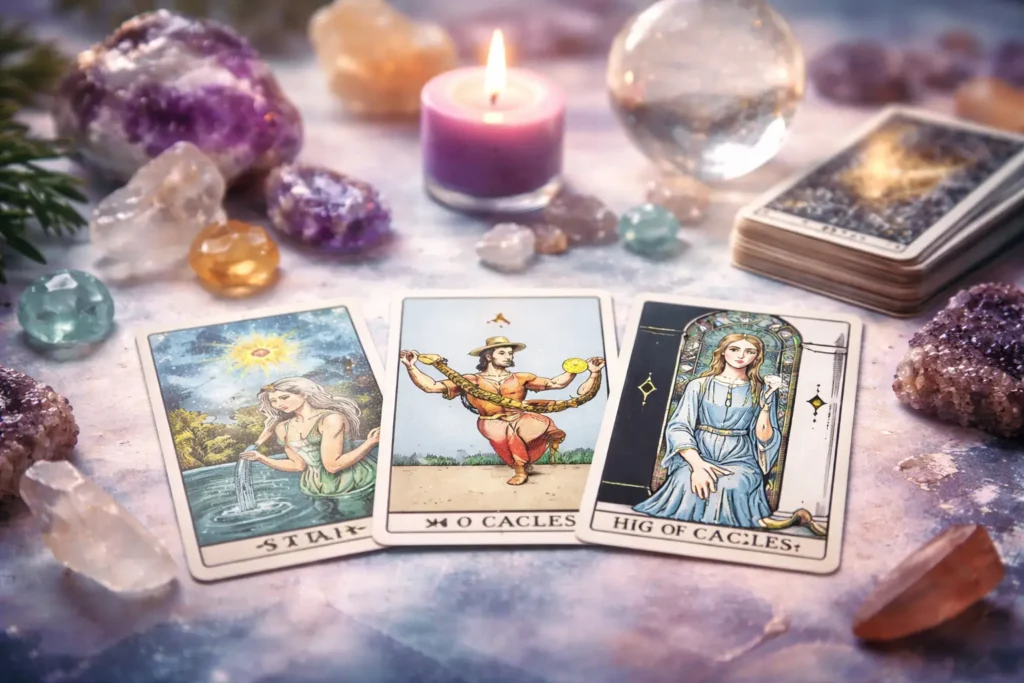
A tarot spread is a structured layout of tarot cards where each position has a specific role (for example: “challenge,” “advice,” or “what to focus on”) tied to one focused question or theme. The spread doesn’t “create” meaning—it organizes the cards’ symbolism so you can interpret a situation with clearer context.
Quick takeaways
- A spread = a layout + named positions + one focused question.
- Positions act like “lenses” that narrow interpretation and reduce vagueness.
- A spread isn’t a reading—it’s the structure a reading uses.
- Choose spread types by goal: clarity, decision, dynamics, planning, self check-ins.
- Keeping scope tight makes interpretations clearer and more consistent.
Editorial approach & disclaimer
Written by: NowHoroscope Editorial Team
Reviewed by: NowHoroscope Content Team (clarity & safety)
We present tarot as a reflection tool for clarity, self-inquiry, and perspective—not as a guarantee of outcomes. This content is informational and intended for personal reflection. It is not a substitute for professional advice (medical, legal, financial, or mental health).
What “tarot spread” means (in plain English)
In tarot, a spread is the layout—a framework that tells you what each card is meant to speak to. One card can hold many ideas, but a spread helps you focus those ideas on a specific angle of your question.
- Cards = symbols and themes
- Positions = the angles you view those themes from
- Your question = the topic that keeps everything coherent
A spread helps you structure reflection so you can notice patterns, trade-offs, and next-step themes with more clarity.
Tarot spread vs. tarot reading vs. card meanings
Tarot spread
- What it is: A layout with named positions
- What it does: Breaks one question into clear parts
- What it doesn’t do: Interpret by itself
Tarot reading
- What it is: The interpretation you make using cards + a spread
- What it does: Connects symbols into insight
- What it doesn’t do: Provide a fixed or guaranteed answer
Card meanings
- What it is: The symbolic vocabulary of each card
- What it does: Offers themes and cues for interpretation
- What it doesn’t do: Answer a question without context
Why this matters: If a reading feels confusing, it’s often because the structure and the interpretation got mixed together. The spread is the structure; the reading is the interpretation you build from it.
The building blocks of a tarot spread
Positions: what they represent
A position is the “job” a card has in the layout. Positions commonly point to:
- Context: what’s influencing the situation
- Challenge: the friction point, constraint, or lesson
- Advice: what to prioritize or consider next
- Direction: what the situation may be emphasizing if patterns continue
Position lens (a quick demonstration): the same card can feel very different depending on where it lands. In a “Challenge” position, a card might highlight what’s blocking progress; in an “Advice” position, it may point to a helpful approach. The spread doesn’t change the card—it changes the angle you’re interpreting from.
Direction: helpful framing (not a promise)
When a spread includes a “direction” or “outcome” position, it’s best treated as a theme or trajectory—a way to reflect on what may be unfolding— rather than a guaranteed result.
Scope: one spread, one situation
Spreads work best when they stay focused on one topic—not your entire life at once.
- Tight scope: “What’s the main dynamic I should understand here?”
- Too broad: “Tell me everything about my future.”
Time window: context, not “timing”
Some spreads reference a timeframe (like “the coming weeks”) as a reflection window—a boundary that helps you focus. This is different from trying to predict exact dates.
Clarifiers: what the term means
A clarifier is an extra card some readers draw when a position feels unclear. The key idea is simple: clarifiers add context—they don’t replace the original position.
Examples of tarot spreads (with positions)
These examples show how spreads create structure and consistency—without forcing a definitive answer.
1-card “Focus” spread
Best for: quick clarity or a simple check-in when you want one clear theme.
- Position: Focus — “What theme should I prioritize right now?”
See an example layout: 1-Card Draw Tarot Reading
3-card “Situation–Challenge–Advice” spread
Best for: one situation where you want context, the key tension, and a practical next focus.
- Position 1: Situation — what’s happening / what you’re working with
- Position 2: Challenge — the main friction point, constraint, or lesson
- Position 3: Advice — what to prioritize, try, or consider next
See an example layout: 3-Card Spread Tarot Reading
3-card “Past–Present–Future” (optional alternative)
Best for: reflecting on how a situation developed and what it may be emphasizing next.
- Position 1: Past — what shaped the current situation
- Position 2: Present — what’s most active right now
- Position 3: Future — a theme to watch for if patterns continue
Simple 3-card spread diagram (positions labeled)
This basic layout keeps interpretations clear and repeatable:
- Situation
- Challenge
- Advice
Layout: left to right — Situation → Challenge → Advice.
Types of tarot spreads (by intention)
Instead of memorizing dozens of named layouts, it helps to think in categories. Each category supports a different kind of question.
Clarity / reflection spreads
Example question: “What’s the main thing I’m not seeing in this situation?”
Decision framing spreads
Example question: “What are the trade-offs between option A and option B?”
Relationship dynamics spreads
Example question: “What pattern is shaping communication here—and what do I need to name?”
Career / planning spreads
Example question: “What should I prioritize next to move this goal forward?”
Self check-in spreads
Example question: “What mindset would support me most this week?”
Decision tree: choose a spread type that matches your goal
This is a fast way to choose a spread type (not a step-by-step reading tutorial).
If you want clarity about a situation
Choose a clarity/reflection spread type (simple structure that highlights context, tension, and focus).
If you’re choosing between option A and option B
Choose a decision-framing spread type (built to compare trade-offs and the emphasis of each path).
If you want a sense of next steps
Choose an action-oriented spread type (positions focused on priorities, obstacles, and what to do next).
If the topic feels emotionally loaded
Choose a grounding/reflection spread type (positions aimed at perspective, what you can control, and a steady focus). Rule of thumb: when emotions run high, simpler layouts usually keep the message clearer.
Two quick examples (question → spread type → takeaway style)
Example 1: clarity
- Question: “What’s the main thing I’m not seeing in this situation?”
- Spread type: Clarity/reflection
- Takeaway style: “This highlights a theme worth exploring—rather than a fixed outcome.”
Example 2: decision
- Question: “What should I consider when choosing between option A and option B?”
- Spread type: Decision framing
- Takeaway style: “This helps me name trade-offs so I can choose more intentionally.”
Simple checklist: sanity-check your spread choice
- Is my question about one situation (not everything at once)?
- Do the positions match my goal (clarity vs. decision vs. planning)?
- Can I summarize the spread’s purpose in one sentence?
- Will this layout help me notice themes and trade-offs (not chase certainty)?
Mini-glossary (spread-related terms)
- Spread: A layout with positions tied to a focused question/theme
- Position: The role a card plays (challenge, advice, context, etc.)
- Clarifier: An extra card used to add context to a position
- Significator: An optional “representative” card for a person or theme
- Querent: The person asking the question (sometimes the reader)
- Reversed: A card drawn upside down; interpretations vary by tradition
What this page covers (and what it doesn’t)
This page covers: what a tarot spread is, how positions work, core components, a few common example layouts, spread categories, and a practical way to choose a spread type.
This page does not cover: a step-by-step tutorial for performing a full tarot reading, card-by-card interpretation methods, prediction or timing techniques, debates about “accuracy,” religious arguments, or tarot history/origins.
Frequently Asked Questions
What is a tarot spread?
A tarot spread is a structured layout where each position has a role tied to one question or theme. It helps organize symbolism so you can interpret a situation with clearer context.
What does “spread” mean in tarot?
“Spread” refers to the arrangement of positions in a layout. The positions guide what each card is meant to represent in the context of your question.
Is a tarot spread the same as a tarot reading?
No. The spread is the structure (layout + positions), while a reading is the interpretation you draw from the cards using that structure.
What are “positions” in a tarot spread?
Positions are labels like “challenge” or “advice” that shape how you interpret a card. They act like lenses that focus meaning on one part of the situation.
Why do tarot spreads have positions?
Positions create context and separation within one theme. They help you look at distinct angles instead of reading every card as “everything at once.”
How many cards are in a tarot spread?
It depends on the layout. Some spreads use only a few cards for quick clarity, while others use more positions for a broader view of the same topic.
Can I use the same spread for any question?
You can reuse a spread type, but it works best when the positions match your intention. A decision layout fits choice questions better than a reflection layout.
Can you create your own tarot spread?
Yes—as long as the positions are clear, non-overlapping, and focused on one theme. The goal is a structure you can interpret consistently.
What does “reversed” mean in tarot?
“Reversed” usually means a card appears upside down. Different traditions interpret reversals differently, so it’s best treated as a definition rather than a single rule.
Do tarot spreads predict the future?
A spread is best understood as a framework for reflection and interpretation, not a guarantee. For a deeper explanation of what “predicting the future” can responsibly mean in tarot (and how to ask future-focused questions safely), see: https://nowhoroscope.com/articles/do-tarot-cards-predict-the-future/