
What Is a Sign From the Universe? Meaning, Context, and How to Interpret It
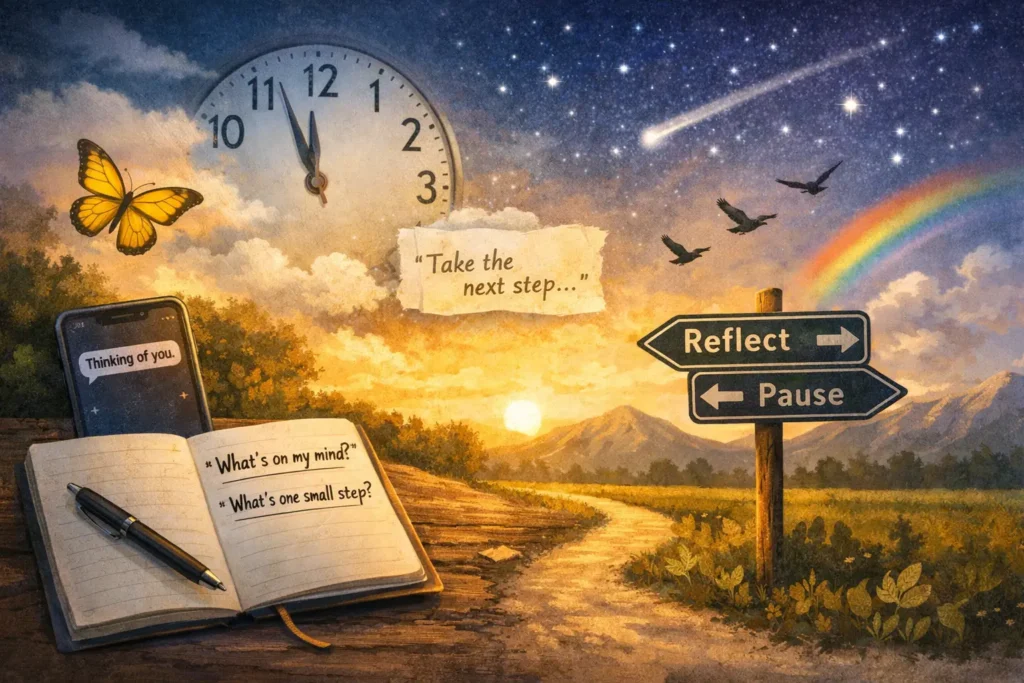
Direct answer: A “sign from the universe” is a label people use for an event, coincidence, symbol, or pattern that feels personally meaningful in the context of a specific question or life moment. It’s commonly experienced as a prompt to reflect—not as proof, a prediction, or an order.
- Quick takeaway: A sign is about perceived relevance in context, not certainty.
- Quick takeaway: The most helpful “sign-like” moments feel specific, not endlessly flexible.
- Quick takeaway: Repetition can add weight, but it isn’t required.
- Quick takeaway: Useful signs invite reflection, not panic or pressure.
- Quick takeaway: Keep high-stakes choices grounded in facts, timelines, and reality checks.
What people mean by “a sign from the universe”
When people ask, “What is a sign from the universe?” they’re usually describing a moment that feels unusually relevant to what they’re navigating. It might be a coincidence, a repeated theme, a snippet of language that “lands,” or a timing-based encounter that feels hard to ignore.
A sign isn’t the same as evidence. It isn’t a guarantee about what will happen next, and it doesn’t have to be treated like a command. Many people describe a “sign” as a meaningful nudge—a moment that brings a priority, fear, hope, or decision point into sharper focus.
Common types of “sign” experiences
People describe “signs” in a few repeatable categories. These are not claims about why something happened—just the ways it’s commonly experienced.
- Repeating themes or patterns: The same word, symbol, topic, or message shows up more than once in a short window.
- Timely coincidences: You think of someone and they text; you consider an idea and then hear it mentioned elsewhere.
- A phrase that hits at the right time: A line in a song, book, podcast, or conversation feels closely tied to what you’re wrestling with.
- “Too specific” encounters: A meeting, detail, or situation mirrors your question in a way that feels unusually precise.
- Inner clarity that feels “sign-like”: A strong internal sense of “this matters” or “pay attention,” even without an external event.
- Recurring dreams: A theme repeats and feels emotionally charged (note: this page doesn’t interpret dream symbols).
A simple checklist: when it might feel like a sign
If you want a grounded way to evaluate whether something is “sign-like,” use these criteria. The goal isn’t to prove anything—it’s to keep interpretations from becoming overly broad or automatic.
Checklist: “Does this feel like a sign—or like noise?”
- Context match: Is it clearly connected to your actual question or situation, not something you could apply to anything?
- Specificity: Does it point to a concrete theme (e.g., “have the conversation,” “get clarity,” “slow down”) rather than a vague reassurance?
- Repeatability: Has it shown up more than once in a similar context, or is it a one-off you’re forcing into a story?
- Actionability: Does it point toward a practical next step, rather than spiraling, avoidance, or wishful thinking?
- Non-coercive feel: Does it feel like an invitation to reflect—not like “you must” or “you’re doomed”?
Reality check: Many people notice “sign-like” moments most often during transitions—when a question is already active in their mind. In those moments, ordinary inputs can feel more relevant because they’re being filtered through a specific concern. A steady approach is to treat the experience as a prompt for reflection while still allowing that the trigger could be simple coincidence.
What a sign is not
Clear boundaries make this concept safer and more useful.
- Not a guarantee about the future.
- Not proof of anything supernatural.
- Not a substitute for facts, conversations, or professional advice.
- Not a reason to make high-stakes decisions without reality checks.
- Not “everything.” If every detail becomes a message, the idea stops being useful.
Also: If an interpretation creates pressure or urgency, treat that as a cue to slow down and reality-check your next step.
How to use a “sign” in a grounded way (one small exercise)
You don’t need a ritual or a belief test. If something feels meaningful, you can use it as a reflection prompt while staying anchored in practical steps.
The Two-Sentence Check
- “What question am I connecting this to?”
- “What is one grounded action I can take regardless?”
Many people find it helpful to write the theme down in plain language, then choose a small, low-risk step that would be sensible even if the moment is just coincidence.
Two quick examples (safe, non-predictive)
Example 1: Career uncertainty
Question: You’re unsure whether to apply for a role that feels like a stretch.
What you notice: Over one week, you hear the phrase “apply anyway” twice in unrelated contexts.
Interpretation approach: You treat it as a prompt to explore, not a promise of success.
Safe conclusion: You update your resume and ask one trusted person for feedback—then decide based on fit and facts.
Example 2: Relationship crossroads
Question: You feel disconnected and don’t know whether it’s a phase or a pattern.
What you notice: A friend randomly mentions “clarity comes from direct conversations,” and it sticks with you.
Interpretation approach: You take it as a cue to communicate, not as a verdict on the relationship.
Safe conclusion: You plan a calm check-in conversation and listen to the response, instead of guessing.
Frequently Asked Questions
What does “a sign from the universe” mean?
It usually means an event or coincidence that feels personally meaningful in the context of your question or life moment. A practical way to use the idea is as a prompt to reflect—not as a guarantee or instruction.
What are common examples of signs people notice?
People often point to repeating patterns, timely coincidences, a phrase that “hits,” unusually specific encounters, recurring dreams, or a strong feeling of inner clarity. The shared feature is perceived relevance, not objective proof.
What’s the difference between a sign and a coincidence?
A coincidence is simply an overlap of events. A “sign” is the meaning someone assigns to that overlap in a particular context. If you use the idea of a sign, it helps to extract a helpful prompt and then reality-check the next step.
Do repeating patterns always matter?
Not always. Repetition can make something feel more meaningful, but it can also stand out more once you’re already focused on a theme. A good test is whether it connects clearly to your context and points toward a grounded next step.
Can a sign be a warning or a command?
Most people describe “signs” as invitations to reflect, not orders. If an interpretation feels fear-based, urgent, or coercive, it’s a reason to slow down and return to facts before acting.