
How to ask for a sign from the universe?
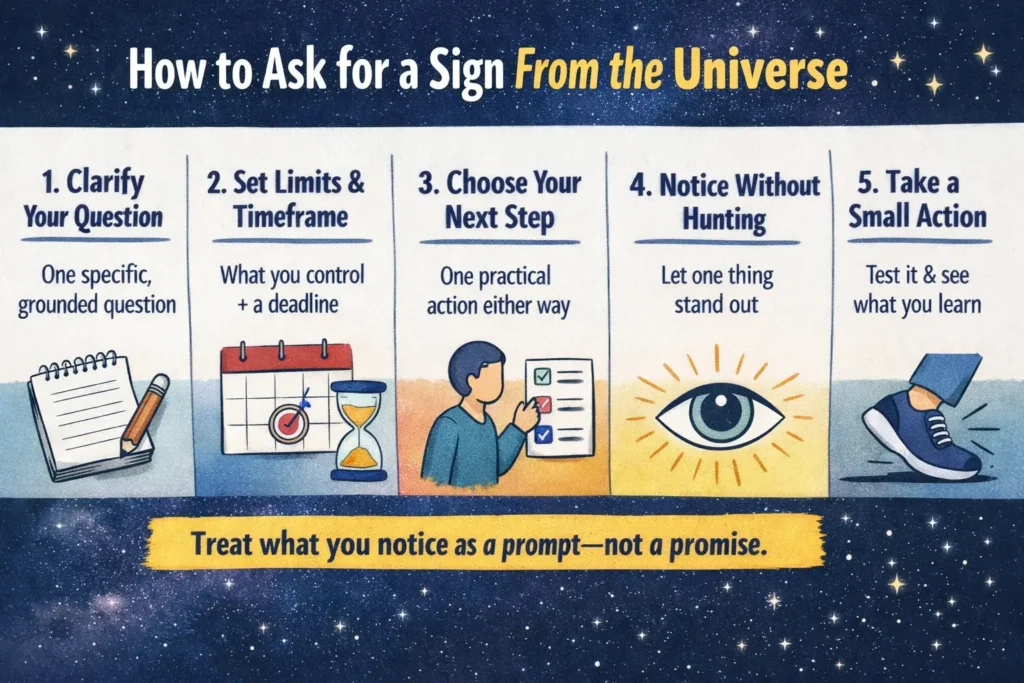
Direct answer: To ask for a sign from the universe, treat it as a reflection tool, not a promise of a supernatural outcome: get specific about what you’re asking, set clear limits (what you control + how long you’ll wait), and decide one practical next step you’ll take either way. Then notice what stands out—without hunting—and use it to prompt a small, low-risk action.
- Ask one clear question in one life context.
- Set a time window so you don’t get stuck waiting.
- Use neutral language (“may/could”), not demands (“will/must”).
- Interpret = prompt → action, then verify with reality.
- Don’t use signs for high-stakes decisions.
5-step process:
- Clarify: Write one question in one context you can act on.
- Set limits: Name what you control (and what you don’t) so you stay grounded.
- Define a window: Choose a finite timeframe (days to two weeks), then commit to moving forward.
- Decide the follow-up action: Pick one practical next step you’ll do either way.
- Notice & test: Let one thing stand out, then verify it with one safe, low-risk action.
What asking for a sign from the universe really means
Asking for a sign is a way to focus attention and clarify your next step. Treat what you notice as a prompt for action—not proof or prediction.
Note: People use “the universe” as shorthand for intuition, attention, and meaning-making.
Before you ask: clarify the question (one topic, one context)
If your question is broad, your “sign” will be vague, too. Narrow to one topic in one context—something you can act on in the real world.
Make the question usable
- Too broad: “What should I do with my life?”
- More usable: “What’s my next step to explore a new career path?”
- Too broad: “Is this relationship meant to be?”
- More usable: “What’s one honest conversation I need to have next?”
Choose the decision type
- Choice decision: picking between options (A vs. B).
- Directional clarity: identifying the next step (not the whole map).
- Getting clear enough to choose: reducing noise so you can decide.
How to set limits (scope, window, control)
Limits keep this practice grounded and prevent “waiting mode.”
1) Define what you control vs. what you don’t
- You control: research, conversations, boundaries, how you spend your time, the next small action.
- You don’t control: other people’s choices, exact timing, outcomes, perfect certainty.
2) Set a reasonable time window
Pick a finite window that matches the decision—think days or a couple of weeks, not months. When the window ends, you move forward using your decision criteria—sign or no sign.
3) Decide your follow-up action (even if nothing stands out)
This is the anchor. You’re not asking to be rescued from choice—you’re asking for a prompt that helps you act.
Quick table: question type → window → next step
| What you’re asking | Suggested window | Next step regardless |
|---|---|---|
| Next step in a decision | 3–7 days | Take one small exploratory action |
| Whether to pursue an option | 7–14 days | Gather 2–3 concrete data points |
| How to communicate clearly | 48 hours–7 days | Have one honest conversation |
| Feeling stuck or scattered | 24–72 hours | Do one brief reset + one doable task |
How to phrase the request (neutral language)
Use language that keeps you open without making demands. Aim for “may / could / help me notice” rather than “will / must / prove”.
Simple request templates (choose one)
- “If it would help me move forward, may I notice what supports my next step.”
- “Over the next week, may it become clear what I’m overlooking about this decision.”
- “Help me notice what aligns with my values in the next week.”
- “If I’m stuck, may I notice a prompt that encourages a wise next action.”
- “Over the next 7 days, may I notice what reduces doubt and supports action.”
Language rules (keep it clean)
- Keep it one sentence.
- Don’t demand a specific outcome.
- Avoid “prove,” “guarantee,” “must,” “always,” “never.”
- Focus on clarity and next steps, not certainty.
What to do while waiting (don’t force meaning)
The goal is to stay open, not to search the world for hidden messages. If you’re constantly scanning for “signs,” it’s easy to turn random input into certainty—which can create more confusion instead of clarity.
Do / Don’t checklist
- Do: continue your normal routines.
- Do: keep a simple note: date + what stood out + what you plan to do next.
- Do: ask, “What would a practical next step look like?”
- Don’t: refresh social media or conversations for “evidence.”
- Don’t: interpret every coincidence as a directive.
- Don’t: keep extending the window because you’re afraid to choose.
A 60-second reset (if you feel stuck)
- Restate your question in one sentence.
- Restate your time window (and end date).
- Name one small action you can take today.
How to interpret responsibly (prompt → action)
Responsible interpretation means you treat what you notice as a prompt, then you test it with a practical step. If your interpretation helps you take constructive action, it’s useful. If it pulls you into delay or indecision, simplify the process and return to your limits.
Three-step verification loop
- Notice: What stood out (one thing, not a pile of clues)?
- Name: What might it be prompting (encouragement, caution, clarity)?
- Next step: What’s one low-risk action to test that idea?
Mini-table: what you noticed → possible prompt → safest test
| What you noticed | It may be prompting you to… | Safest test action |
|---|---|---|
| A repeated theme in conversations | Pay attention to a value or desire | Write 3 decision criteria; check alignment |
| A phrase that resonates | Reflect on what you’re avoiding | Journal one page; choose one honest next step |
| An opportunity shows up unexpectedly | Explore without committing | Gather info: one call or one application |
| A sense of tightness or hesitation | Slow down and verify your assumptions | Pause; review facts; ask for perspective |
Example: Career clarity
Question: “Over the next 7 days, may I notice what supports my next career step?”
What you notice: Two different people mention a role you’ve been curious about.
Interpretation approach: Treat it as a prompt to explore, not a verdict.
Safe conclusion + action: Schedule one informational interview and review the job requirements. If it still fits after real data, continue; if not, pivot.
Common mistakes to avoid
- Asking a vague question, then trying to force a clear answer.
- Re-asking the same request repeatedly because you’re uncomfortable with uncertainty.
- Using “signs” to avoid researching, communicating, or choosing.
- Treating one coincidence as a guarantee.
- Reading absence as meaning: “If I don’t see a sign, it means…”
- Using rigid, superstitious rules (for example, “Ask for a specific symbol and wait”).
- Writing in absolutes like “The universe will show you…” or “This proves that…”
- Rule of thumb: If it doesn’t lead to a safe, practical next step, treat it as noise.
Quick safety note: Not for medical, legal, or financial decisions—use qualified advice and real data. If you’re not safe, seek local help.
Editorial note: This article treats “signs” as interpretive prompts for reflection and action. It’s not professional medical, legal, financial, or mental health advice—and it doesn’t claim guaranteed outcomes.
Frequently Asked Questions
How do I ask the universe for a sign about a decision?
Ask one specific question, set a clear time window, and decide what you’ll do next either way. Then treat what you notice as a prompt to reflect and take a small, practical step.
Should I ask out loud or in my head?
Either is fine. Choose the method that helps you feel clear enough to choose, and keep your request short and neutral.
How specific should my question be?
Specific enough to guide action. If you can’t imagine a next step based on the answer, narrow the question to one context and one decision.
How long should I wait for a sign?
Pick a finite window that won’t keep you stuck—often days or up to two weeks for most everyday decisions. When the window ends, move forward using your criteria and what you learned.
What if I don’t receive any sign?
Don’t treat that as a verdict. Use it as a cue to get more information, revisit your criteria, or take the smallest reasonable next step.
Can I ask for a yes-or-no sign?
You can, but don’t let it replace decision-making. Use it as a reflection prompt and verify with real-world steps and evidence.