
What Is the Difference Between Synchronicity and Coincidence?
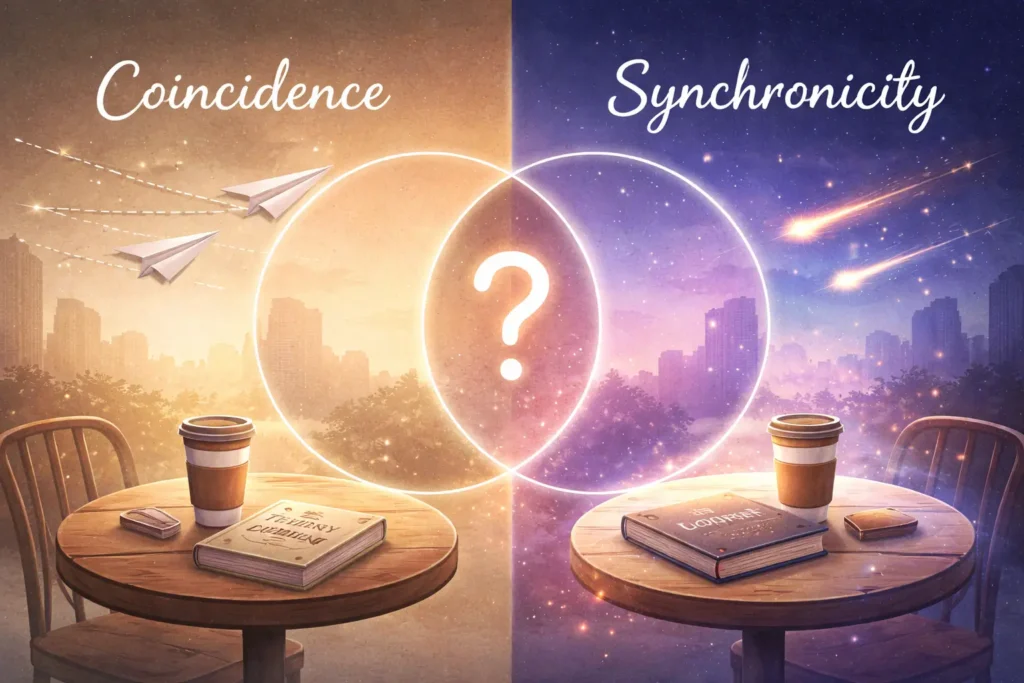
Direct answer: A coincidence is an unexpected overlap you treat as random. Synchronicity is an unexpected overlap you experience as personally meaningful in your current situation. The key difference is interpretation, not the event itself.
- Coincidence = “This happened by chance.”
- Synchronicity = “This feels relevant to what I’m dealing with.”
- Same kind of event, different framing and meaning.
What people mean by “coincidence”
In everyday English, a coincidence is when two things line up unexpectedly—timing, details, or events—without any requirement that it carries meaning. It’s a neutral label for an overlap that surprises you, but doesn’t automatically point to anything beyond chance.
Coincidence in everyday language
- “It was a coincidence that we showed up at the same café.”
- “Probably just chance that I saw the same number twice today.”
- “Funny coincidence—I was just thinking about that.”
Key point: With coincidence, meaning is optional. You can notice it and move on.
What people mean by “synchronicity”
Synchronicity is how people often describe a coincidence that feels meaningfully connected to what you’re thinking or going through. The event might still be random, but the experience of it is: “this feels significant right now.”
Some people associate the term with Carl Jung and the idea of a “meaningful coincidence” that doesn’t rely on a clear cause-and-effect link. In modern use, it’s often used as shorthand for a moment of strong subjective significance—a coincidence that seems to “fit” your current situation.
- You notice it strongly (it stands out).
- It connects to what you’re dealing with right now.
- You describe it because the meaning feels central—not because the facts are different.
The core difference (meaning vs randomness)
What is the difference between synchronicity and coincidence? In practice, it’s the difference between describing an event as random timing versus describing it as personally meaningful timing.
Think of it like two captions under the same photo:
- Coincidence caption: “Interesting overlap. No meaning required.”
- Synchronicity caption: “Interesting overlap that feels relevant to my situation.”
Rule of thumb: If meaning is optional, you’re in “coincidence.” If meaning is central to why you’re mentioning it, you’re in “synchronicity.”
Side-by-side comparison
| Dimension | Coincidence | Synchronicity |
|---|---|---|
| Context | Not required. It can be purely external timing. | Central. It connects to your current situation. |
| Subjective meaning | Optional. You can file it as “random.” | Primary. You notice it because it feels meaningful. |
| Impact on choices | Low. Usually just a note or a story. | Moderate. It can prompt reflection on what matters to you. |
| Repeatability | May be one-off. Repeats can still be random. | Repeats may feel like a pattern, without proving anything. |
Two ultra-short examples (same event, different framing)
- Trying to pick a book to read → you hear the same title mentioned twice in unrelated places → coincidence (timing), synchronicity (felt relevance).
- Considering a new hobby → the same hobby keeps coming up in casual conversations → coincidence (overlap), synchronicity (personal significance).
Common confusions to avoid
- “Synchronicity proves that…” → It doesn’t prove anything by itself. It describes an experience of meaning.
- “Coincidences don’t exist.” → Coincidences are a normal part of life and perception.
- “It’s unlikely, so it must be meaningful.” → Unlikely things happen. Meaning is an interpretation, not a conclusion forced by probability.
- “Repeating = certainty.” → Repetition can increase salience without guaranteeing significance.
- “Meaning = an external force.” → Meaning can be internal: values, needs, priorities, emotions.
Safer phrasing (sentence templates)
- “It might be coincidence, but it feels relevant to what I’m dealing with.”
- “I’m calling it synchronicity because it connects to my current situation.”
- “This doesn’t prove anything, but it’s making me reflect.”
Use the terms clearly (3 quick language rules)
- Describe the facts first (what happened), then name your framing (random vs meaningful).
- Keep claims modest: “felt,” “seems,” “relevant,” rather than certainty language.
- Don’t convert meaning into prediction: synchronicity is a label for significance, not a guaranteed outcome.
Boundary note: This is a language distinction, not a rule for decision-making.
Editorial note: This guide explains how people commonly use the terms coincidence and synchronicity and how to distinguish them clearly. It does not claim to prove whether events are “signs,” nor does it offer instructions for seeking them.
Frequently Asked Questions
Can an event be both coincidence and synchronicity?
Yes. The same event can be random (coincidence) while still feeling personally meaningful to you (synchronicity). The difference is how you frame it, not what “objectively” happened.
Is synchronicity just a coincidence with meaning attached?
Often, yes. Synchronicity emphasizes personal significance and timing, without requiring you to claim it proves anything external.
Do repeating coincidences automatically mean synchronicity?
No. Repetition can happen by chance, and it can also become more noticeable once your attention is tuned to it. If repeats feel meaningful, treat “synchronicity” as a description of that meaning—not as evidence.
Does a coincidence have to be unlikely?
Not necessarily. People tend to remember the striking overlaps, but “coincidence” can describe any unexpected co-occurrence. “Unlikely” doesn’t automatically equal “meaningful.”
How can I talk about synchronicity without overclaiming?
Use personal, low-certainty language: “It felt meaningful to me,” “It seems relevant,” “It might be coincidence.” That keeps the insight without turning it into proof, prediction, or pressure.