
Why Do I Feel Angry After a Powerful Spiritual Awakening?
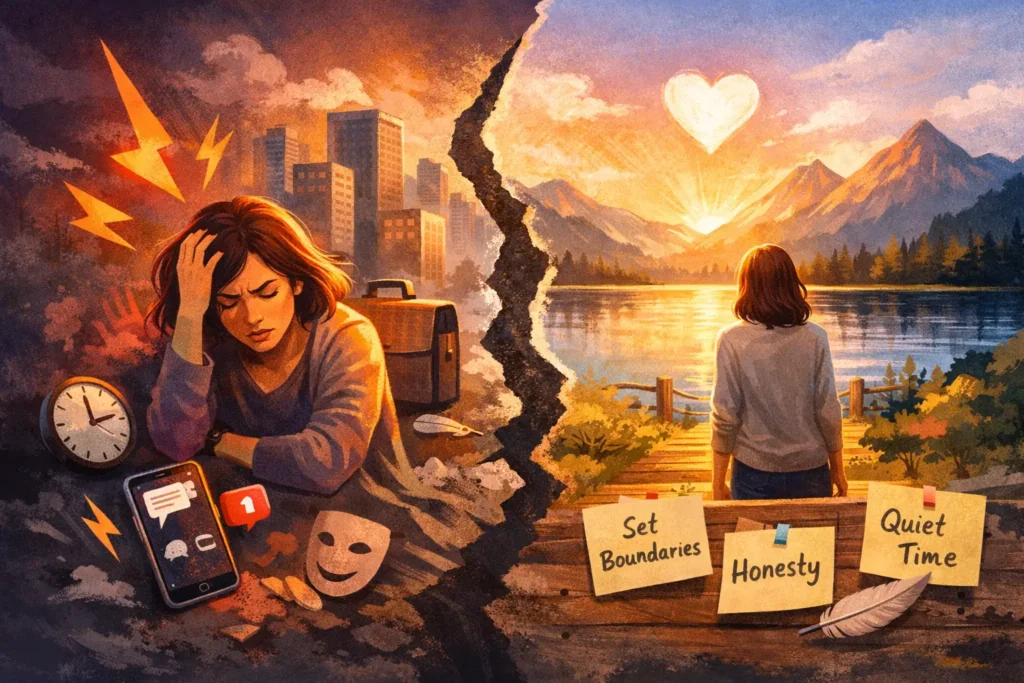
If you’re wondering “why do I feel angry after a powerful spiritual awakening,” you’re not alone—and it doesn’t automatically mean you did anything wrong. A spiritual awakening can change what you value, tolerate, and notice. When your new awareness collides with old routines, relationships, or self-abandoning habits, anger can show up as a signal that something needs adjusting.
TL;DR / Short answer: After a spiritual awakening, anger often appears because your inner values and sensitivity shift faster than your outer life can catch up. Start with regulation (pause + slow exhales), then decode what’s being crossed (a boundary, need, or value), and take one small, safe action this week. Feeling angry doesn’t mean you “did it wrong”—it often means you’re integrating change.
Common ways this anger shows up:
- Feeling “raw” or overstimulated (noise, messages, social feeds hit harder than usual)
- Snapping over small things, then feeling confused or guilty
- Resentment building quietly instead of clear “rage”
- Low tolerance for inauthenticity, people-pleasing, or emotional labor
- Moral irritation: “Why is everyone acting like this is normal?”
What we mean by “spiritual awakening” here: not a doctrine or a proof of anything—just an intense inner shift in perception and values that changes how you relate to life. Many people also describe it as a big inner shift. Labels vary; the practical challenge is integration.
Quick note (what this is / isn’t): This is an educational, grounded guide for making sense of anger after a spiritual awakening. It avoids doctrine, “signs,” and moral labels. It’s not medical or mental health advice and can’t replace professional support. If your anger feels unsafe or out of control, jump to “What’s normal vs when to worry” below.
The core idea: anger as mobilized energy for change
After a spiritual awakening, your external life may look the same—but your internal “settings” don’t. That gap can feel irritating or even infuriating. For many people, anger functions as mobilization energy: it highlights what matters, what hurts, and what needs a boundary or repair.
Why it can feel so intense (without making it clinical): a big inner shift can make you more sensitive to inputs (conflict, noise, constant information), less willing to tolerate misalignment, and quicker to notice subtle disrespect or self-betrayal. When your threshold changes, the same situations can land harder—even if nothing “new” happened on the outside.
Practically, anger after a spiritual awakening often points to one (or more) of these:
- A boundary that’s being crossed (time, respect, emotional labor, privacy)
- An unmet need (rest, honesty, space, support, reciprocity)
- A value conflict (you can’t “unsee” misalignment anymore)
- A transition cost (grief for an old identity, expectations, or roles)
Mismatch Map: find what your anger is protecting (mobile-friendly)
The goal isn’t to justify anger or spiritualize it. The goal is clarity: what doesn’t fit anymore after this awakening, and what is the smallest safe adjustment you can make?
Mismatch 1: Honesty increased
- New awareness: You value honesty more.
- Old friction: You keep agreeing to things you resent.
- Anger may be protecting: Self-respect and time.
- Small step this week: “Let me think and get back to you.”
Mismatch 2: Need for quiet and space increased
- New awareness: You need more quiet and space.
- Old friction: Constant noise, messages, social pressure.
- Anger may be protecting: Capacity and recovery.
- Small step this week: One daily 20-minute offline block.
Mismatch 3: People-pleasing is now obvious
- New awareness: You notice people-pleasing patterns.
- Old friction: You default to fixing, smoothing, overgiving.
- Anger may be protecting: Autonomy and dignity.
- Small step this week: Say no once without over-explaining.
Mismatch 4: Meaning matters more
- New awareness: You want work to feel meaningful.
- Old friction: Your job feels performative or draining.
- Anger may be protecting: Purpose and energy.
- Small step this week: Change one controllable variable (scope, hours, priorities).
Mismatch 5: Sensitivity to inputs increased
- New awareness: You’re more sensitive to inputs.
- Old friction: News/social feeds leave you activated.
- Anger may be protecting: Emotional bandwidth.
- Small step this week: A 48-hour input reset; reassess your baseline.
4 common reasons you might feel angry after a spiritual awakening
1) Disappointment: “I expected peace—why is life still hard?”
Many people expect a spiritual awakening to erase messy emotions. When stress or conflict returns, disappointment can turn into irritation. The mismatch isn’t “awakening vs failure.” It’s expectation vs reality.
2) Losing your old orientation
Old goals can stop motivating you. Old identities can feel tight. Anger may rise because you’re in an in-between phase: you can’t go back, but you don’t know what “forward” looks like yet.
3) Loneliness and feeling misunderstood
If your circle can’t relate, you may feel isolated. Isolation removes emotional buffering, so small frustrations can hit harder. You don’t need everyone to get it—you need a few safe places to be honest.
4) Boundary pressure
After a spiritual awakening, your tolerance for disrespect, overfunctioning, or inauthentic dynamics often drops. Anger can arrive fast because your system is flagging: “This costs me too much now.”
Reality check: This doesn’t mean awakening “always” causes anger. It means anger can appear when your inner change is ahead of your outer life—and it often points toward a practical adjustment.
Anger vs aggression (and why suppression backfires)
Anger is an internal signal. Aggression is behavior. The work isn’t to become someone who never feels anger—it’s to feel it without harming yourself or others, and translate it into a clear next step.
Suppression doesn’t usually remove anger; it can reroute it into sarcasm, shutdown, resentment, or sudden blow-ups. Integration is the middle path: regulated expression + honest action.
When anger hits: regulate → decode → act
A 2-minute de-escalation reset
- Pause: stop typing, talking, deciding.
- Release: unclench jaw; drop shoulders; soften belly.
- Slow exhale x5: make the out-breath longer than the in-breath.
- Name it: “This is irritation / resentment / overwhelm.”
- Delay: “I’ll choose my next step after I’m calmer.”
Decode with one question
Ask: “What boundary, need, or value is being crossed right now?”
Then finish the sentence: “What I need is…”
Act with one small, grounded move
- One boundary you will set (small and specific)
- One conversation you will schedule (not improvise mid-spike)
- One input you will reduce for 24–48 hours
- One support you will ask for (one person, one request)
- One decision you will postpone until you’re regulated
What’s normal vs when to worry (integration turbulence vs needing support)
After a spiritual awakening, it’s common to feel more reactive for a while—especially if your routines and relationships haven’t caught up yet. Use these markers to stay grounded without over-pathologizing yourself.
Often normal during integration:
- Anger comes in waves, then eases when you rest, reduce inputs, or set one boundary
- Irritability links to specific situations (a dynamic, a demand), not “everything all the time”
- You can still function day-to-day, even if you feel emotionally raw
- After you regulate, you can choose your response again
- Intensity gradually decreases over days/weeks as you make small adjustments
When to get support:
- You feel unsafe with yourself or others, or fear you might lose control
- You have thoughts of harming yourself or someone else
- You can’t function day-to-day beyond a short period (sleep, eating, responsibilities)
- Your anger feels frightening, unmanageable, or escalating toward violence
- You haven’t slept for days and feel intensely agitated or unable to settle
Anger → Clarity checklist (use it instead of spiraling)
- Label it precisely: irritation, resentment, grief-adjacent anger, overwhelm
- Name the friction: “I’m angry because _____ no longer fits after this awakening.”
- Find the hidden request: “What I need is _____.”
- Pick a small, reversible step you can do this week
- Talk when calm (or schedule a time to revisit)
- Avoid big life decisions while activated
- Track the pattern for 7 days before making major changes
Primary path (keep it simple): regulate → write the mismatch sentence → one small safe step. The goal is integration, not perfection.
Decision tree: what to do first based on your anger type
After a spiritual awakening, the same anger can come from different mismatches. Choose the closest category, then do the smallest stabilizing step first.
- A) Relationship friction
Today: stop the loop; name one boundary.
This week: make one specific request using a short script below. - B) Work / direction mismatch
Today: list what’s intolerable vs negotiable.
This week: run one small experiment (scope, schedule, priorities) instead of a dramatic leap. - C) Overwhelm and sensitivity
Today: reduce inputs for 24–48 hours.
This week: protect one daily quiet block (thresholds often change after an awakening). - D) Self-directed anger (regret, “How did I not see this?”)
Today: replace self-attack with one repair action.
This week: apply one lesson once, in a real situation, to support integration. - E) Community / values anger (“I don’t fit here anymore”)
Today: stop performing; take a step back.
This week: choose one honest boundary and one supportive connection.
Boundary scripts (short, repeatable, no preaching)
After a spiritual awakening, your values can recalibrate faster than your relationships do. Use these as calm repeats, not as speeches.
With a partner or friend
- “Something in me has shifted. I need slower conversations this week.”
- “If I pause, I’m regulating so I can respond better.”
With family
- “I’m not debating this. I want to stay connected respectfully.”
- “I’m not discussing that right now. Let’s switch topics.”
At work
- “Which two priorities matter most this week?”
- “I can do this with a later deadline or support on X.”
What integration looks like (a realistic outcome)
- You recover faster after triggers
- You set boundaries earlier, with less guilt
- You stop negotiating against your own values
- You make fewer impulsive decisions and more sustainable changes
If you do only one thing today: Do the 2-minute reset, then write one sentence: “I’m angry because _____ no longer fits after this awakening.” Pick one small, safe adjustment (one boundary, one input reduction, or one scheduled calm conversation) and do it within 24–72 hours. Integration isn’t suppression—it’s turning intensity into clear, sustainable change.
Disclosure: Educational content only. This article focuses on practical integration tools and commonly used self-regulation practices (pause, breath, naming emotions, boundary-setting). It is not medical or mental health advice.
Frequently Asked Questions
Can anger coexist with gratitude after a spiritual awakening?
Yes. Gratitude and anger can sit side by side—especially during transition. Gratitude reflects what you value; anger can highlight what still needs adjusting in your daily life.
What if I’m mostly angry at myself?
Self-directed anger often comes from regret or “I ignored my needs for too long.” Treat it as a cue to make one repair move now (one boundary, one honest choice, one small corrective action) instead of punishing yourself.
Should I tell everyone about what happened?
Not necessarily. If sharing increases conflict or makes you feel exposed, choose selective disclosure: one trusted person, one supportive space, and clear boundaries around debate.
How do I know if my anger is pointing to a boundary or just overload?
Try rest and an input reset first. If the anger softens quickly, overload likely amplified it. If it stays specific (“this dynamic isn’t okay for me anymore after this awakening”), it’s probably boundary-related.
What if I feel pressured to make huge life changes immediately?
Urgency can be common after a spiritual awakening, but it can also be reactivity. Regulate first, track the pattern for a week, then choose one small experiment before committing to a big irreversible move.
How long does this anger last after a spiritual awakening?
There isn’t one timeline. For many people, anger comes in waves and reduces as integration happens—especially when you improve rest, reduce overstimulation, and make a few concrete boundary adjustments. If intensity stays high, functioning drops, or you feel unsafe, use the “When to get support” markers in the article as your guide.
Is this a “dark night” or “shadow work”?
Different traditions use different labels. You don’t need a perfect name to move forward. Focus on integration: regulate, clarify what’s misaligned, and take small safe actions. If things feel unmanageable or risky, prioritize support and stability over interpretation.