
Is Astrology a Science or a Pseudoscience?
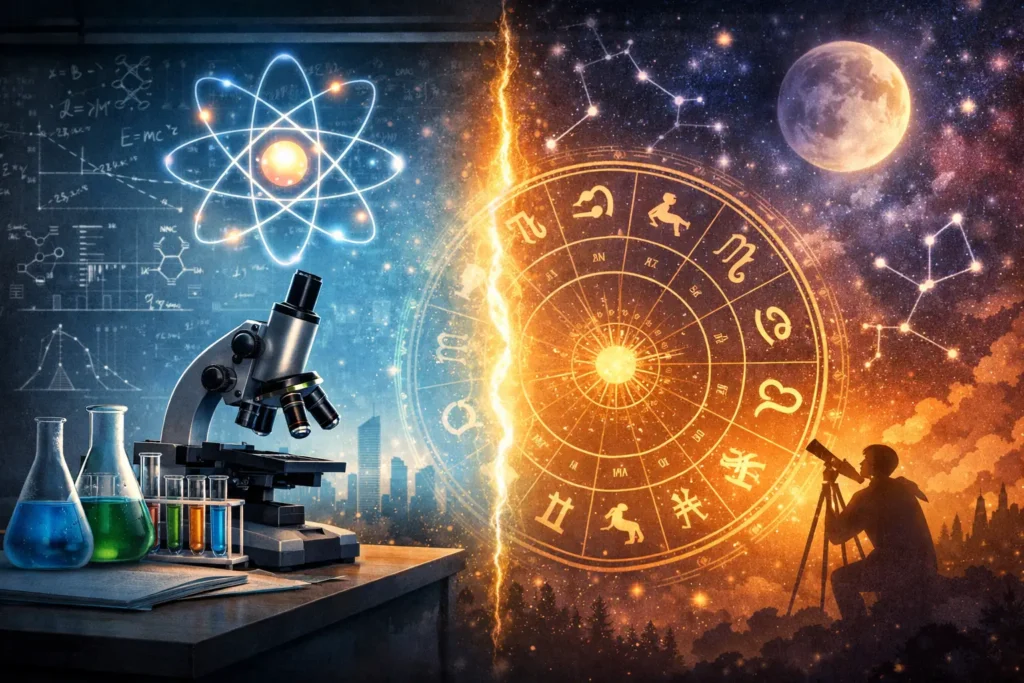
Direct answer: In modern academic and scientific contexts, astrology is generally classified as pseudoscience because its core claims do not reliably meet key standards used to judge scientific knowledge: clearly testable and falsifiable hypotheses, reproducible results, and independent verification. This is a classification about method and evidence—not a judgment on whether astrology can feel meaningful as a symbolic or reflective practice.
- Science relies on testable, falsifiable claims and repeatable results.
- Astrology’s claims are often difficult to operationalize into consistent, controlled tests.
- In controlled and blinded testing contexts, findings have not converged into a reliably replicable evidence base.
- Pseudoscience is a knowledge category, not an insult.
- “Not science” can still be symbolically useful—so long as the boundary is kept clear.
What Counts as Science (in Plain English)
When people ask whether astrology is “science,” they’re usually asking whether it fits the standards used in modern scientific fields. Those standards are less about sounding technical and more about how claims are built, tested, and checked by others.
The core criteria used to evaluate scientific claims
- Testability: A claim is defined clearly enough that you can test it against observable reality.
- Reproducibility: Other researchers can run the same test and get similar results.
- Falsifiability: The claim could be proven wrong in principle (it takes the risk of failure).
- Independent verification: Evidence holds up beyond one person, one lab, or one method.
Why these criteria matter: In philosophy of science and scientific methodology, ideas like falsifiability and replication are often used as “demarcation” tools—ways to distinguish scientific knowledge from other kinds of claims. The point is not to grant respect or disrespect, but to classify claims based on whether they can be reliably tested and updated through shared evidence standards.
What Astrology Claims (Only What We Need for Classification)
Astrology broadly proposes that the positions and movements of celestial bodies correspond with human affairs. For the purpose of this article, the question is not whether people enjoy astrology, but whether these claims can be evaluated and supported using scientific standards.
Applying Scientific Criteria to Astrology
1) Testability: can astrology’s claims be tested?
Scientific testing starts with an operational definition: a claim must be stated in a way that specifies what you measure, how you measure it, and what would count as success or failure. Many astrological statements are interpretive, context-dependent, or open to multiple readings. Those features may work within symbolic frameworks, but they make scientific testing difficult because the claim can be hard to pin down as a measurable hypothesis.
To be scientifically testable, astrological claims would need tight, pre-stated definitions (e.g., which outcome, over what timeframe, measured how, compared to what baseline).
2) Reproducibility: do results repeat reliably?
In science, it’s not enough that a conclusion feels convincing once. If a method is valid, independent researchers using the same approach should reach similar results at rates that exceed chance.
For astrology to meet this standard, controlled tests would need to show consistent results beyond chance across repeated trials, and those results would need to appear across different teams and samples.
3) Falsifiability: can astrology be proven wrong?
A claim is scientifically strong when it can fail. If a statement can be adjusted after the fact to fit many outcomes, it becomes difficult to falsify. Some astrological claims can be framed in falsifiable ways, but that requires pre-stated hypotheses, clear outcome measures, and predefined criteria for what would count as a miss.
4) Independent verification: can outsiders replicate the evidence?
Scientific knowledge strengthens when results hold up across different researchers, methods, and settings. In practice, astrology has not produced a widely accepted body of replicated evidence that would meet mainstream scientific standards and shift scientific consensus.
A key barrier is methodological: when claims aren’t operationalized into precise, testable hypotheses, independent teams can’t run clean, comparable experiments that would allow replication results to accumulate into a stable evidence base.
Criteria Matrix: Science vs Astrology (Classification Lens)
This table is not a “gotcha.” It’s a practical way to see why astrology is usually categorized as pseudoscience in scientific contexts.
On mobile: swipe sideways to view the full table.
| Criterion | What science expects | What would satisfy it for astrology | Why it’s difficult (in practice) |
|---|---|---|---|
| Testability | Clear, measurable hypotheses | Operational definitions + measurable outcomes | Many claims are interpretive and hard to operationalize |
| Reproducibility | Similar results across repeated tests | A consistent track record of results beyond chance across independent replications | Results have not converged into a stable, reliably replicable evidence base |
| Falsifiability | Claims can fail in principle | Predefined “wrong outcome” criteria | Flexible interpretations can reduce falsifiability |
| Independent verification | Multiple teams reproduce findings | Controlled studies replicated independently | Evidence has not shifted mainstream scientific evaluation |
So Why Is Astrology Usually Classified as Pseudoscience?
Pseudoscience is a category used for systems of claims that resemble science in language or presentation, but do not meet core methodological standards—especially testability, reproducibility, falsifiability, and independent verification.
Astrology is typically labeled pseudoscience in scientific contexts because it is often framed as making empirical claims about human affairs, yet it has not produced a replicable evidence base that meets scientific standards for controlled testing and independent replication.
Pseudoscience vs Religion vs Philosophy vs Art (A Quick Distinction)
- Science aims to explain the natural world using testable methods and shared evidence standards.
- Pseudoscience presents empirical-sounding world-claims in a science-like way without meeting those standards.
- Religion and many philosophical systems often address meaning, values, and metaphysics—topics that are not always testable scientifically.
- Art and symbolic practices can be valuable without claiming scientific proof.
This is why “astrology isn’t science” is a classification statement, not a moral verdict about people who engage with it.
Important: “Not Science” Doesn’t Automatically Mean “Useless”
Some people use astrology as a symbolic language for reflection or storytelling. That kind of use can be psychologically or culturally meaningful without being scientifically validated. The boundary is simple: symbolic usefulness is not the same as scientific evidence.
Safety boundary: For health, legal, or financial decisions, rely on qualified professionals; treat astrology as reflective, not evidentiary.
Frequently Asked Questions
Is astrology considered a science?
In modern academic and scientific contexts, astrology is generally not considered a science because it does not reliably meet core scientific criteria such as falsifiability, reproducibility, and independent verification. This is a methodological classification—not a judgment on personal meaning.
Why is astrology called a pseudoscience?
“Pseudoscience” is a category for systems that present empirical-sounding claims in a science-like way but do not meet science’s standards for testability, replication, and independent verification.
What would scientific evidence for astrology look like?
It would require clearly defined, testable hypotheses that consistently perform beyond chance in controlled studies and then reproduce across multiple independent teams and samples, building a stable, replicable evidence base that could shift scientific evaluation.