
Is Astrology Compatible With Religion? A Neutral Guide to Authority, Guidance, and Conscience
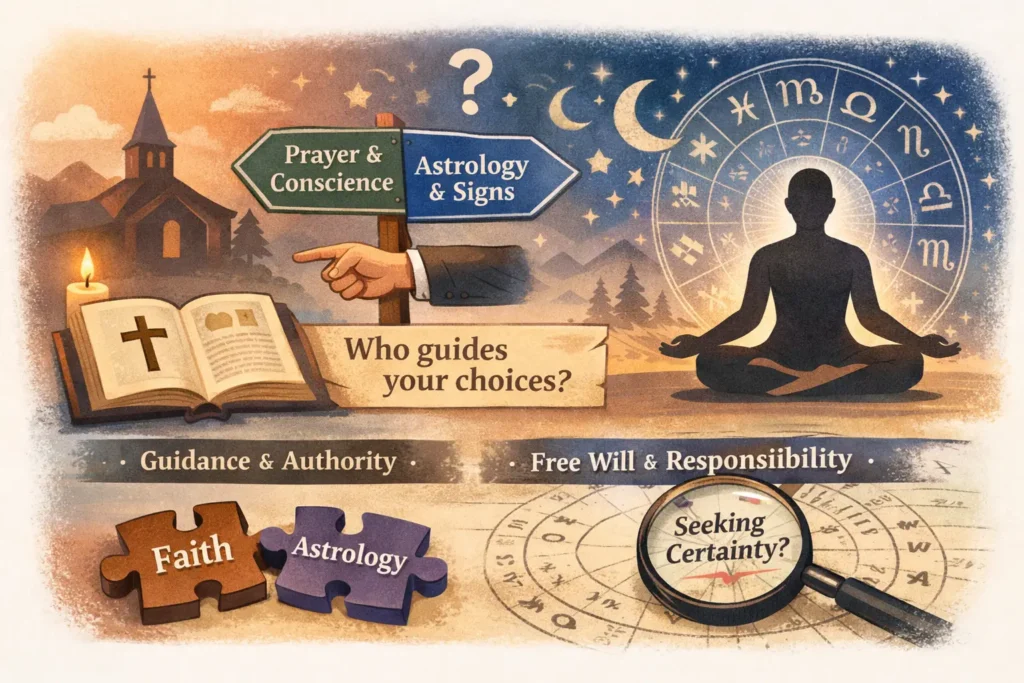
Astrology may feel compatible with religion for some people—but the core question usually isn’t whether astrology is “true.” It’s whether astrology becomes a source of spiritual authority and guidance that competes with (or distracts from) your faith’s practices, teachings, and sense of meaning.
- Compatibility is mainly about authority, not “accuracy.”
- The key tension is where you seek direction when you’re unsure.
- Traditions vary, but concerns often rhyme: guidance, trust, and free will.
- Many believers focus on boundaries rather than blanket conclusions.
- If it becomes a way of seeking certainty through signs or distracts from core practices, it may not be spiritually helpful.
What “Compatible” Means Here (And What It Doesn’t)
In religious contexts, “compatible” rarely means “proven” or “effective.” It usually means:
- Does this fit my faith’s view of guidance and meaning?
- Does it pull my trust away from God, scripture, prayer, community, or conscience?
- Does it shape my decisions in a way my tradition might consider spiritually risky?
This guide stays descriptive—not a ruling. Different communities and leaders draw lines differently, and people within the same tradition can land in different places.
Why Religions Even Discuss Astrology
Most religions aren’t only sets of beliefs; they’re systems of guidance: how to live, how to decide, how to interpret suffering and blessing, and where to place trust.
That’s why alternative sources of meaning raise questions. The tension often isn’t “ban vs allow.” It’s competition for authority:
- Who gets to define what’s meaningful?
- What do you treat as reliable guidance when you’re unsure?
- What practices shape your attention, hope, and choices?
For a believer, this can feel like an inner conflict: curiosity or comfort on one side, and loyalty or caution on the other.
Two Common Ways People Relate to Astrology (Without Getting Into Horoscopes)
People often engage astrology in one of two broad modes:
Reflective use (low-authority)
Treating it as reflection or symbolism—a non-binding lens for noticing themes—without treating it as instruction.
Directive use (high-authority)
Treating it as direction—a source of answers, permission, timing, or certainty—especially for major decisions.
This difference matters because many religious concerns focus less on symbolism and more on who or what is steering your life.
The 3 Core Tension Points (Simple Framework)
1) Guidance: Where You Go for Direction
When you’re uncertain, you seek direction somewhere: prayer, scripture, trusted mentors, conscience, community, tradition. Astrology can become another “voice” in that mix.
Religious tension often rises when astrology becomes:
- the first stop for guidance,
- the final word on choices,
- or a substitute for spiritual discernment.
2) Authority: Who Interprets Your Life
Religion often centers ultimate meaning in God (or the sacred), with guidance shaped through tradition and practice. Astrology can feel like a competing authority if it’s treated as a “decoder” for destiny, identity, or outcomes.
A helpful question is not “Is it accurate?” but:
- What authority am I granting this?
- Is it secondary reflection—or spiritual direction?
3) Free Will vs Determinism: Agency and Responsibility
Many religions emphasize moral responsibility and agency. If astrology is used in a way that implies “this must happen” or “I can’t help it,” it can conflict with a faith-based view of choice, accountability, and growth.
- using it to excuse behavior (“I’m just made this way”),
- using it to avoid hard choices (“the chart said no”),
- or treating timing and labels as binding limits.
A Neutral Answer in One Sentence
Astrology and religion can feel more or less compatible depending on whether astrology stays secondary (symbolic reflection) or becomes spiritual direction that competes with your faith’s authority.
- More likely to feel compatible when… it remains optional, non-binding, and clearly lower in authority than prayer, conscience, and community guidance.
- More likely to conflict when… it starts functioning like a deciding voice—especially for major choices—or like a substitute for discernment.
- Most sensitive point for many believers… when astrology becomes a way of seeking certainty or “signs” in moments of uncertainty.
High-Level Views Across Traditions (No Doctrinal Debate)
This is intentionally broad. Real-world practice varies by denomination, community, and teacher.
Abrahamic traditions (Judaism, Christianity, Islam — general pattern)
Many communities tend to be cautious about practices that resemble divination-like guidance or alternative spiritual authority—especially when they guide decisions, claim certainty, or compete with prayer and trust in God.
In plain language: the concern is often that astrology can shift the “center of gravity” of a person’s spiritual life—away from prayer, conscience, and sacred teaching, and toward an external system for interpreting what to do and what events mean. Even when used casually, it can be experienced as a rival channel of guidance.
Common reasons for caution (stated broadly, without doctrine) include:
- Concern about divination-like practices (seeking “signs” as direction or certainty),
- Placing trust in signs rather than prayer and spiritual discernment,
- Outsourcing moral agency—letting an external system override conscience and responsibility.
Some individuals still engage symbolically, while others avoid it entirely. Where the line is drawn often depends on the role astrology plays (reflective vs directive).
Dharmic/Eastern religious systems (Hindu, Buddhist, etc. — broader spectrum)
In some cultures, astrology can be woven into tradition, ceremony, or community life. One reason the spectrum can look wider is that astrology may function as custom or calendar practice (timing rituals, marking seasons) rather than as a competing authority for personal decisions.
Another difference is that “religion” can be experienced more as a layered set of practices than a single centralized source of teaching—so astrology may sit alongside other cultural forms of meaning without automatically being treated as ultimate guidance.
Even in these contexts, boundaries still vary: some treat it as heritage or symbolism, while others treat it as spiritually weighty.
Why people within the same tradition differ
- how central faith practice is in daily life,
- community norms and leadership guidance,
- personal conscience and spiritual sensitivity,
- and how astrology is used (reflective vs directive).
A Conscience-Safe Discernment Checklist (Practical, Not Preachy)
Intent & role
- Am I using this for reflection or for direction?
- Do I treat it as optional—or as something I “need” before acting?
- Would I still make the same choice without it?
Authority & trust
- When astrology pulls me one way and my faith pulls me another, what do I treat as higher?
- Has it become a louder voice than prayer, conscience, or wise counsel?
- Am I seeking certainty my faith usually asks me to hold with humility?
Attention & spiritual life
- Does this pull time and attention away from core practices?
- Does it leave me more grounded—or does it blur my priorities?
- Does it feed a sense of control that competes with trust?
Community & integrity
- If my community disapproves, am I hiding it to avoid discomfort?
- Can I speak about it honestly with a trusted faith leader?
- Does it align with the kind of person my faith calls me to become?
Boundaries Many Believers Choose (Without Universal Rules)
- Keeping major decisions grounded in faith-based discernment and wise counsel, not astrological timing.
- Avoiding “sign-seeking” use when uncertain (treating astrology as the deciding voice).
- Keeping identity labels light so agency and character remain primary.
- Keeping primary practices primary (prayer, community, ethical reflection).
- Keeping it secondary: optional, non-binding, and not a substitute for discernment.
When Compatibility Questions Usually Intensify (Red Flags)
- It starts functioning as the final authority in choices.
- It shapes major decisions more than prayer, conscience, or counsel.
- It becomes a routine way of seeking certainty or signs in moments of uncertainty.
- It pulls attention away from core faith practices or community.
- It’s used to avoid responsibility (“the signs decide for me”).
If you’re conflicted, many people find it clarifying to talk with a trusted faith leader and frame the issue around authority, conscience, and boundaries rather than debate.
Editorial note: This page treats astrology as a symbolic/interpretive practice and discusses compatibility with religion as a question of authority and spiritual direction. Traditions vary; this is not religious counsel and not advice for medical, legal, or financial decisions.
Frequently Asked Questions
Is astrology compatible with religion?
It may be for some people, depending on how it’s used and what their tradition teaches about spiritual authority. Compatibility questions usually center on guidance and trust, not “whether astrology works.”
Why do some religions object to astrology?
Often because it can function like an alternative source of direction or certainty. The concern is usually about where authority is placed—especially in decision-making and spiritual life.
Is it different if I treat astrology as symbolic?
For many believers, yes—symbolic reflection tends to raise fewer concerns than directive guidance. The key is whether it stays secondary and doesn’t replace faith-based practices.
How do I know if I’m giving it too much authority?
Signs include treating it as necessary before acting, letting it override conscience or wise counsel, or using it to avoid responsibility. Many believers respond by tightening boundaries or stepping back.
Should I ask a faith leader about this?
If religion is central to you, it can help—especially if you feel conflicted. Frame the conversation around authority, conscience, and boundaries, not winning a debate.