
Astronomy vs. Astrology: A Simple Explanation for Beginners
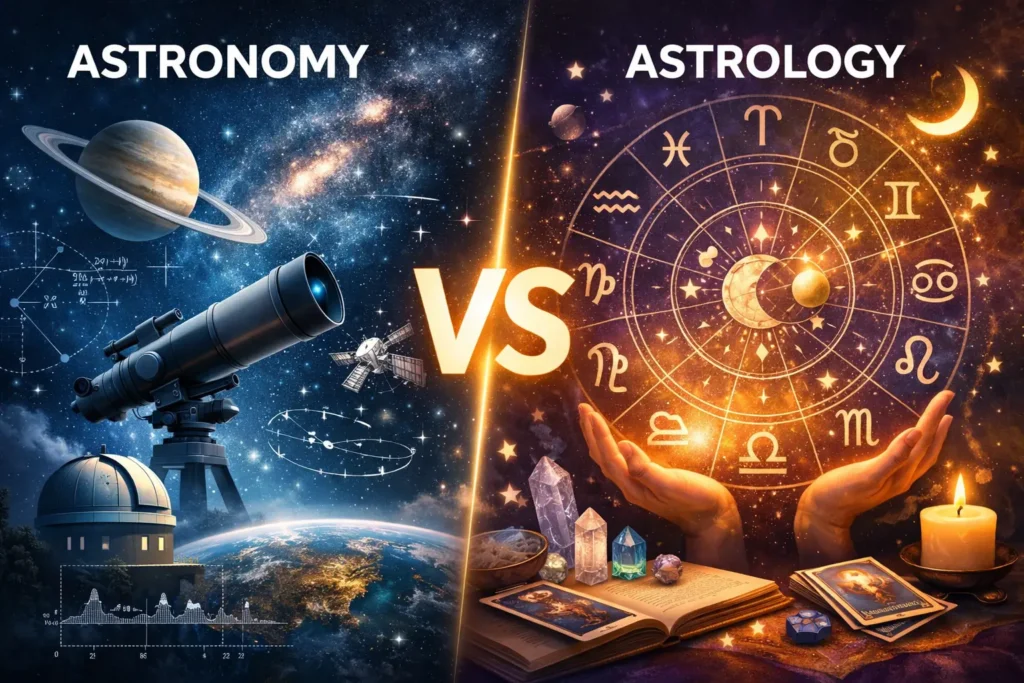
Direct answer: Astronomy is the scientific study of space—planets, stars, galaxies, and the physical processes that shape the universe—using observation, measurement, and testable models. Astrology is a symbolic, interpretive tradition that uses the sky as a language of meaning. Many people use it for reflection on personal themes and life periods, rather than for testing physical causes.
- Astronomy asks: What’s happening in the sky, and how does it work?
- Astrology asks: What might this symbolize or suggest to me?
- They share terms like planets, zodiac, and constellations, which makes them easy to mix up.
- A telescope supports astronomy; a chart supports astrology.
What Is Astronomy? (In Plain English)
Astronomy is a branch of science focused on celestial objects and events—like the Moon, planets, stars, galaxies, and cosmic phenomena. Its goal is to understand how the universe works: how objects form, move, interact, and change over time.
Astronomers use observations (data from telescopes and instruments), measurements (numbers you can compare), and models (physics- and math-based explanations that can be checked against evidence). The key point: astronomy is built around evidence that can be measured and tested.
What Is Astrology? (A Symbolic, Interpretive System)
Astrology is an interpretive tradition that uses the positions of the Sun, Moon, and planets as symbols. Many people approach it as a structured way to reflect on identity, patterns, and periods of time—similar to how someone might use archetypes, mythology, or reflective prompts.
The key difference is purpose: astrology is about meaning-making and interpretation. It is not designed to measure physical causes in the way astronomy does. In modern terms, astrology is not a scientific discipline.
Astronomy vs Astrology: The Simple Difference
Tip: Swipe to view the full table.
| Aspect | Astronomy | Astrology | Example question |
|---|---|---|---|
| Purpose | Explain the physical universe | Interpret meaning and themes | “What is this?” vs “What might this suggest?” |
| Method | Observation, measurement, testable models | Symbolic frameworks, traditions, interpretation | “How can we verify it?” vs “How do we read it?” |
| Typical output | Data, explanations, calculations of physical motion | Reflections, themes, narratives, prompts | “When will it rise?” vs “What theme fits this period?” |
| Core question type | “What’s happening in the sky, and why?” | “What does this symbolize for me?” | Moon phases vs personal symbolism |
| Where you see it | Science education, research, space missions | Personal practice, apps, media, spiritual communities | Planetarium vs astrology app |
If you remember one thing: astronomy explains the physical universe, while astrology interprets meaning using the sky as a symbolic map.
The Fast Test: Which One Fits Your Question?
- Is your question about a physical object or event? (What is it? Where is it? When will it happen?) → Start with astronomy.
- Is your question about themes, meaning, or reflection? (How do I frame this period? What story helps me understand what I’m experiencing?) → You’re in astrology.
- Do you want both? That can be fine—just keep the goals separate.
A clean shortcut: “What’s happening?” (astronomy) versus “What might it mean?” (astrology).
Why People Confuse Them
- Shared history: In many ancient cultures, studying the sky combined careful observation with symbolic interpretation.
- Shared vocabulary: Both use words like planets, stars, zodiac, and constellations—even when they mean different things.
- Pop-culture shortcuts: Headlines, apps, and casual speech sometimes swap the terms or blur the boundary.
The similar names add to the confusion: both start with “astro-” (sky/star-related), but they point to different goals.
Common Mix-Ups (Quick Fixes)
- “Astronomy = horoscopes” — Horoscopes are an astrology format, not astronomy.
- “Astrology uses telescopes” — Telescopes are astronomy tools; astrology typically uses charts and symbolic systems.
- “Zodiac signs = constellations” — Constellations are mapped star patterns/regions; zodiac signs are symbolic categories used in astrology.
Examples (2 Mini-Cases)
Example 1: A practical sky question
Question: “I saw a bright ‘star’ near the horizon after sunset—what is it?”
Best fit: This is an astronomy question because you’re identifying a physical object and its position.
Simple next step: Note the time and direction and check a reputable sky map (or planetarium) app to see whether it matches a bright planet (often Venus or Jupiter) or a prominent star.
Example 2: A personal reflection question
Question: “I want a symbolic way to reflect on what this period of life feels like.”
Best fit: This can fit astrology if you’re using it as a reflective, interpretive framework (similar to journaling prompts or archetypes), rather than as a claim about physical causation.
Simple next step: Use any interpretation as optional language for reflection—what resonates, what doesn’t—and keep conclusions flexible.
A Simple Checklist: Using Both Without Mixing Them Up
- Do use astronomy for facts: positions, events, distances, “what is it?”
- Do use astrology for reflection: themes, meaning, personal symbolism.
- Do keep interpretations flexible and personal.
- Don’t treat symbolic readings as guaranteed outcomes.
- Don’t assume shared vocabulary means shared methods.
Safety Notes (Keep It Simple)
If you use astrology, treat it as interpretive and personal—not as a substitute for qualified, evidence-based guidance in high-stakes decisions.
- Claims that a reading is guaranteed, “certain,” or unavoidable.
- Fear-based messages (“something bad will happen unless…”).
- Pressure to pay more to “remove,” “fix,” or “cleanse” a problem.
Mini Glossary (Beginner-Friendly)
- Celestial body
- An object in space, like a planet, moon, or star.
- Constellation
- A recognized pattern/region of stars used for mapping the sky.
- Zodiac
- A band of the sky along the Sun’s apparent path (the ecliptic); used differently in astronomy and astrology.
- Ecliptic
- The Sun’s apparent path across the sky over the year.
- Horoscope
- A short astrology-style interpretation, often written for a sign.
- Birth (natal) chart
- An astrology diagram of celestial positions at a specific time and place, used for interpretation.
Sources (For Further Reading)
Frequently Asked Questions
What’s the difference between astronomy and astrology?
Astronomy studies space using observation and measurement to explain physical processes. Astrology uses symbols and interpretation to explore meaning and personal themes.
Why do people confuse astronomy and astrology?
They share similar words and sky vocabulary—planets, stars, zodiac—and historically the two were sometimes studied side by side. Pop culture also uses the terms loosely.
Is the zodiac part of astronomy or astrology?
In modern usage, the zodiac is most commonly discussed in astrology as a symbolic framework. Astronomy focuses on constellations and sky mapping rather than “sign meanings.”
Are zodiac signs the same as constellations?
Not exactly. Constellations are mapped star patterns/regions; zodiac signs are symbolic categories used in astrology.
Do astronomy and astrology use the sky in the same way?
They look at many of the same objects and use some of the same terms, but they use them for different purposes: astronomy explains physical processes, while astrology interprets symbolism and meaning.
Can I like astrology and still be interested in astronomy?
Yes. Many people keep them separate: astronomy for physical explanations and learning about the universe, astrology for personal reflection and symbolic language.
What’s the easiest way to remember the difference?
If you’re asking “What is happening in the sky?” think astronomy. If you’re asking “What might this mean for me?” think astrology.