
What Are Scientific Decision Making Tools?
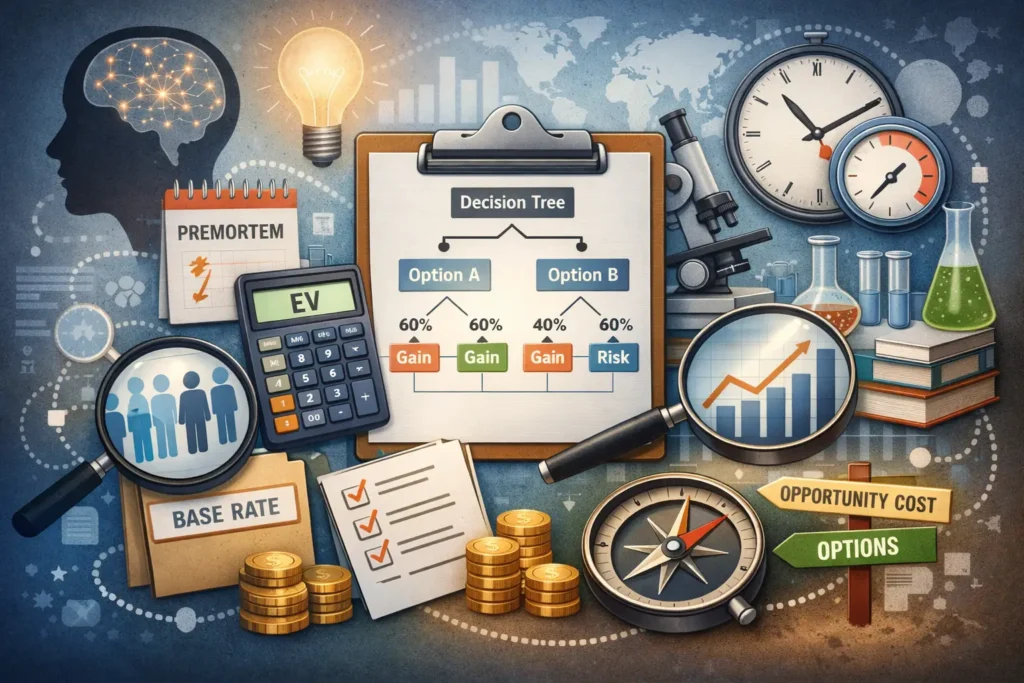
Scientific decision-making tools are evidence-based methods designed to help individuals make better decisions by reducing cognitive biases, improving forecasting, and making trade-offs more transparent. These tools rely on verified principles from fields like psychology, behavioral economics, and management. Unlike intuition or guesswork, these tools help structure the decision-making process, making it more reliable and informed.
What Are Scientific Decision-Making Tools?
Scientific decision-making tools are designed to improve decision-making by applying structured, evidence-backed methods. These tools use data, probabilities, and psychological insights to guide decision-makers through complex situations, helping them reduce bias and avoid common cognitive pitfalls. Instead of relying on gut feelings or intuition, these tools provide a systematic framework that enhances the reliability of choices, particularly in uncertain or high-stakes environments.
The Top Scientific Decision-Making Tools
Base Rate Thinking
When to apply: When you have a general probability or data on similar situations.
How it works: Helps avoid overestimating the likelihood of specific outcomes by comparing your situation with broader statistical trends.
Example: When considering whether to invest in a stock, base rate thinking encourages you to look at historical market trends, rather than focusing only on the performance of the specific stock in question.
Expected Value
When to apply: When faced with multiple possible outcomes with varying probabilities.
How it works: You calculate the potential value of each outcome and weigh them by their likelihood.
Example: In business, if the expected value of a product launch outweighs the potential risk of loss, it’s a rational decision to proceed. Research in behavioral economics shows that people often fail to use expected value correctly, overestimating small risks and underestimating larger potential benefits.
Decision Tree
When to apply: When there are multiple decision paths and you need to assess each based on probability.
How it works: You create a flowchart that breaks down each decision and its possible outcomes, helping you make an informed choice.
Example: A tech startup considering launching a new product might use a decision tree to weigh the risks of different marketing strategies based on potential market success. A study from the Journal of Business Research showed that decision trees are highly effective for visualizing complex business decisions.
Premortem
When to apply: Before making a decision in high-risk situations.
How it works: This tool helps you imagine why a project might fail and prepares you to mitigate potential problems.
Example: A project manager at a large corporation might use the premortem method before launching a new software update to identify risks such as customer dissatisfaction or technical issues, then plan contingencies accordingly.
Backcasting
When to apply: When planning for long-term goals.
How it works: Start with the desired end result and work backward to identify the steps needed to achieve it.
Example: A business aiming for $10 million in revenue by 2027 can use backcasting to determine annual revenue goals and the marketing and operational steps required to reach them. Research from Strategic Management Journal shows that companies that implement backcasting improve their long-term strategic planning.
Reversible vs Irreversible Decisions
When to apply: When decisions have lasting consequences.
How it works: Distinguish between decisions that can be undone (reversible) and those that cannot (irreversible).
Example: Deciding to sign a long-term lease for office space is irreversible, while choosing a new laptop model is reversible. This distinction can help avoid unnecessary stress in decision-making.
Opportunity Cost Framing
When to apply: When choosing between options.
How it works: This tool encourages you to consider what you’re sacrificing when choosing one option over another.
Example: Deciding whether to take on a new client at work involves weighing the time and resources required against the opportunity to work on existing clients. According to a study from the American Economic Review, opportunity cost framing improves decision quality by making trade-offs clearer.
Reference Class Forecasting
When to apply: When predicting future outcomes based on similar past situations.
How it works: You compare your current decision with similar cases and their outcomes to estimate probabilities.
Example: A construction company planning a new building project can use reference class forecasting to look at similar projects’ success rates and predict the likely outcome of their venture.
Calibration
When to apply: When you’re making subjective estimates or predictions.
How it works: Calibration helps you improve your ability to make accurate predictions by comparing past forecasts to actual outcomes.
Example: A sales manager reviewing past sales forecasts and adjusting future projections accordingly. Studies in Psychological Science show that calibration significantly improves the accuracy of expert predictions.
Checklists / Decision Criteria
When to apply: When decisions involve multiple factors.
How it works: Establish clear criteria in advance to evaluate options objectively.
Example: A hiring manager may use a checklist to evaluate candidates on key factors such as experience, cultural fit, and salary expectations. A 2020 study in Personnel Psychology confirmed that using structured criteria increases hiring success rates.
When Should You Use Scientific Decision Tools?
These tools are especially useful when:
- High stakes: Decisions involving significant resources, money, or reputation.
- Uncertainty: When the outcomes of a decision are unclear or unpredictable.
- Emotional pressure: When stress or time constraints affect your ability to think clearly.
- Multiple alternatives: When you need to weigh many options and factors simultaneously.
Mini Decision-Routing Scheme
To help you choose the right tool for your situation, here’s a simple routing guide:
- If you’re dealing with uncertainty: Use base rates + reference class forecasting.
- If you fear making a mistake: Use premortem + checklist.
- If there are many options to choose from: Use expected value + opportunity cost framing.
Limitations of Scientific Decision Tools
While these tools can significantly improve the decision-making process, they do not guarantee the best possible decision. They help increase the likelihood of making a sound decision by reducing bias and providing structure, but external factors such as incomplete data or unforeseen events can still affect outcomes. Additionally, these tools are most useful when you have access to reliable data—without it, they may not be as effective.
Conclusion
Scientific decision-making tools are practical and effective methods for navigating uncertainty and making better-informed choices. These tools help reduce bias, enhance forecasting, and make trade-offs in decision-making more transparent. While they don’t predict the future, they help improve the process of reaching the best possible decision. With the right tools, you can approach complex choices with more confidence and clarity. Research and real-world applications confirm their value, providing a solid foundation for anyone looking to improve their decision-making processes.
Frequently Asked Questions
What is a scientific decision-making tool?
Scientific decision-making tools are evidence-based methods designed to help improve decision quality by reducing cognitive biases and increasing forecasting accuracy.
When should I use a decision tree in decision-making?
Use a decision tree when you have multiple possible outcomes and want to evaluate each based on probability and impact.
What does “base rate thinking” mean in decision-making?
Base rate thinking involves using statistical data or historical trends to inform decision-making, rather than relying solely on individual cases.
How does expected value help in making decisions?
Expected value helps you evaluate options by considering both the potential benefits and their likelihood, allowing you to make a more rational choice.
What is the premortem technique for decision-making?
Premortem involves anticipating possible failures before making a decision to identify risks and plan for mitigation.