
Does a Decision Need to Be Made? Choose the Right Mode: Decide, Delay, Test, or Default
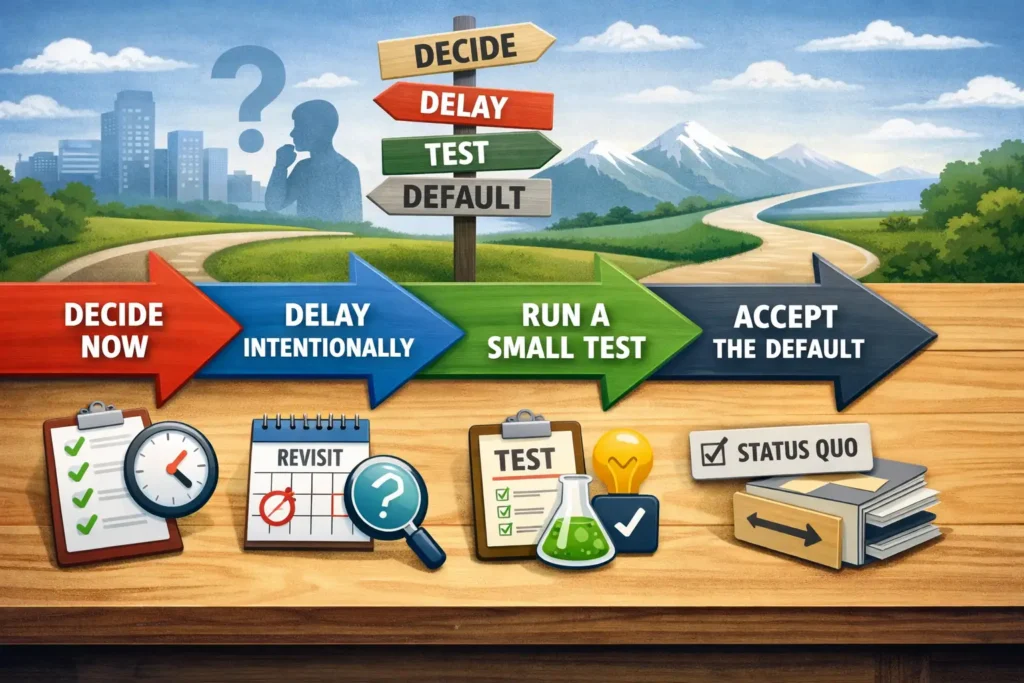
Direct answer: A decision usually needs to be made when one or more of these signals is present: a real deadline, a concrete cost of waiting, an irreversible commitment, or an external obligation (someone needs your answer, a policy applies, a contract is in play). If none apply, you may not need a final answer yet—you may only need to choose a mode: decide now, delay with a plan, run a small test, or accept the default on purpose.
- No deadline? You may not need a final decision yet.
- Reversible? Prefer a test or temporary choice.
- Waiting costs you? That’s a “decide now” signal.
- A default will happen. Choose it consciously—or change it.
- Skip perfection. Pick the next best mode.
This is about choosing a mode, not picking the “best” option.
What it Means That a Decision “Needs to Be Made”
Not every situation requires an active decision point. A decision “needs to be made” when doing nothing creates avoidable downside or quietly locks you into an outcome you don’t want.
- A real deadline exists: a date or cutoff with a concrete consequence.
- Waiting has a clear cost: money, options, time, or risk moves in a known direction.
- The next step is hard to undo: you’re about to create a commitment that’s costly or messy to reverse.
- An external obligation exists: a contract, policy, or another person is waiting on your decision.
Real vs Perceived Deadlines
A real deadline is measurable and external (renewal date, cancellation cutoff, reservation window, a manager waiting for your response). A perceived deadline is “I should decide by tonight” without a concrete consequence. If you can’t name what changes by waiting (e.g., in a week or by the cutoff), you may be dealing with perceived urgency—not an urgency fact.
The Core Move: Choose a Mode, Not an Option
When you feel stuck, the most useful next step is often choosing a mode. Modes prevent you from forcing a permanent answer when the situation doesn’t require one.
| Mode | Use when | Best next step |
|---|---|---|
| Decide now | Deadline/cost-of-waiting is concrete. | Pick a workable option and take the next step |
| Delay intentionally | No deadline + one missing piece of info. | Set a revisit date and a short info plan |
| Run a small test | Reversible step can generate feedback. | Choose a low-commitment experiment |
| Accept the default | Status quo acceptable + set a review trigger. | Choose “no change” on purpose—and monitor |
Decide Now
Use this mode when waiting has a known downside: you’ll lose an option, pay more, miss a window, or create avoidable problems by delaying.
One clean move: choose the option that meets your minimum needs, then take the next step.
Delay Intentionally (with a plan)
Use this mode when there’s no real deadline and you can name one specific thing you need to learn before deciding.
Delay template: “I’ll revisit this on [date]. Before then, I’ll learn [one specific piece of information]. If I can’t learn it, I’ll choose [test/default/decide].”
Run a Small Test
Use this mode when you can take a reversible step that creates real-world feedback without trapping you.
One clean move: pick the smallest action that produces new information with low commitment.
Accept the Default (Consciously)
Use this mode when “no change” is reasonable for now. The default isn’t “doing nothing”—it’s choosing the status quo as your current path.
One clean move: set a review trigger (a date, a signal, or a threshold) so the default stays intentional.
Quick Check: Are You Forcing a “False Decision”?
Sometimes the pressure to decide is real. Sometimes it’s pressure without a concrete consequence. These markers suggest you may be forcing a decision before it’s needed.
If you recognize these, you likely don’t need a better argument—you need a better mode (delay with a plan, test, or default).
Reversible vs Irreversible: How Much Pressure to Apply
Some choices are easy to undo. Others aren’t. The more reversible a decision is, the less useful it is to demand certainty before moving.
- Reversible (two-way door): you can switch back with manageable cost. These often fit test or a temporary choice.
- Hard to reverse (one-way door): reversing is expensive, messy, or creates long-term consequences. These often fit delay intentionally (gather key info) or decide now if the deadline is real.
Rule of thumb: if you can reverse course without major damage—often within days or weeks—treat it as reversible. This is a guideline, not a guarantee.
Mini-Checklist: Does This Decision Need to Be Made?
- Is there a real deadline with a concrete consequence?
- What does waiting cost me (money, time, options, risk)?
- Is this reversible, or does it lock me in?
- Can I test a smaller step instead of committing?
- What is the default if I do nothing?
- What one specific piece of info would change my mode or choice?
- Is there an external obligation (contract, policy, other people waiting)?
A Tiny Decision Path: Pick Your Mode Fast
- Deadline: If the deadline or cost of waiting is concrete, choose Decide now.
- Reversibility: If a reversible step can teach you something, choose Run a small test.
- If neither applies: choose Delay intentionally (with one info goal) or Accept the default (with a review trigger).
Small test ideas (pick one)
- Use a free trial or a one-month plan instead of annual.
- Choose a refundable option (or a clear return window) to reduce lock-in.
- Do a single session or short intro before a long commitment.
- Set a rule: “Try it for 14 days, then reassess.”
Three Quick Examples: Choose the Mode
Example 1: Subscription Upgrade
Situation: You’re considering upgrading to a paid plan “to finally commit.”
Signals: No real deadline; reversible; you want closure more than you need features right now.
Mode: Run a small test.
Next step: Try one month (not annual), then reassess on a set date.
Example 2: Job Switch
Situation: You have a job offer, but you’re unsure whether to take it.
Signals: A deadline may exist, and resigning can be an irreversible step.
Mode: Delay intentionally (one info goal) or Decide now (if the deadline is close).
Next step: Get one missing data point before the deadline; otherwise decide on the next irreversible step.
Example 3: A Hard Conversation
Situation: You need to address a recurring issue with someone, but you’re unsure how it will go.
Signals: No formal deadline, but waiting has a cost; the first step is usually reversible.
Mode: Run a small test or Accept the default.
Next step: Try a short version of the conversation, or set a review trigger for staying with the default.
When Not to Use This (High-Stakes Red Flags)
This guide is for everyday decisions and decision timing. For high-stakes choices, slow down and get qualified support.
- Legal/contract decisions: consult a qualified professional if terms or liability matter.
- Major financial commitments: large debt, high-risk investments, or obligations you can’t absorb.
- Medical decisions: diagnosis, treatment, medication changes—use clinician guidance.
- Personal safety concerns: coercion, threats, or situations where safety is uncertain.
If you feel at risk of harm, seek immediate local help.
What This Article Is (and Isn’t)
What this is: a practical way to check whether a decision needs to be made and to choose a mode: decide, delay, test, or default.
What this isn’t: a full decision-making system, a long list of decision questions, a tool roundup, a scientific method guide, or a journaling/self-reflection deep dive.
Frequently Asked Questions
Do I need to decide right now?
You usually need to decide now only if a deadline is real, waiting has a concrete cost, the next step becomes hard to undo, or someone is waiting on your answer. If none apply, choose a mode like delay with a plan, a small test, or an intentional default.
What if there’s no deadline?
No deadline often means you don’t need a final decision yet. Delay intentionally (with a revisit date and one info goal) or run a small test that creates real feedback.
Is not deciding still a decision?
Often, yes—because the default outcome happens either way. The goal isn’t to avoid defaults; it’s to choose them consciously when they’re acceptable and set a review trigger.
How do I tell intentional delay from open-ended delay?
Intentional delay is time-bound and plan-based: you set a revisit date and name one thing you’re learning. Open-ended delay has no revisit point and produces no new information—so you stay in the same loop.