
5 Minute Journaling: A Simple 5-Minute Daily Template (With Examples)
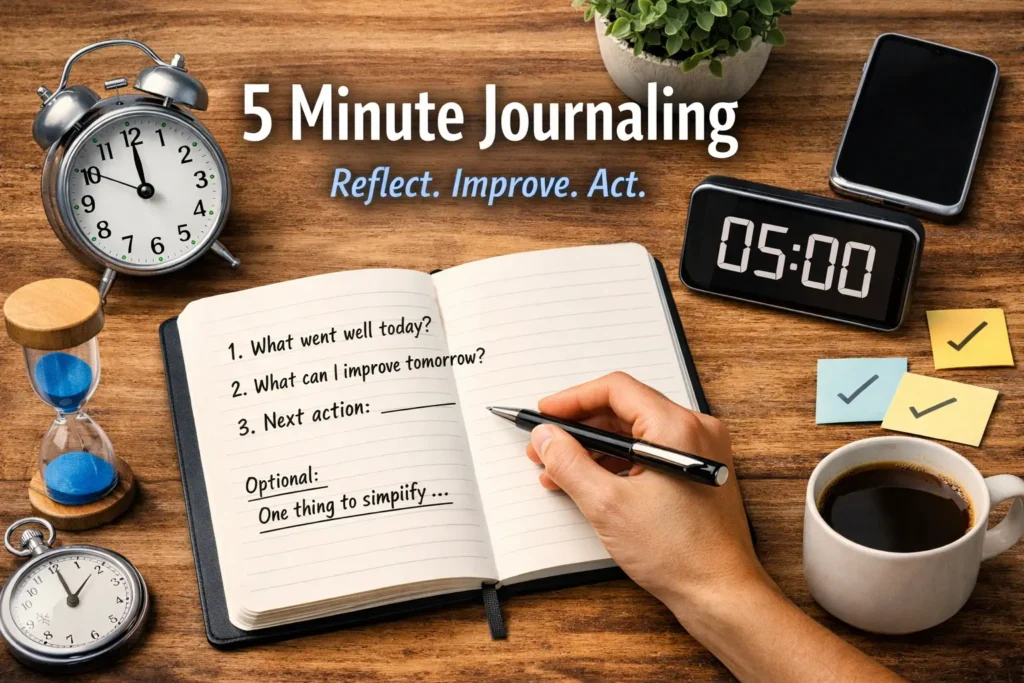
Direct answer: 5 minute journaling is a time-boxed daily writing habit where you answer a few focused prompts in five minutes. The goal is practical clarity—capture what inspired you (or what went well), what to improve, and one next step—without turning journaling into a long reflection session.
- Set a 5-minute timer. Stop when time’s up.
- Answer 3 prompts, then pick 1 next action. Keep it short, specific, and doable.
What Is 5 Minute Journaling?
5 minute journaling is a short, structured daily check-in you can finish in five minutes. You’re not trying to capture everything or write a long story. You’re using a simple template to notice what’s working, make one small adjustment, and choose one clear action for the next day.
Think of it as a quick reset you can repeat—even on busy days.
Who This Works For
- People who want a journaling habit that fits into a tight schedule
- Anyone who prefers structured prompts over a blank page
- Readers who want journaling to end with an action step
- Those who want a simple way to track small wins and improvements
The Core 5 Minute Journaling Template
Use the same 5 minute journaling template daily for 7–14 days. Consistency beats variety.
Prompt 1: What inspired me today (or what went well)?
Write 1–3 bullets. Keep them specific and observable.
Prompt 2: What could I improve tomorrow?
Write 1 bullet. Make it constructive, not self-critical. Focus on behavior, not personality.
Prompt 3: What’s one task I can do today to move forward?
Write 1 action that is small, clear, and doable.
Optional (only if time remains): One thing to simplify tomorrow
Write 1 thing to remove, reduce, or make easier.
How to Do It in Exactly 5 Minutes
- Set a timer for 5:00.
- Answer the 3 prompts with bullets. One short line per bullet.
- Make your next action tiny. If it’s not startable, shrink it.
- Stop when time’s up. If needed, jot one last bullet.
Non-negotiable rule: protect the five-minute boundary. That’s what makes the habit sustainable.
Examples
Example 1: Busy day with scattered attention
- Inspired / went well: Took a 10-minute walk. Ate a real lunch. Finished one important errand.
- Improve tomorrow: Put my phone in another room for the first hour.
- One task: Write a 3-item priority list before opening apps.
Tomorrow’s focus: One boundary (phone) + one simple plan (3 priorities).
Example 2: Low energy and procrastination
- Inspired / went well: I started, even if late. I drank water. I did one small household task.
- Improve tomorrow: Start with a 2-minute version instead of waiting to feel ready.
- One task: Set a timer for 2 minutes and do the first step only.
Tomorrow’s focus: Make starting easy enough to happen.
Example 3: Workday overload (meetings, distractions, priorities)
- Inspired / went well: Finished one key deliverable. Kept two meetings from derailing the day.
- Improve tomorrow: Block one 30-minute focus window and decline one non-essential meeting.
- One task: Write tomorrow’s top 1 priority and the first step before logging off.
Tomorrow’s focus: Protect one focus block and start with the top priority.
Why Daily Quick Notes Can Help
For many people, a short daily check-in can help because it:
- Creates closure: you name what’s working and move on.
- Makes the next step obvious: you pick one action instead of carrying everything mentally.
- Reduces open loops: tomorrow starts with one clear priority, not a vague pile of intentions.
Some people find it may help them feel less stressed simply by getting thoughts out of their head and onto paper. It can also increase day-to-day awareness of what’s working—because you’re forced to name it clearly.
How to evaluate it: After 7 days, check whether you’re starting tasks faster, forgetting fewer priorities, and feeling less mentally loaded because your next step is written down.
Tips to Make 5 Minute Journaling Effective
- Write in bullets. Paragraphs usually mean you’re drifting.
- Stay behavior-based. “Prep my water bottle tonight,” not “be healthier.”
- Keep the improve prompt gentle. It’s a tweak, not a verdict.
- Pick a consistent time. Morning for direction, evening for closure, or split (2 + 3 minutes).
- Reduce friction. Keep your notebook or notes app easy to reach.
- Restart, don’t backfill. Missed a day? Just write today.
Common Mistakes (and Quick Fixes)
- Mistake: It turns into a long session. Fix: Use a timer and stop at 5 minutes.
- Mistake: “Improve” becomes self-criticism. Fix: Rewrite as “Next time, I’ll try…”
- Mistake: The next action is too big. Fix: Shrink it to a 2-minute first step.
- Mistake: I forget to do it. Fix: Attach it to an existing habit (coffee, brushing teeth).
When Not to Use This (Safety)
Important: 5 minute journaling is a self-help habit, not a substitute for professional support. If writing consistently makes you feel worse, it’s okay to stop.
Red flags (pause or change the approach)
- You feel worse after writing (more anxious or upset)
- Your notes turn into rumination or harsh self-judgment
- You can’t stay safe or have thoughts of self-harm
What to do
- Pause for a day or two. Don’t force the habit.
- Switch to factual logging (sleep, meals, tasks completed).
- If you’re in immediate danger, contact local emergency services.
5 Minute Journaling Checklist
Do
- Set a 5-minute timer
- Write bullets and keep them specific
- Choose one next action you can start easily
- Use the same 5 minute journaling prompts for at least 7–14 days
Don’t
- Turn it into a long reflection session
- Use the “improve” prompt to attack yourself
- Backfill missed days like homework
- Make your next action vague or unrealistic
Copy-Paste 5 Minute Journaling Template
Copy this into Notes/Google Docs (or bookmark this page) so you can reuse the same prompts daily.
- What inspired me today (or what went well)? (1–3 bullets)
- What could I improve tomorrow? (1 bullet, constructive)
- What’s one task I can do today to move forward? (1 clear action)
- Optional (only if time remains): One thing to simplify tomorrow (1 line)
5 Minute Journaling — Print-Friendly One-Page Template
- What inspired me today (or what went well)? (1–3 bullets)
- What could I improve tomorrow? (1 bullet, constructive)
- What’s one task I can do today to move forward? (1 clear action)
Frequently Asked Questions
What should I write in a 5 minute journal?
Use the same three prompts every day: what inspired you (or what went well), what to improve, and one next action. Bullets are enough—aim for clarity, not completeness.
Can I use this as a 5 minute journal template?
Yes. Use the copy-paste section in the article and repeat the same prompts daily for 7–14 days. This is a minimal 3-prompt template, not a long prompt list. If you want a long prompt list, this page isn’t that.
Is this the same as The Five Minute Journal?
No. This is a general 5 minute journaling routine anyone can use. It’s not tied to any specific branded journal or product.
How do I keep it from turning into overthinking?
Protect the five-minute limit, write bullets only, and keep your “improve” prompt behavior-based. If you notice spiraling, switch to factual logging or pause the practice.
Should I do it in the morning or evening?
Morning is best if you want direction; evening is best if you want closure. If consistency is your biggest issue, split it into 2 minutes in the morning and 3 minutes at night.
Do I need a specific journal?
No. Any notebook or notes app works. Choose the option that reduces friction and feels private enough for daily use.
What if journaling makes me feel worse?
Pause and don’t force it. If writing reliably increases distress or rumination, switch to factual logging—and if you can’t stay safe, contact local emergency services.