
How to Improve Personal Growth (A Simple 30-Day System)
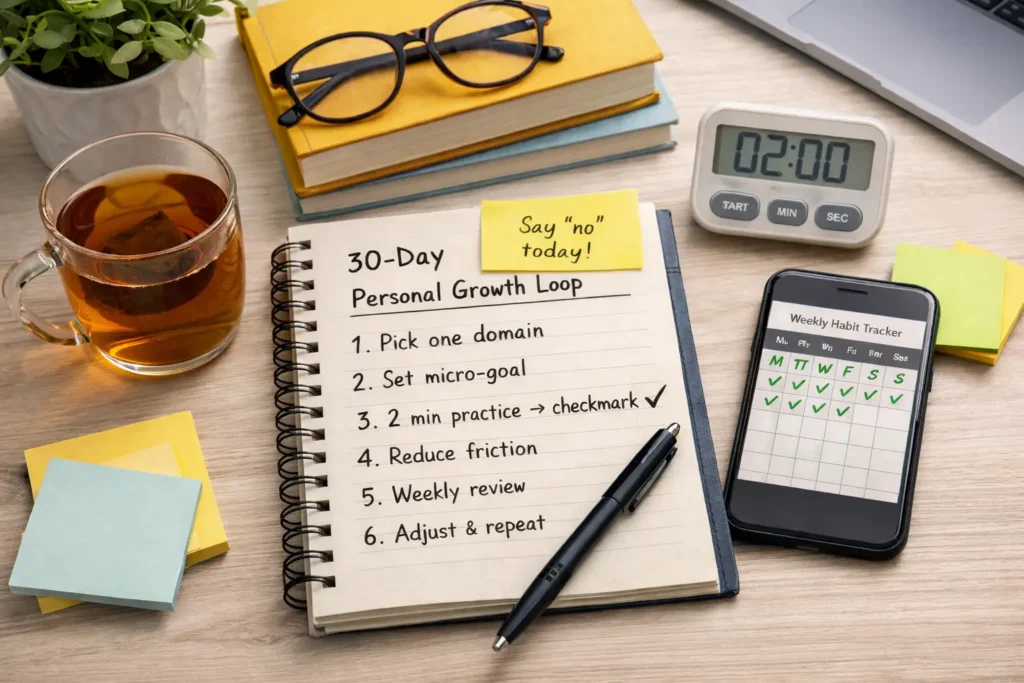
Direct answer: To improve personal growth, treat it like a repeatable loop: choose one domain, set one measurable micro-goal, practice it in a tiny daily routine, reduce friction, review once a week, then adjust and repeat. Small, consistent experiments create steady progress without needing a “new you” or a perfect plan.
If you want a simple system (not a list of 50 tips), use this 30-day loop. This page gives you a repeatable loop you can reuse for any domain.
- Pick one domain for 30 days.
- Write one measurable “I will…” micro-goal.
- Practice 2–10 minutes using a reliable cue.
- Reduce friction so starting is easy.
- Review weekly, change one variable, repeat.
What “personal growth” means here (quickly)
In this guide, personal growth means improving specific life domains through behaviors and skills—like habits, learning, communication clarity, and boundaries. It can also include emotional skills, but we’ll keep the focus on practical actions you can repeat: one domain at a time, one small goal, one simple loop.
What this guide is (and isn’t)
- Is: a simple system to build follow-through through small experiments.
- Is: focused on consistency, feedback, and making practice easier to start.
- Isn’t: a “meaning of life” discussion or a purpose-finding method.
- Isn’t: a journaling program or prompt list.
- Isn’t: a decision-making toolkit with frameworks and matrices.
- Isn’t: therapy or healing advice.
The 6-step loop to improve personal growth (core framework)
Step 1 — Pick one domain (30 days)
Choose a single area to focus on for the next month. One domain beats “everything at once” because it keeps your effort measurable and realistic.
- Boundaries: saying no, protecting time, limiting interruptions
- Habits: consistency, routines, follow-through
- Learning: building a skill with steady practice
- Communication: clear requests, clarity, fewer misunderstandings
Rule: If you can’t measure progress weekly, the domain is too broad.
Step 2 — Define one measurable micro-outcome
Write one micro-goal in a format you can actually complete. Keep it concrete and small.
Micro-goal formula: I will [tiny action] for [X minutes / X times] on [days per week].
- Good: “I will practice Spanish for 10 minutes, 4 days a week.”
- Too vague: “I will be more disciplined.”
Step 3 — Build a tiny practice loop (2–10 minutes)
Turn your micro-goal into a loop you can start quickly:
- Cue: a reliable trigger (after breakfast, after brushing teeth)
- Action: 2–10 minutes of practice
- Mark done: a simple checkmark or mental “done”
Start-only rule: on low-energy days, you only have to start for 2 minutes. Finishing is optional.
Step 4 — Reduce friction (environment design)
Make the right action easier and the wrong action harder. This is often more reliable than relying on motivation alone.
- Prep the first step (open the book, set the mat, place materials out).
- Remove common barriers (extra clicks, clutter, missing supplies).
- Use a visible reminder (leave it where you’ll see it).
- Lower the start cost (shorter session, simpler setup).
- Make distractions less convenient (move them out of reach).
Step 5 — Feedback (5-minute weekly check-in)
Once a week, do a short review. Keep it light and practical—no deep analysis.
- What worked? (one sentence)
- What got in the way? (one sentence)
- One tweak for next week: change a single variable
Step 6 — Adjust + scale
Use your weekly feedback to choose one next move:
- If you’re consistent: scale slightly (add 2 minutes, add 1 day).
- If you’re inconsistent: shrink the goal, change the cue, or reduce friction.
- If you’re bored: keep the domain, swap the practice method.
- After 30 days: continue, or pick a new domain.
Why this loop works (in one minute)
- Cues can help you start: tying an action to a reliable moment (“after breakfast”) often makes practice more consistent than waiting for motivation.
- If-then plans can reduce friction: “If it’s after coffee, then I do 2 minutes” can remove a lot of in-the-moment negotiating.
- Repetition can make starting feel easier: repeating a tiny action in a stable context often helps the start become more automatic over time.
- Weekly feedback can prevent all-or-nothing quitting: you adjust one variable instead of overhauling everything.
- Small reps can compound: tiny sessions can add up to skill and follow-through without pressure.
Week 1–4 (a simple 30-day plan)
- Week 1: Pick one domain and make your micro-goal very small. Your only target is showing up consistently.
- Week 2: Reduce friction: remove one barrier and add one reminder. Keep the goal the same.
- Week 3: If you’re consistent, scale slightly (+2 minutes or +1 day). If not, shrink and simplify.
- Week 4: Stabilize the loop. Keep it easy to start, review weekly, and decide whether to repeat the domain or switch.
High-leverage levers (what moves growth fastest)
- Consistency usually beats intensity for long-term change: steady reps beat occasional “big pushes.”
- Skill-building usually beats waiting for inspiration: practice tends to create momentum.
- Environment often beats willpower for consistency: design your defaults.
- Social feedback helps: one trusted person can keep you honest (no coaching required).
Micro-goal examples by domain (mobile-friendly)
Choose one domain and one goal small enough to repeat. Use these as templates, not a giant menu.
Boundaries
Micro-goal: Say one clear “no” per week without over-explaining.
Tiny loop: Sun evening → review invitations → send one short reply.
Micro-goal: Check messages only at two set times daily.
Tiny loop: After lunch → 5 minutes messages → stop when timer ends.
Learning
Micro-goal: Practice one skill for 20 minutes, 3×/week.
Tiny loop: After breakfast → 10 minutes → optional extra 10.
Micro-goal: Do one “micro-lesson” (10 minutes), 4×/week.
Tiny loop: After coffee → open lesson → complete first exercise.
Habits
Micro-goal: Use the “start-only” rule: 2 minutes daily.
Tiny loop: After brushing teeth → start task for 2 minutes.
Micro-goal: Do a 5-minute reset (tidy one surface), 5×/week.
Tiny loop: Before dinner → clear one counter → done.
Communication
Micro-goal: Make one clear request per week (one sentence).
Tiny loop: Mon morning → write request → deliver it same day.
Micro-goal: Confirm one detail instead of assuming, 3×/week.
Tiny loop: When unsure → ask one clarifying question → proceed.
Two mini-cases (question → approach → safe conclusion)
Case 1 (Habits): “I waste time scrolling and feel scattered.”
Approach: Choose the habits domain for 30 days. Micro-goal: “I will keep scrolling to two set windows daily.” Tiny loop: after lunch → 5 minutes messages → stop when timer ends. Reduce friction: move distracting apps off your home screen.
Safe conclusion: Progress can look like higher consistency and “it felt easier to stop” over time—not perfection and not zero scrolling.
Case 2 (Learning): “I want to learn a skill, but I quit after a week.”
Approach: Choose the learning domain for 30 days. Micro-goal: “I will practice for 10 minutes, 4 days a week.” Tiny loop: after breakfast → open the lesson → complete the first exercise. Reduce friction: keep materials ready and visible.
Safe conclusion: You’re “improving” when you show up more reliably and the start feels simpler—not when you feel motivated every time.
How to track progress without perfectionism
Keep tracking simple. You’re measuring follow-through and ease, not chasing an ideal version of yourself.
- Metric 1: Frequency — How many planned sessions did you complete?
- Metric 2: “Felt easier?” — Yes / No (or 1–5) at weekly review.
Weekly review (5 minutes): look at your frequency, answer “felt easier?”, and choose one tweak for next week.
Common mistakes (and quick fixes)
- Too many goals at once. Fix: pick one domain for 30 days.
- Goals too abstract (“be better”). Fix: rewrite as “I will…” + frequency.
- Expecting fast transformation. Fix: measure reps and ease, not hype.
- Comparing yourself to others. Fix: compare to your own baseline week-to-week.
- Perfect plan, little practice. Fix: cut the plan and run a simple 7-day trial of the smallest version.
Troubleshooting (quick fixes)
Pick the closest problem and apply one adjustment for the next 7 days. Change only one variable at a time.
Problem: I keep forgetting.
Fix: Attach the action to an existing routine (for example: after breakfast).
Problem: I avoid starting.
Fix: Use the 2-minute start-only rule for the next week.
Problem: Setup feels annoying.
Fix: Prep the first step the night before (materials out, page open, tab ready).
Problem: I’m consistent but bored.
Fix: Swap the practice method but keep the same domain.
Problem: I miss a week and quit.
Fix: Restart with the smallest version the very next day.
30-day setup checklist (printable in your head)
- Choose one domain for the next 30 days.
- Write one micro-goal in “I will…” format.
- Pick a cue you already do most days.
- Define a 2–10 minute action (start-only version included).
- Remove one barrier and add one reminder.
- Schedule a weekly 5-minute check-in (same day each week).
- At week’s end, change one variable—only one.
When not to use this (safety + red flags)
This guide is for everyday improvement. Don’t use it as a substitute for professional help when the stakes are high.
- If you’re in crisis, feel unsafe, or your distress is intense or persistent, seek professional support.
- If the issue is medical, legal, or financial, use appropriate licensed support.
Red flags to avoid (rewrite if you catch these):
- “If you’re not growing, you’re failing.”
- “This will transform your life in 7 days.”
- “You must optimize everything.”
- “Personal growth should be your main purpose.”
If you notice pressure building: shrink the goal, lower the stakes, and return to one repeatable loop.
Mini glossary
- Domain: one area you’re improving (habits, learning, boundaries, communication).
- Micro-goal: a small, measurable outcome you can repeat weekly.
- Tiny loop: cue → small action → done.
Frequently Asked Questions
What’s the first step to improve personal growth?
Pick one domain to focus on for 30 days (boundaries, habits, learning, or communication). Then choose a micro-goal you can measure weekly—trying to improve everything at once usually kills consistency.
What are realistic personal growth goals for 30 days?
Realistic goals are small, measurable, and repeatable, such as: “10 minutes, 4 days/week” or “one clear request per week.” A good goal feels slightly challenging but easy to start most days; if you keep skipping, it’s too big or too vague.
How do I stay consistent when motivation drops?
Use a cue-based loop plus a 2-minute start-only version. When motivation is low, your job is to start for two minutes, not to do a perfect session. Then reduce friction so starting takes less effort (prep the first step, remove setup hassles).
How do I track personal growth progress simply?
Track just two things: (1) Frequency (how many planned sessions you did) and (2) “Felt easier?” (yes/no or 1–5). Review once a week for five minutes and change one variable (cue, size of goal, or friction).
What if I keep falling off—do I restart?
Don’t do a dramatic restart—do a smaller next step. Resume the very next day with the smallest version (2 minutes), then adjust one thing: strengthen the cue, shrink the goal, or reduce friction. The goal is continuity, not a perfect streak.