
Journaling vs Bullet Journaling: What’s the Difference (and Which Fits Your Goal)?
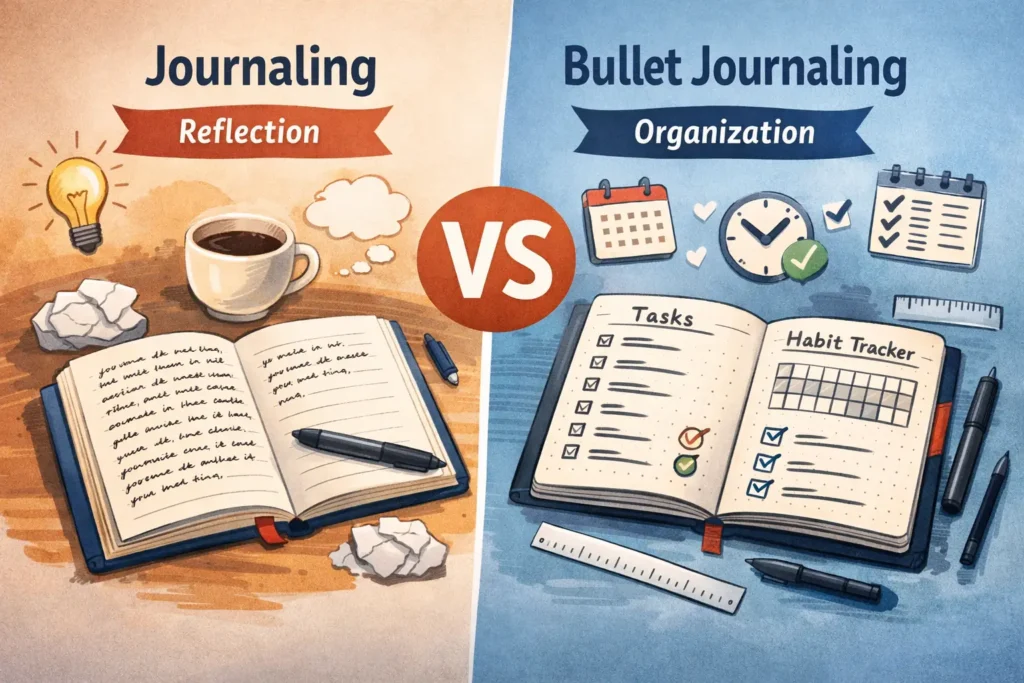
Direct answer: Journaling is free-form writing that helps you explore thoughts, feelings, and ideas—often in paragraphs or full sentences. Bullet journaling is a structured system that uses short bullet entries, logs, and simple symbols to plan, organize, and track what you’re doing.
This guide compares journaling vs bullet journaling by purpose, structure, and best use cases.
- Journaling is open-ended; bullet journaling is structured.
- Pick journaling for reflection/clarity; pick bullet journaling for organization/tracking.
- Bullet journaling doesn’t require art or fancy layouts.
- You can use both—kept as separate sections, not a hybrid system.
The core difference: reflection vs organization
Both formats involve writing in a notebook, but they serve different functions. Journaling is designed for exploring what’s on your mind—usually in longer, narrative form. Bullet journaling is designed for capturing and managing information quickly—often with short lines, symbols, and simple logs you can scan at a glance.
If you’re deciding between them, focus on function: Do you want to think something through, or do you want to keep track of something?
What is journaling?
Journaling is free-form writing where you put thoughts, feelings, and ideas into words. It doesn’t require a set structure, and it’s often written in paragraphs or full sentences. You can journal daily, weekly, or only when you feel the need.
What a journaling entry can look like
I’ve been feeling tense today, and I’m not sure what’s driving it. A few things happened back-to-back, and I want to sort out what matters most so I can see it more clearly and choose my next step.
This kind of entry is about exploring your experience in your own words—without forcing it into a checklist.
What is bullet journaling?
Bullet journaling is a structured method of planning and tracking. Instead of writing long paragraphs, you capture information in short bullet lines you can review quickly.
Rapid logging means capturing tasks, events, and notes in short, scannable lines.
Most bullet journals use a few basic building blocks: an index (so you can find pages later), logs (time-based lists for planning), and rapid bullet entries (short notes for tasks, events, and ideas). Many people also use simple signifiers—for example: • task, ○ event, – note—to make entries easy to scan.
What a bullet journaling entry can look like
• Pay utility bill
• Draft project outline
• Grocery run
• 20-minute walk
– Note: reschedule dentist appointment
The point is quick capture and quick review—so you can see what matters without rereading pages of text.
Side-by-side comparison
If you only read one section, read this. It’s the fastest way to see which format matches your goal.
| Criteria | Journaling | Bullet Journaling |
|---|---|---|
| Goal | Reflection / clarity | Organization |
| Format | Free-form text | Structure and symbols |
| Emotions | Often yes | Not required |
| Planning | Rarely | Yes |
| Measurability | Low | High |
Pros & limits (neutral)
- Journaling: richer detail, but harder to scan later.
- Bullet journaling: easy to review, but requires consistent shorthand.
- Journaling: flexible, but less measurable.
- Bullet journaling: measurable, but tracking can add overhead.
- Journaling: narrative pages are great for context, but less “at-a-glance.”
- Bullet journaling: can stay minimal, but still involves some setup (pages, headings, and a few recurring lists).
When journaling fits better
Journaling tends to fit best when your goal is to explore what you think or feel, rather than manage a planning system.
Common real-life uses include processing a conversation, capturing ideas, or untangling a situation in your own words.
- Capturing feelings and thoughts in your own words
- Understanding a situation or reaction
- Exploring ideas without needing a structure
- Getting ideas out of your head and onto the page
When bullet journaling fits better
Bullet journaling tends to fit best when your goal is to organize, track, and review.
Common real-life uses include a weekly task list, project milestones, habit streaks, and recurring chores.
- Managing tasks and deadlines
- Tracking habits or recurring responsibilities
- Keeping long-term projects visible
- Turning scattered responsibilities into a clear, reviewable list
It can stay very simple: a few lists and short bullets are enough for most people.
Can you combine them?
Yes—without building a hybrid system.
- Use bullet journaling for structure: short bullets, lists, logs, trackers.
- Use journaling for depth: longer entries when you need them.
- Keep them separate: different sections (or different notebooks) so each format stays clear.
Quick pick: which one should you use?
- Need to think through feelings or ideas? Choose journaling.
- Need to track tasks, habits, or projects? Choose bullet journaling.
Common misconceptions (and what’s actually true)
- Myth: Bullet journaling is only for artistic people. Reality: Minimal bullet lists work.
- Myth: Journaling has to be daily to “count.” Reality: It can be occasional.
- Myth: Bullet journaling replaces journaling. Reality: Different goals, different formats.
Frequently Asked Questions
What’s the main difference between journaling and bullet journaling?
Journaling is free-form writing, often in full sentences. Bullet journaling is a structured method that uses short bullets, logs, and symbols to plan and track. The best fit depends on whether you want reflection/clarity or organization.
Is bullet journaling the same as journaling?
No. Bullet journaling focuses on structure and reviewability, while journaling focuses on open-ended exploration. They can overlap, but their default formats are different.
Do you need to be artistic to bullet journal?
No. A functional bullet journal can be plain text: a few simple bullets, an index, and basic logs. Decoration is optional.
Can a bullet journal include long-form writing?
Yes, but it usually works best as an occasional page or a separate section. Bullet journaling is built around short entries you can scan.
Can you do both journaling and bullet journaling?
Yes. Use bullet journaling for structure and journaling for depth, and keep them separated so each format stays easy to maintain.
Is a bullet journal just a planner?
It can function like one, but it’s more flexible because you create the structure yourself. A planner is typically pre-formatted; a bullet journal is user-formatted.
How much time do you need for each?
Journaling can be short or long depending on what you need. Bullet journaling depends on how much you choose to track—keeping it minimal is usually faster.
Can journaling be just a few lines?
Yes. Journaling doesn’t have to be long. It can be a short paragraph or a few lines—as long as it’s free-form writing rather than a structured list.
Is bullet journaling still bullet journaling without trackers?
Yes. Trackers are optional. Short bullet entries, simple logs, and an index (if you want it) are enough for a functional bullet journal.
Can I keep them in one notebook?
Yes. The simplest approach is to keep separate sections: one for bullet-style planning/tracking and one for long-form journaling.