
How Manifestation Communities Create Shared Beliefs and Rituals
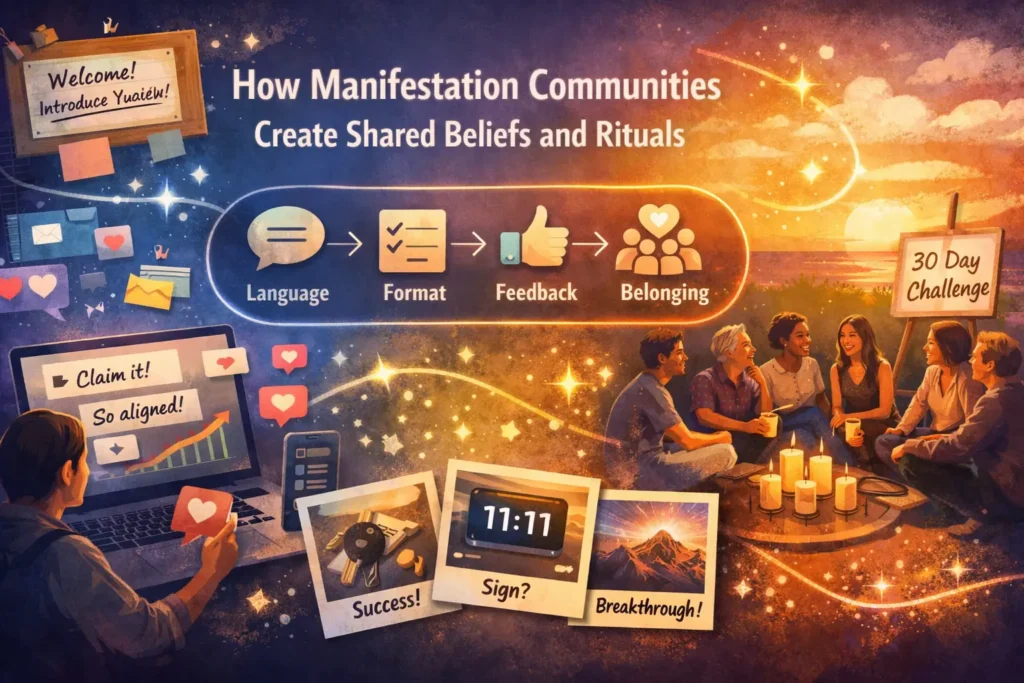
Manifestation communities build shared beliefs through repeated language, visible success stories, and recurring participation formats that make a group narrative feel normal to repeat. Across chats, forums, masterminds, and meetups, the same phrases, post structures, and feedback loops turn loose ideas into repeatable group norms.
Language → Format → Feedback → Belonging
What manifestation communities are
Manifestation communities are group spaces organized around manifestation ideas, shared wording, and recurring ways of participating. They can take shape as online groups, closed chats, forums, masterminds, recurring video calls, and offline meetups.
What makes them communities is repetition. The same kinds of posts appear again and again, the same phrases circulate, and members learn what the group notices, rewards, and repeats.
How shared beliefs start to form
Shared beliefs usually do not form through formal argument. They form when members encounter the same language, the same story patterns, and the same public reactions often enough that a common frame starts to feel normal.
A shared vocabulary does much of the work. Phrases such as speak it into existence, aligned action, or raise your vibration give members a ready-made way to describe events. Once those phrases circulate often enough, they stop sounding unusual and start functioning as the default language of the group.
Success stories reinforce that language. Repeated posts about “wins,” signs, breakthroughs, or timely outcomes act as public models for interpretation. They show members which events are most likely to be treated as meaningful and how those events are usually framed.
That is how beliefs become shared at the group level: the community keeps naming experience in the same way until that pattern feels obvious from the inside.
How repeated actions become ritual-like patterns
Here, ritual means a repeated social pattern, not a religious rite. Manifestation communities often stabilize around recurring practices that make participation easier to recognize and easier to repeat.
- Pinned welcome prompts that show new members how to introduce themselves
- Daily affirmation threads with short, repeated post formats
- Recurring “win” posts that collect the same kinds of replies
- Recognizable update templates for signs, shifts, or progress
- Standard comment language under visible successes
- Weekly challenge formats with the same reporting structure
These patterns do more than organize activity. They standardize participation. Members do not need to invent a format each time they show up because the group already supplies one.
| Community format | Visible signal | What it reinforces |
|---|---|---|
| Pinned welcome prompt | New members introduce themselves in a familiar way | Shared entry rules |
| Daily affirmation thread | Short repeated posts in the same style | Shared rhythm |
| Win-sharing post | Fast engagement and recognizable praise | A common narrative of progress |
| Standard reply language | Comments repeat the same encouragement scripts | In-group recognition |
Once those routines are in place, the group stops feeling loose and starts feeling structured. The structure matters because it gives members a repeatable social format for repeating the same beliefs.
How the setting changes the same mechanism
Online groups reinforce beliefs through speed, visibility, and repeated prompts. Members can see wins, affirmations, and challenge updates all day long. What gets quick engagement becomes a norming signal: people notice which phrasing, tone, and story shape receive immediate recognition, then adjust their own posts to match.
Offline spaces reinforce the same pattern differently. Repeated opening rounds, familiar check-in questions, and recognizable closing phrases give the group a physical routine. Those moments tend to stay with people because they happen in shared time and space rather than as scattered posts in a feed.
The mechanism is the same in both settings. Online spaces scale repetition quickly. Offline spaces anchor repetition through embodied routine and memory.
How belonging keeps the pattern stable
Belonging helps the pattern hold. A manifestation community becomes easier to return to when members feel that people here already understand the frame. They do not need to explain every phrase, justify every interpretation, or translate their update into outside language before posting.
That lowers friction, but it also does something more basic: it reduces the sense of isolation that can come from feeling out of step with other spaces. Inside the group, members know what kind of post makes sense, what kind of reply is likely to follow, and what counts as a recognizable “win,” sign, or shift.
That is why participation lasts. Members are not only attached to the topic. They are attached to a setting where the language, recognition, and response pattern are already in place.
How group storytelling shapes what feels normal
Communities do not just repeat ideas. They repeat story shapes. In manifestation spaces, the most visible stories often follow a familiar sequence: intention, sign, confirmation, outcome. Those stories travel well because they are concise, emotionally clear, and easy for others to echo.
This creates a visible imbalance. Public wins are easier to post than mixed results. Clean narratives are easier to reward than uncertainty. Over time, members do not simply see those stories more often. They learn that these are the stories most likely to count as meaningful inside the group.
That is how a shared narrative stabilizes: the group keeps circulating the examples that best fit its own language and formats.
What this looks like in practice
Imagine a new member joining a 30-day manifestation challenge in a private group. The welcome post tells them how to introduce themselves. The daily thread shows short affirmation-style updates. Win posts collect fast replies such as “claim it,” “so aligned,” or “it’s already unfolding.” Within a day or two, the member can already see the house style.
At first, they post a neutral update: they had an ordinary conversation, felt slightly encouraged, and are not sure it means anything. The replies push the update toward the group frame. Commenters single out the “sign,” call the timing meaningful, and mirror back the community’s usual vocabulary.
The next update looks different. The member adopts the same wording, shapes the story into a clearer pattern, and highlights the part of the experience that best fits the group’s logic. That shift shows the mechanism at work: the community supplies the language, the format, and the feedback that turn loose impressions into shared norms.
The key limitation
A strong community can make ideas feel coherent, memorable, and socially reinforced. It cannot, by itself, make those ideas objectively true. Group repetition can strengthen confidence, belonging, and narrative stability, but collective agreement is not the same as verification.
This matters because the same mechanism is not unique to manifestation. Any idea becomes easier to sustain when a group gives it shared language, repeated formats, visible examples, and a stable pattern of recognition.
Frequently Asked Questions
What is a manifestation community?
A manifestation community is a group space where people discuss manifestation through shared language, repeated routines, and familiar story patterns. It can exist in chats, forums, masterminds, video groups, or offline meetups.
How do manifestation communities create shared beliefs?
They create them through repeated language, visible success stories, recurring participation formats, and recognizable feedback. Over time, those patterns teach members how to describe experience in ways the group already understands and rewards.