Why Tarot Readings Often Use Symbolic Language Instead of Direct Answers
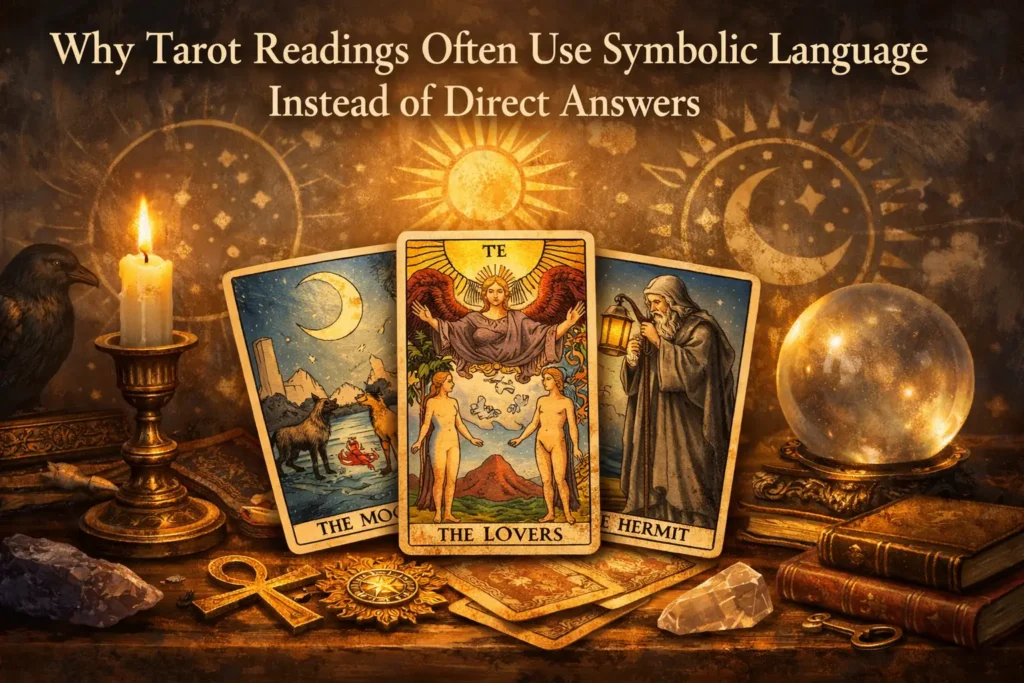
Tarot readings often use symbolic language instead of direct answers because tarot cards are built around scenes, motifs, and metaphorical imagery rather than literal statements. Because of that, readings usually describe themes, movement, and possible direction instead of reducing a situation to one fixed claim. This indirect style reflects the way tarot presents meaning from the start.
- Tarot cards communicate through images and symbols, not plain sentences.
- Readings often describe themes, movement, and direction.
- Symbolic wording helps preserve nuance, layered meaning, and context.
- Indirect phrasing does not automatically mean unclear phrasing.
- This style reflects tarot’s traditional visual and metaphorical language.
Tarot Is Built on Symbols and Visual Scenes
One reason why tarot readings often use symbolic language instead of direct answers is that tarot relies on visual scenes rather than plain verbal claims. Each card presents figures, objects, gestures, settings, and recurring motifs. Meaning comes from how those elements relate to one another, not from a single literal sentence.
That is why this kind of language is so common in tarot. The cards carry meaning through imagery, archetypal scenes, and metaphorical patterns, so readings naturally sound more descriptive than strictly literal.
- Archetypal images: recognizable roles, forces, and stages
- Symbols: objects, posture, setting, movement, and atmosphere
- Visual scenes: conflict, pause, balance, transition, effort, or change
- Recurring patterns: suits, numbers, motifs, and repeated imagery
Why That Leads to Thematic Rather Than Direct Answers
Because tarot is built on symbols, readings often describe themes instead of fixed statements. A single image can suggest caution, tension, momentum, change, or uncertainty without collapsing everything into one narrow conclusion. That is a central reason why tarot readings often use symbolic language instead of direct answers.
This is why tarot responses can sound indirect while still remaining clear: they usually frame the overall shape and movement of a situation rather than compressing it into one short literal claim.
Why Direct Answers Appear Less Often
Direct answers appear less often because many situations involve multiple layers of meaning and context. Tarot readings often respond to that complexity by describing tension, movement, priorities, or emerging direction. Symbolic wording leaves room for nuance, layered meaning, and context.
For that reason, a broader thematic response often fits tarot better than a narrow literal conclusion.
Why Symbolic Does Not Mean Intentionally Vague
Symbolic language in tarot is a result of the cards’ visual and metaphorical structure, not necessarily an attempt to avoid directness.
When tarot readings often use symbolic language instead of direct answers, that does not automatically mean the response is evasive or unclear. It usually means the wording stays close to the nature of the cards themselves. Symbolic phrasing can still be focused, readable, and specific even when it is not reduced to one literal claim.
Tradition and the Continuity of Tarot’s Symbolic Language
Tradition also helps explain why tarot readings often use symbolic language instead of direct answers. Tarot has long been read through image-based associations, metaphorical scenes, and recurring symbols, and that long tradition has preserved a response style that remains descriptive and theme-driven rather than purely literal.
Modern readings still sound this way because the symbolic character of tarot is not incidental to the practice. It is one of its defining features.
Final Takeaway
Tarot readings often sound indirect for a simple reason: tarot is designed to communicate through symbols first. When a system speaks through scenes, motifs, and metaphor, its answers will usually arrive as themes and direction, not as blunt literal statements.