
Can the Same Tarot Spread Lead to Different Interpretations Over Time?
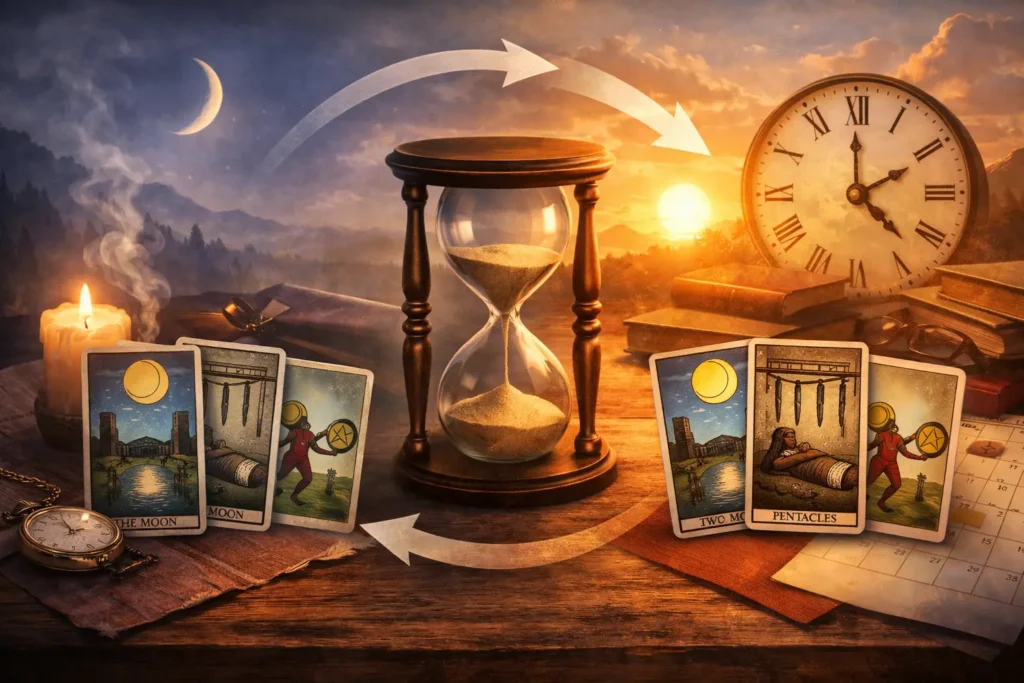
Yes, sometimes it can. The same tarot spread may be understood somewhat differently later because the situation has developed, different details are easier to notice, and the person revisiting the spread has more distance from the original moment.
Short answer
The same tarot spread can sometimes lead to a different interpretation over time. That usually happens because more of the situation has unfolded, certain symbols stand out more clearly on a second look, and lived experience gives the person a broader way to understand the same spread.
The spread itself does not change. What changes is how much of the situation is visible when the person returns to it.
Why interpretation can change later
A first reading often happens in the middle of uncertainty. At that point, information may be incomplete, emotions may be stronger, and the person may be focused on what feels most urgent. When they revisit the same spread later, they are no longer reading from exactly the same position.
That shift can affect interpretation. A card that seemed vague at first may feel more defined later, not because the card changed, but because later developments make its symbolism easier to place within the situation.
The situation may become clearer
Some parts of a spread are easier to understand after events move forward. A card that first suggested delay, retreat, caution, or instability may make more sense once those patterns become easier to recognize in real life.
Different details may stand out
On a second look, someone may notice imagery, card pairings, or positional links they barely focused on the first time. Those elements were already present, but they may not have seemed important yet.
Lived experience may change what feels relevant
As time passes, a person may connect a card’s symbolism to something more specific than they could during the first reading. That can make the spread feel clearer without turning it into a different spread.
Why the first and later reading may not sound the same
The first interpretation and the later interpretation happen under different conditions. The spread is unchanged, but the amount of visible information is not.
| Reading stage | What is available | Main limitation |
|---|---|---|
| First reading | Less information, stronger emotion, immediate uncertainty | The broader pattern may not be visible yet |
| Later revisit | More context, more distance, more real-world developments | There is a risk of forcing later events onto the spread |
During the first reading, attention often goes to the most immediate concern. Later, the same spread may be read with more perspective and less urgency. That difference alone can change the interpretation.
The role of time distance
Time distance can matter because it may reduce emotional pressure. If the original reading happened during confusion or stress, the person may have focused mostly on the most charged parts of the spread.
Later, with less tension, it may be easier to notice relationships between cards or a pattern across the spread as a whole. This can make the reading feel clearer later, without implying that the spread itself changed.
What changing interpretation does not mean
It does not automatically mean the first reading was wrong
The first interpretation may reflect what was visible at that moment. A later interpretation may reflect a fuller understanding of the same situation.
It does not mean the cards can mean anything at all
A later interpretation still needs to stay tied to the original spread, the original card positions, and the original question. Reinterpretation can deepen a reading, but it should not turn the spread into an unlimited set of meanings.
It also does not automatically make the spread predictive
A later interpretation may feel clearer simply because later events made one reading of the spread easier to recognize.
Two examples of reinterpretation over time
Example 1: A friendship spread
Question: What is happening in this friendship right now?
First reading: The spread includes the Moon, Four of Swords, and Two of Pentacles. At first, the reading suggests uncertainty, mixed signals, and emotional distance.
Later reading: A few weeks later, the person learns the friend had been overwhelmed and stepping back from several obligations. The Four of Swords now stands out more clearly as withdrawal and recovery, while the Two of Pentacles looks more like overload than indecision.
Why it changed: The spread stayed the same, but later developments made the symbolism easier to place.
Example 2: A project spread
Question: What is shaping the path of this project?
First reading: The spread includes the Hermit, Eight of Pentacles, and Wheel of Fortune. At first, it looks like slow progress and a need for patience.
Later reading: Over time, the person sees that the project improved through private revision and careful work, and that an outside opportunity shifted its direction. The Hermit now reads more clearly as solitary refinement, while the Wheel of Fortune looks more connected to timing and an external change.
Why it changed: The later interpretation became more defined because the situation itself became more defined.
Final takeaway
So, can the same tarot spread lead to different interpretations over time? Sometimes, yes. That can happen when the situation develops, different symbolic details become easier to notice, and time gives the person enough distance to view the spread with more perspective.
That does not mean the original interpretation was wrong, and it does not mean the cards have endless meanings. It means the same spread may be understood somewhat differently later because understanding can develop over time.
Frequently Asked Questions
Can the same tarot spread mean something different later?
Sometimes, yes. The spread stays the same, but its interpretation may shift when more of the situation becomes visible and different details stand out.
Does a later interpretation mean the first tarot reading was wrong?
Not necessarily. The first reading may reflect what was clear at the time, while the later one reflects a fuller understanding of the same situation.
Can emotional distance affect how the same spread is interpreted?
Sometimes, yes. With less urgency or stress, it may be easier to notice patterns, relationships, and symbolism that were harder to see during the first reading.