
Why Tarot Answers Are Often Open to Multiple Meanings
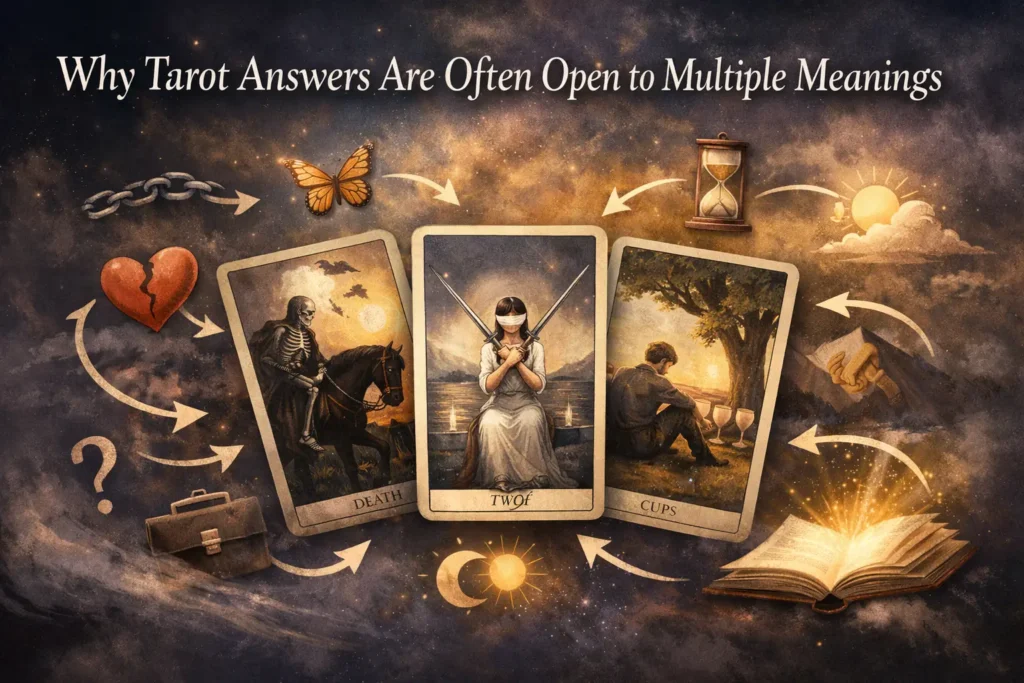
Tarot answers are often open to multiple meanings because one card can hold several related meanings rather than one fixed interpretation. A card usually points to one main theme, but that theme can show up in different connected ways depending on what part of the situation is most relevant.
- One card can support more than one related meaning.
- Those meanings stay tied to one main theme.
- A card may apply to emotional, practical, inner, or external experience.
- Question topic and nearby cards can shift emphasis.
- Multiple meanings do not mean unlimited interpretation.
Short answer
Tarot answers can have more than one meaning because tarot cards are structured to allow several connected interpretations around one main idea. One card may reflect different aspects of the same situation, and the most relevant meaning can shift based on the question topic and the surrounding cards.
That does not mean the card can mean anything at all. A strong interpretation stays tied to a limited set of connected meanings.
Why one tarot card can support several meanings
A tarot card can support several meanings because one card is not limited to one narrow expression. A card centered on change, for example, may point to release, transition, or the close of an old phase. These are not separate messages. They are related expressions of the same underlying theme.
Because a tarot card brings together several established elements at once, it can point to more than one related life theme. That is why a single card can support several connected meanings without becoming arbitrary.
In practice, the card starts with a small range of plausible meanings instead of one rigid definition.
How those meanings stay organized
The clearest way to understand interpretive openness is to separate a card’s main theme from its related expressions.
- Main theme is the central idea the card keeps returning to.
- Related expressions are the connected ways that idea may appear in a reading.
A card linked with tension, for instance, may suggest pressure, conflict, strain, or inner friction. The emphasis changes, but the interpretation still stays anchored to the same center.
This is why several interpretations can be valid at once without collapsing into randomness.
Why one card can apply on different levels
Another reason tarot answers can hold multiple meanings is that the same card may describe different levels of experience. A card may refer to:
- an emotion
- an event
- an inner state
- an external circumstance
That does not make the card vague. It means one theme can appear across more than one layer of the same situation.
For example, a card associated with pause may describe a real delay, a need for patience, or a feeling of being temporarily unable to move forward. These readings differ, but they still point back to the same pattern.
Why the question topic can shift the meaning that comes forward
A tarot card does not lose its main theme when the question topic changes, but a different part of its meaning range may become more relevant.
If the question is about a relationship, a card may emphasize emotional distance, hesitation, or the need for space. If the question is about work, the same card may point more toward delay, caution, or strategic pause. The central idea stays intact, but the expression changes according to the life area the question addresses.
Why card combinations can change the emphasis
Tarot cards are often interpreted as part of a larger pattern. When a card appears with other cards, its main theme usually stays intact, but one related meaning may become more prominent than another.
For example, a card with a theme of withdrawal may lean toward rest in one spread, caution in another, or emotional distance in another. Nearby cards narrow which expression is most active.
Why different tarot traditions may allow different accepted meanings
Different tarot traditions may put weight on different parts of the same card. One approach may stress archetypal tone, another may stress suit logic, and another may give more importance to established card associations.
Because of that, a card may come with several accepted meanings across tarot systems. Those meanings are still usually connected by one underlying theme rather than scattered in unrelated directions.
Mini-examples of one card leading to several valid readings
Example 1: A card with a theme of change
Possible reading 1: letting go of an old attachment
Possible reading 2: moving through a transition period
Possible reading 3: closing one phase so another can begin
Each reading points to a different expression of the same theme: change that involves release and movement out of what no longer holds.
Example 2: A card with a theme of pause
Possible reading 1: events are moving slowly for now
Possible reading 2: patience is required before the next step
Possible reading 3: the situation needs a different angle before progress resumes
These readings differ in emphasis, but all remain tied to one central idea: temporary suspension.
Multiple meanings do not mean unlimited meanings
When tarot answers are open to multiple meanings, that does not mean:
- the card can mean absolutely anything
- every interpretation is equally strong
- the meaning is fully arbitrary
- the card is hiding a secret answer behind the obvious one
A grounded interpretation stays tied to the card’s main theme and its related meanings. Once an interpretation moves outside that set, it becomes weak or unsupported.
Conclusion
A tarot card can hold several related meanings without losing its center. That is why tarot answers can be open while still remaining grounded.
Frequently Asked Questions
Can one tarot card really have more than one meaning?
Yes. A tarot card can support several connected meanings rather than only one fixed interpretation.
Does multiple meaning mean the card can fit anything?
No. A valid interpretation still has to stay connected to the card’s main theme instead of expanding into unrelated ideas.