
What Is the Difference Between Spiritual Clarity and Spiritual Certainty?
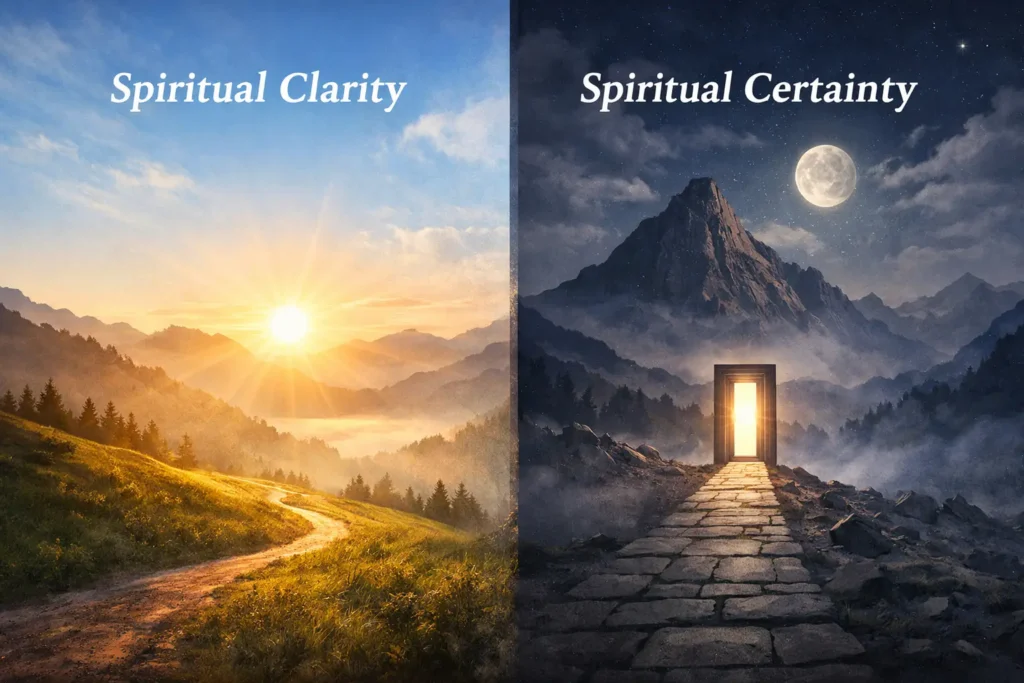
Direct answer: The difference between spiritual clarity and spiritual certainty is that spiritual clarity makes something feel easier to understand, while spiritual certainty makes it feel fully settled. Clarity is about better understanding. Certainty is about stronger conviction. They can overlap, but they are not the same inner state.
- Clarity makes an experience feel more coherent or easier to grasp.
- Certainty makes an interpretation feel more settled and less doubtful.
- Clarity can exist without finality.
- Certainty usually carries a stronger sense of closure.
- Neither one, by itself, settles whether an interpretation is true.
The Core Difference
The simplest way to separate the two is this: clarity is about understanding, while certainty is about being sure.
Spiritual clarity means something feels easier to make sense of. Spiritual certainty means that same matter feels inwardly settled. One brings more understanding. The other brings more conviction.
That is why they should not be treated as stronger and weaker versions of the same thing. They describe different shifts in inner experience.
What Spiritual Clarity Means
Spiritual clarity is the sense that something has become clearer than it was before. What once felt vague or hard to grasp now feels more organized, more coherent, or easier to name.
That does not mean everything is resolved. Clarity can be partial and still matter. A person may understand an experience better without feeling that every question has been closed.
- Something feels easier to understand.
- The experience feels less confusing than before.
- Understanding improves, even if it remains incomplete.
- Openness can still remain.
What Spiritual Certainty Means
Spiritual certainty is the sense of being sure. The emphasis is not on whether something became clearer, but on whether it feels settled.
A person may feel firm, decided, or no longer inwardly divided about what something means. That is why certainty usually feels more closed and more final than clarity.
- The interpretation feels settled.
- Inner hesitation is reduced.
- The conclusion feels firmer.
- The state leans more toward closure than further exploration.
Why People Confuse Spiritual Clarity and Spiritual Certainty
People often confuse the two because both can feel significant and inwardly affirmative. Both may bring relief, steadiness, or a strong sense that something matters.
Ordinary language blurs the line too. People often use “clear” and “sure” loosely, even though they do not point to the same thing. Clarity refers to what feels more understandable. Certainty refers to what feels more settled.
The Key Distinction: Openness vs Closure
The most important difference is that clarity remains compatible with openness, while certainty leans toward closure.
A person can say, “This feels clearer now,” and still leave room for revision or further reflection. That does not weaken the clarity. It simply means the experience is better understood without being treated as final.
Certainty works differently. It moves more strongly toward a conclusion. Instead of leaving the matter open, it makes it feel decided.
This is the distinction many readers miss: clarity does not require finality, and certainty does not necessarily add understanding.
Why Clarity Does Not Have to Become Certainty
Spiritual clarity does not need to become spiritual certainty in order to matter. Something can become clearer without becoming absolute.
A person may understand an inner experience better or feel less confused by it while still refusing to treat that understanding as final. That does not make the clarity weaker. It simply means understanding and conviction have not deepened in the same way.
In that sense, clarity is not an unfinished form of certainty. It is a different mode of experience.
Spiritual Clarity vs Spiritual Certainty at a Glance
| Aspect | Spiritual Clarity | Spiritual Certainty |
|---|---|---|
| Core shift | Something feels easier to understand | Something feels more settled |
| Main emphasis | Understanding | Conviction |
| Relation to doubt | Doubt may still remain | Doubt feels reduced |
| Inner posture | Open, revisable, exploratory | Firm, settled, conclusive |
| Need for finality | Not required | Often stronger |
| What it does not do | Settle the question by itself | Settle the question by itself |
A Simple Example
If something feels easier to understand, but not fully settled, that points to clarity without certainty.
If something feels fully settled, but not much clearer, that points to certainty without much added clarity.
The point is simple: better understanding and stronger conviction do not always deepen together.
What Neither One Can Establish
Neither spiritual clarity nor spiritual certainty automatically settles the larger question of whether an interpretation is correct. Both terms describe how an experience feels from the inside.
That is why clarity should not be mistaken for confirmation, and certainty should not be mistaken for a final answer. A person can feel deep coherence or strong conviction without resolving everything beyond doubt.
Conclusion
Spiritual clarity and spiritual certainty are related but distinct. Clarity means something feels easier to understand. Certainty means it feels more settled and less open to doubt.
That is why clarity can exist without certainty, and certainty can exist without much added clarity. Both describe different inner states, and neither one should be treated as the same thing as final confirmation.
Frequently Asked Questions
Can you have spiritual clarity without spiritual certainty?
Yes. Something can feel easier to understand without feeling final or beyond doubt. That is one of the main differences between the two states.
Does spiritual clarity mean all doubt is gone?
No. Clarity usually means improved understanding, not the complete disappearance of doubt. A person can feel clearer while still remaining open or uncertain.
Can spiritual certainty exist without much clarity?
Yes. Someone may feel strongly convinced even if they cannot clearly explain what became easier to understand. Conviction and understanding do not always deepen together.
Why do spiritual clarity and spiritual certainty feel similar?
They can feel similar because both may bring relief, significance, or an inner sense of affirmation. The difference is that clarity centers on understanding, while certainty centers on settled conviction.
Does spiritual certainty prove something is true?
No. Spiritual certainty describes a felt sense of conviction, not independent confirmation. Feeling sure is not the same as settling the question.