
Are Online Tarot Readings Accurate? What Accuracy Really Means Online
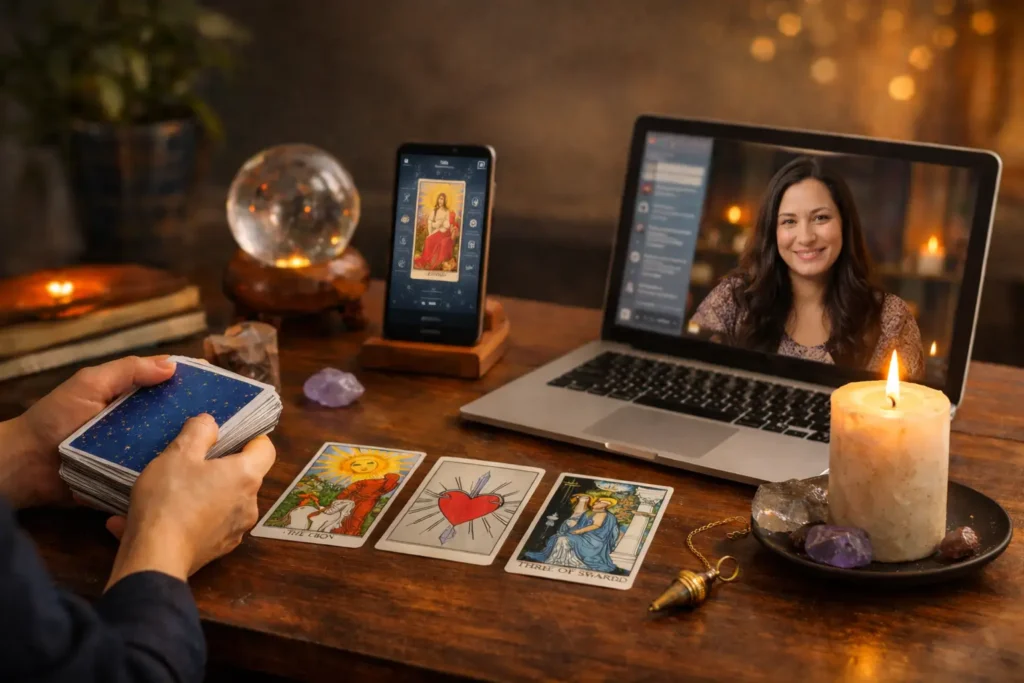
Online tarot readings can feel “accurate” when you treat tarot as a reflective, interpretive tool for clarity—not as a guaranteed prediction. In practice, live online readings (video/phone/chat with a human reader) tend to feel more specific because you can share context and ask follow-ups, while automated app/website readings are usually broader and work best as structured prompts for journaling and self-reflection.
Verdict in 30 Seconds
- Want nuance and personalization? Choose a live online reader (video/phone/chat).
- Want a quick reflection prompt? Use an app/website draw—expect general themes.
- “Accurate” in tarot usually means you gain usable insight and a next step you can test.
- Be cautious of “100% accurate” claims, fear tactics, urgent upsells, or “curse removal.”
- Don’t use tarot for medical, legal, financial, or crisis mental-health decisions.
What “Accurate” Means in Tarot (and What It Doesn’t)
Tarot isn’t a measurement instrument. So when people say a reading was “accurate,” they usually mean one or more of the following:
- The message felt relevant to their situation.
- It helped them notice patterns, motivations, blind spots, or options.
- It produced a clear next step they could try in real life.
In a responsible tarot context, “accurate” does not mean:
- Guaranteed predictions or certainty about outcomes.
- Mind-reading (“exactly what someone thinks/will do”).
- Replacing professional advice in high-stakes situations.
A practical definition: If a reading helps you see your situation more clearly and make a wiser, testable choice, it can be “accurate” in the way tarot is most useful.
If you want a deeper breakdown of what “tarot works” can mean (prediction vs. insight) and why readings often feel accurate, read do tarot readings really work?
What Counts as an “Online Tarot Reading”?
The phrase “online tarot reading” typically refers to two formats:
1) Live online readings with a human reader
Sessions via video, phone, or chat where you can clarify the question, share relevant context, and ask follow-ups. This is the closest online equivalent to an in-person reading.
2) Automated website/app readings
Digital draws paired with prewritten meanings. These can be useful for reflection, but they’re naturally less contextual and less tailored than a live conversation.
Why this matters: Many disappointments about “online accuracy” come from expecting an automated tool to behave like a skilled human session.
If you’re approaching tarot from a Christian perspective and want to understand why many churches view readings as divination, see is tarot reading a sin?
What Makes Online Tarot Different (and How It Affects “Accuracy”)
Online readings can feel comparable to in-person for reflective guidance and conversation, but the medium changes a few practical things:
- Format affects depth: video/phone typically supports more nuance than pure chat, though chat can work well for focused questions.
- Follow-ups are the advantage: asking “What do you mean by that?” often makes the reading more relevant.
- Context-sharing is easier: you can summarize constraints and refine the question quickly.
- Documentation can help: notes or transcripts can make guidance easier to apply (where privacy policies allow).
- Privacy varies: platforms handle data differently; share only what you’re comfortable disclosing.
What a Live Online Session Typically Looks Like
- Question framing: you state the situation and what you want help with (ideally in one sentence).
- Clarifying questions: the reader checks context and constraints (timeframe, goals, what you can influence).
- Card pull and interpretation: themes, options, and likely dynamics are explored—without guarantees.
- Actionable takeaway: you leave with 1–3 next steps (a conversation, boundary, plan, or decision criteria).
- Aftercare: guidance on how long to wait before re-reading and what to track in real life.
Key point: Tarot “accuracy” depends far more on interpretation quality, question clarity, and ethics than on physical proximity.
Are Online Readings as Accurate as In-Person?
They can be—depending on what you expect. If you want conversation, nuance, and a practical perspective on options, a skilled live online reader can feel comparable to in-person because the value comes from interpretation and question framing.
If you want certainty about outcomes, neither online nor in-person tarot can responsibly promise that. A healthy reading uses probability language (“may,” “often,” “likely,” “watch for”) and leaves you with agency—options and next steps, not verdicts.
What Most Affects “Accuracy” (Online or Offline)
1) Reader skill and ethics (for live readings)
- Good readers avoid absolutes and invite clarification.
- They don’t use fear to control your choices.
- They set boundaries, especially around health/legal/financial topics.
2) Question quality (for any format)
Better questions create better interpretations. The most reliable questions are specific, actionable, and focused on what you can influence.
Better questions: quick examples
- Instead of: “Does my ex miss me?” Ask: “What’s the healthiest way for me to move forward, with or without reconnection?”
- Instead of: “Will they text me?” Ask: “What’s the dynamic between us, and what would improve communication?”
- Instead of: “Should I quit?” Ask: “What risks should I plan for, and what would make staying workable?”
- Instead of: “Will I get the job?” Ask: “What can I strengthen to improve my chances, and what’s my Plan B?”
- Instead of: “Tell me what to do.” Ask: “What are my best options, and what tradeoffs should I consider?”
- Instead of: “Is this person my soulmate?” Ask: “What boundaries and values matter most in this connection?”
- Instead of: “Is something bad going to happen?” Ask: “What can I control right now to feel safer and more grounded?”
3) Context (especially online)
You don’t need to overshare, but a few relevant details prevent generic interpretations. A useful structure is: goal + constraint + timeframe.
What to share vs what to keep private
- Usually helpful to share: your goal, the general situation, timeframe (weeks/months), and a key constraint (budget, distance, schedule).
- Usually not necessary: full legal names, exact addresses, passwords, account numbers, or detailed medical history.
- Be cautious with: workplace identifiers, sensitive family details, or anything you wouldn’t want saved in a chat log.
- Red flag request: a reader demanding sensitive data as a condition of “accuracy.”
4) Expectation management
If you keep repeating readings until you hear a preferred outcome, it can become reassurance-seeking instead of clarity-seeking. One solid reading plus real-world action is usually more useful than five “checks.”
5) Your emotional state
If you’re in a high-anxiety loop, tarot can feel urgent and addictive. In that state, pause and prioritize grounding support.
Are Online Tarot Readings “Rigged” or Just Random?
This depends on the format:
- Live online readings: there’s no “algorithm deciding your fate.” The reader interprets the cards they pull (physically or digitally) in conversation with you.
- Apps/websites: most generate a randomized draw and attach a general meaning. The limitation is rarely the randomness—it’s the lack of context and one-size-fits-most interpretation.
The biggest reliability issue for either format is repeat-checking: doing multiple readings on the same question until you get a preferred answer. If you want a more grounded experience, do one reading, choose one practical next step, and then act before you re-read.
Why Tarot Can Feel “Accurate” (Without Being a Guarantee)
Tarot can feel specific because humans are strong pattern-recognizers. Two common factors can amplify that feeling:
- Confirmation bias: we naturally notice what matches our concerns and expectations.
- Context-driven interpretation: broad themes become meaningful when you apply them to real details and decisions.
This is why tarot works best when you translate a reading into one concrete action and evaluate results in real life.
Live Online vs Tarot Apps: What to Choose
| Format | Best for | Limits | What “accuracy” looks like |
|---|---|---|---|
| Live online (human) | Nuance, follow-ups, complex topics, decision framing | Quality varies; depends on ethics and skill | Clear themes + realistic options + actionable next steps |
| Automated app/website | Quick reflection, journaling prompts, learning meanings | Generic meanings, limited context | Prompts that help you think differently |
If you have a physical deck: self-pulls can be useful for journaling and skill-building, but personal bias can dominate—especially when emotions are high.
Two Mini-Cases: What “Accuracy” Looks Like in Practice
Mini-case 1: Relationship clarity
Less helpful question: “Does my partner love me?”
More reliable reframe: “What’s the emotional pattern between us, and what would improve it?”
Responsible conclusion: cards may highlight themes (communication, trust, boundaries), but they can’t responsibly promise mind-reading certainty. Use the reading to choose one constructive step and observe what changes.
Mini-case 2: Career decision
Less helpful question: “Will I get the job?”
More reliable reframe: “What should I strengthen to improve my chances, and what’s my Plan B?”
Responsible conclusion: the reading can point to preparation themes (skills, timing, confidence), but outcomes remain uncertain. Treat it as decision support—not a verdict.
How to Get a More Reliable Online Tarot Reading
If you’re booking a live online reader
- Check boundaries first: do they clearly refuse medical/legal/financial “verdicts”?
- Look for transparent terms: pricing, duration, and what you receive explained upfront.
- Expect collaboration: they should invite clarification and help refine your question.
- Watch the language: realistic readers avoid absolutes and use “may/likely/consider.”
- Avoid fear or urgency: no curses, no doom, no pressure to buy add-ons.
5 questions to ask a live reader before you book
- “How do you define ‘accuracy’ in tarot—reflection, prediction, or both?”
- “How do you structure a session (and do you allow follow-up questions)?”
- “What context do you need from me to keep the reading specific?”
- “What topics do you not read on (health/legal/financial)?”
- “What’s one practical way to apply the reading after we finish?”
If you’re using an automated website/app
- Use it as a reflection tool, not a prediction engine.
- Journal your interpretation first, then read the app’s meaning.
- Don’t repeat draws until you get a preferred outcome.
- If it feels generic, treat it as a prompt—not proof.
Quick Scorecard: Is This Online Reader Legit?
Use this 10-point checklist. The higher the score, the safer the experience is likely to be.
- Clear scope and boundaries (especially on health/legal/financial). (0–1)
- Transparent pricing and timing before payment. (0–1)
- No guarantees (“100% accurate,” “certain outcome”). (0–1)
- No fear tactics (curses, doom, urgent threats). (0–1)
- No pressure upsells (“pay more to remove/cleanse”). (0–1)
- Invites clarification and helps refine the question. (0–1)
- Agency-focused (choices, boundaries, next steps). (0–1)
- Professional communication (policies, respectful tone). (0–1)
- Privacy-aware (doesn’t demand sensitive personal data). (0–1)
- Encourages real-world action before re-reading. (0–1)
Interpretation: 8–10 is strong; 5–7 is mixed (be cautious); 0–4 is a red flag cluster.
When Not to Use Tarot (Safety + Red Flags)
Do not rely on tarot for:
- Medical decisions (diagnosis, treatment, medication choices)
- Legal advice or outcomes
- High-stakes financial decisions
- Mental health crises or severe anxiety spirals
- Situations involving coercion, abuse, or immediate danger
Major scam red flags:
- “100% accurate” promises or guaranteed outcomes
- Fear tactics (“curse,” “doom,” “only I can fix this”)
- Pressure to pay more to “remove” or “cleanse” something
- Isolation tactics (“don’t tell anyone,” “only trust me”)
- Requests for highly sensitive information unrelated to the reading
If you’re dealing with a high-stakes situation, seek appropriate professional support. Tarot is best used for reflection, values, and decision framing—not as a replacement for qualified help.
Editorial Policy and Limitations
This article is for informational purposes and frames tarot as a tool for reflection and decision support. It does not provide medical, legal, financial, or mental-health advice and should not be used to replace qualified professional support. Tarot outcomes are subjective and depend on question clarity, context, and practitioner ethics; automated tools are inherently less contextual than live sessions.
Frequently Asked Questions
Are online tarot readings accurate?
They can feel accurate when they provide clarity, highlight patterns, or suggest next steps you can test. Live online readings are typically more personalized; automated readings are usually more general and work best as reflection prompts.
Can online tarot be as accurate as in-person?
For many people, yes—especially with a skilled reader and a clear question. The difference is often the interaction (follow-ups and context), not the distance.
Are tarot apps accurate?
Apps can be useful, but their interpretations are typically generalized. They’re best used for journaling, self-reflection, and learning card meanings rather than seeking certainty about outcomes.
How do I know if an online tarot reader is legit?
Look for clear boundaries, transparent pricing, realistic language, and a style that encourages your agency. Avoid readers who promise certainty, use fear, or pressure you into add-ons.
Can tarot predict the future accurately?
Tarot is best treated as interpretive rather than deterministic. It can suggest themes and likely dynamics, but it can’t responsibly guarantee specific future events.