
Can Astrology Predict the Future? What “Prediction” Means (and Where It Stops)
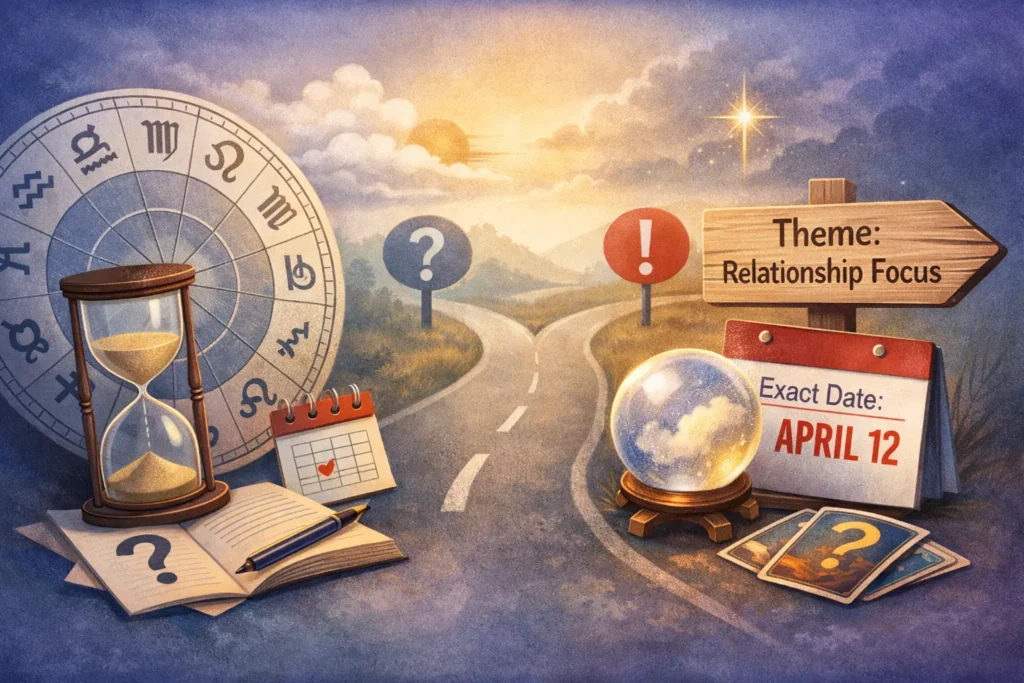
Direct answer: Astrology is often used for future-oriented guidance—highlighting recurring themes, general tendencies, and timing windows—but it becomes least reliable when treated as a tool for naming a guaranteed, specific event on an exact date.
- “Prediction” usually means trends and themes, not certainties.
- Timing windows (e.g., “early–mid month” or “over the next 4–6 weeks”) are more realistic than exact dates.
- Specific-event claims (“X will happen on Tuesday”) are the weakest kind of forecast.
- Clearer questions lead to more usable guidance.
- Best use: plan and prepare—without treating any forecast as a guarantee.
What People Usually Mean by “Prediction”
When people ask, “Can astrology predict the future?” they’re usually asking for one of these:
- A concrete outcome: “What will happen?”
- A timeline: “When will it happen?”
- A shortcut to clarity: “What should I focus on next?”
The catch is that prediction is often taken literally. In practice, many astrology forecasts use interpretive, tendency-based language (“may be more in focus,” “a period of emphasis,” “a window where this topic may be active”) rather than guaranteed outcomes. This is interpretive—not a measurable statistic.
So the real question becomes: what type of forecast are you asking for—and what limits come with that type?
Four Types of Future-Focused Guidance in Astrology
Not all “predictions” are the same. These four categories help set realistic expectations.
Forecast
- What it gives: general tendency (interpretive)
- Best for: planning and pacing
- Common misunderstanding: “This will definitely happen.”
- Safest wording: “You may notice more emphasis on…”
Theme
- What it gives: a repeating focus or motif
- Best for: choosing priorities
- Common misunderstanding: “This theme forces one outcome.”
- Safest wording: “This may be more in focus…”
Narrative
- What it gives: a meaning frame for the future
- Best for: reflection and sense-making
- Common misunderstanding: “The story is the event.”
- Safest wording: “A helpful lens could be…”
Specific event prediction
- What it gives: a concrete event + place/date
- Best for: rarely (highest risk of overreach)
- Common misunderstanding: “Astrology can name exact facts.”
- Safest wording: “If X is already in motion, you may see signs around…”
Anchor boundary: The more specific the claim (exact event + exact timing), the weaker it tends to be. Theme-level guidance is usually more stable and usable than a fixed, date-stamped event claim.
So, can astrology predict specific events?
Some readings try, but specific-event predictions (a single outcome with a date attached) are typically the weakest category. They compress too many variables into one fixed claim. A more usable approach is to ask for themes and timing windows—and then decide what to do with that information.
Theme: “A focus on relationship boundaries over the next 4–6 weeks.”
Not: “You will meet your soulmate on April 12.”
What “Timing Windows” Mean
A timing window is a bounded period where a theme may be more active—not a deadline where an event must occur. In practical terms, a window might be described as:
- Part of a month: “early–mid month” or “mid–late month”
- A multi-week span: “over the next 4–6 weeks”
- A transition period: “around a shift in priorities” or “during a change-heavy phase”
This framing keeps a forecast usable: it supports planning and observation without turning timing into a promise.
The Limits of Any Prediction (and Why Specific Events Are the Weakest)
The future depends on many moving variables—choices, circumstances, timing, resources, and unexpected changes. That’s why the most responsible predictive language focuses on ranges and conditional framing, not certainty.
Strength of claim (quick guide)
- More usable: themes, priorities, timing windows, likely challenges
- Conditional: “If you continue X, Y may stay more in focus”
- Weakest / highest risk: exact event + exact date + certainty language
A forecast can inform preparation, but it shouldn’t be treated as a fixed outcome that overrides real-world decision-making.
Why People Still Seek Forecasts
- To reduce uncertainty: a framework can make a period easier to navigate.
- To plan: themes and windows can help prioritize tasks and timing.
- To prepare: even without guarantees, people want actionable next steps.
Safe vs. Unsafe “Prediction” (Quick Rules)
If you want guidance without overreach, use these rules to evaluate the level of specificity.
- Safer: themes + window + options (“Focus on visibility over the next 4–6 weeks; here are two ways to approach it.”)
- Safer: conditional language (“If you pursue X, Y may be more in focus.”)
- Riskier: single outcome (“This exact thing will happen.”)
- Riskier: exact date certainty (“On March 12, you’ll get the offer.”)
- Riskiest: certainty + high-stakes decisions (any forecast presented as a substitute for real-world due diligence)
How to Use Astrology Forecasts in a Grounded Way
1) Choose timing windows, not deadlines
Ask for a window (part of a month, a few weeks, or a transition phase) and what themes to watch—without turning it into a date-stamped certainty.
2) Reframe “Will it happen?” into “How do I prepare?”
Instead of forcing a yes/no outcome, ask what the period is best used for: what to prioritize and what to watch for.
3) Keep decisions with you
A forecast can support planning and reflection. It shouldn’t replace your judgment, values, or practical constraints.
Mini checklist
- Ask for: themes, timing windows, practical options.
- Listen for: interpretive language (“more in focus,” “a period of emphasis,” “a useful window”).
- Avoid: “one outcome + exact date + certainty.”
Two Short Examples (Question → Approach → Safe Conclusion)
Example 1: A creative project decision
Question: “Will my book launch go viral next month?”
Approach: Replace a fixed outcome (“viral”) with a theme (visibility, feedback, iteration) and a timing window (e.g., early–mid month for outreach, mid–late month for adjustments).
Safe conclusion: “This may be a useful period for visibility efforts if you focus on consistent promotion and iteration. Plan within a window, watch signals (engagement, reviews), and adjust—rather than expecting one guaranteed spike.”
Example 2: A move/home choice
Question: “Should I move to a new city this summer?”
Approach: Use the forecast as a planning lens: identify themes (transition, budgeting, building community) and a window to research and decide (e.g., over the next 4–6 weeks).
Safe conclusion: “If the theme is transition, you may feel pulled to change your environment. Use a window to plan: outline costs, timeline the search, and define decision criteria. The forecast supports your process—it doesn’t decide for you.”
When Not to Rely on Predictions
Some situations require grounded, qualified input first. In these cases, treat any forecast as secondary to real-world expertise and information:
- Health decisions (diagnosis, treatment, medication): consult qualified professionals.
- Legal decisions (contracts, disputes): consult qualified professionals.
- Financial decisions (large commitments, debt, investments): consult qualified professionals.
What This Page Is (and Isn’t)
- This is: a framework for what “prediction” commonly means in astrology—plus clear limits on specificity and timing.
- This isn’t: a promise that astrology can name guaranteed events or exact dates.
Limitations (plain language)
Forecasts are interpretive. They can be useful for reflection and planning, but the future still depends on context, choices, and changing conditions. Treat any prediction as a probability-based lens, not a certainty machine.
Frequently Asked Questions
Can astrology predict the future accurately?
It depends on what “predict” means. Astrology is most often used for themes, tendencies, and timing windows. The more a claim tries to name a guaranteed outcome on a fixed date, the less responsibly it can be treated as certain.
What does “prediction” mean in astrology?
In many contexts, it means a forecast: what themes may be emphasized and when. A useful forecast names the theme and the window, without turning them into an event guarantee.
Can astrology predict specific events?
Some readings attempt it, but specific-event predictions are the highest-risk category. A safer alternative is to ask for themes and conditional guidance: what becomes more likely to matter if you choose one path over another.
Can astrology predict exact dates?
It’s more realistic to ask for a timing window—such as “early–mid month” or “over the next 4–6 weeks”—and what to watch for during that period, rather than expecting a fixed-date promise.
What’s the difference between a forecast, a theme, and a narrative?
A forecast describes general tendencies, a theme describes an ongoing focus, and a narrative offers a meaning frame. Forecasts and themes are most practical when paired with a timing window.
How can I ask future questions that lead to useful guidance?
Ask for (1) the theme, (2) the timing window, and (3) two practical options. This keeps the question out of “one outcome + exact date + certainty.”
What’s a simple way to spot overconfident predictions?
If a claim combines a single fixed outcome with an exact date and certainty language, it’s overreaching. Prefer forecasts that stay at the level of themes, windows, and conditional options.
When should I avoid using astrology predictions?
For health, legal, or major financial decisions, consult qualified professionals first. If you use a forecast at all, keep it secondary to real-world information and expertise.