
Can Spiritual Awakening Cause Anxiety?
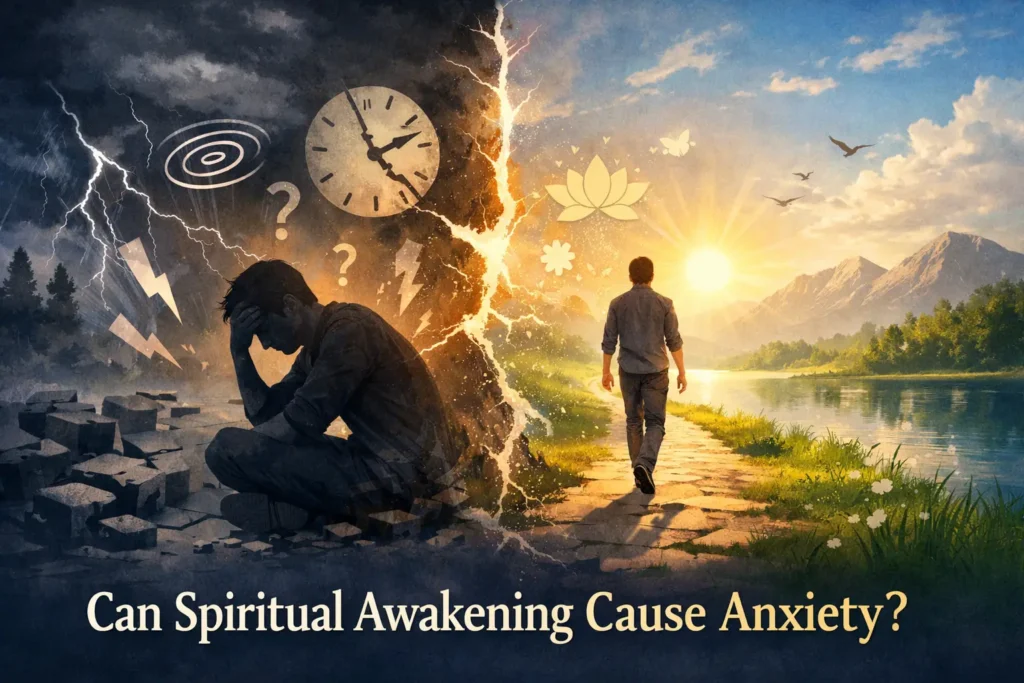
Direct answer: Yes—spiritual awakening can cause anxiety for some people, especially when it feels like your inner “map” of life changes faster than your sense of stability can keep up. Old ways of understanding yourself may stop working before new ones feel steady, and that uncertainty may be registered as threat. This doesn’t “prove” anything mystical; it often reflects overload and a need for stabilization.
- Anxiety can be a transition response to uncertainty and overload.
- Meaning overload can fuel looping doubts and tension.
- Identity shifts can feel like loss of control.
- Stabilize first: lower inputs, return to routines, delay big decisions.
- Get support if sleep collapses, panic hits, or functioning drops.
What people usually mean by “spiritual awakening” (without mystifying it)
In everyday language, a spiritual awakening often refers to an internal shift in perception: life feels different, your priorities or sense of meaning reorganize, and old reference points don’t guide you the way they used to.
It can include feeling more sensitive to uncertainty and meaning-making—like you notice questions, “why,” and ambiguity more intensely than before. It’s less about “proof” and more about a subjective change in how you experience yourself and the world.
Can spiritual awakening cause anxiety?
Yes. For some people, a spiritual awakening can coincide with anxiety because it creates a temporary period of internal instability: the familiar story of “who I am and how life works” loosens, while the new story isn’t formed yet. That uncertainty can raise nervous-system arousal, even if nothing “bad” is happening externally—so the next step is understanding the mechanics and reducing overload.
Why this transition can trigger anxiety (the mechanics)
The uncertainty gap: old map gone, new map not built
When the old way of understanding yourself stops fitting, your mind may scramble for certainty. If answers don’t arrive quickly, the gap can feel unsafe, and anxious arousal may increase.
Meaning overload: when your mind assigns significance to everything
If your attention becomes more tuned to meaning, it can be easier to over-interpret normal experiences. That can create a loop of “What does this mean?” which may fuel doubt spikes, mental tension, and a sense of urgency.
Temporary identity instability
Even subtle changes in identity can feel disorienting: “If I’m not the old version of me, what am I now?” Anxiety can rise when your sense of self feels in motion and you can’t yet predict your next steps.
Sensory sensitivity and overstimulation
During periods of inner change, some people feel more sensitive to noise, screens, crowds, or even their own emotions. Overstimulation can leave the body on edge, which the mind may label as anxiety.
| What’s happening | How it can feel | Low-risk stabilizing move |
|---|---|---|
| Uncertainty gap | “I notice change, but I can’t name it” | Slow down; reduce new inputs; keep routines |
| Meaning overload | Looping thoughts; pressure to “figure it out” | Take breaks from analysis; do something simple |
| Identity in motion | “I don’t recognize myself” | Delay big decisions; focus on baseline stability |
| Overstimulation | Tension; irritability; restless body | Lower screen time; add quiet time; gentle movement |
| Loss-of-control sensations | “What if I’m doing this wrong?” | Choose one low-stimulation routine and repeat it for a day or two |
How anxiety can feel during or after awakening
It can be subtle or intense. Many people describe a mix of body tension and mental uncertainty, such as:
- Inner tightness or a “wired” feeling
- Sudden spikes of doubt
- Trouble falling asleep or staying asleep
- A sense of “I don’t know what’s happening to me”
- Fear of doing it wrong or making the wrong move
These sensations can feel alarming precisely because they don’t have a clear external cause.
Normal turbulence vs when you may need support
Often normal in a transition
- Anxiety comes in waves, not constant intensity
- It gets worse with overload (too much content, too little rest)
- It eases when you slow down and return to simple routines
Consider getting support if…
- You’re losing sleep consistently
- You’re having intense panic episodes
- You feel unsafe in your body or environment
- You can’t function day to day (work, meals, basic tasks)
| Often eases with stabilization | Time to seek support |
|---|---|
| Waves that ease with rest and reduced input | Sleep breakdown for multiple nights |
| Clear link to overstimulation or overthinking | Panic episodes that feel unmanageable |
| You can still do basic daily tasks | You can’t function or feel unsafe |
What to do (stabilization only)
1) Slow down the inputs
Reduce the volume of material you’re consuming about awakening, meaning, and “what it all implies.” If your system is overloaded, more analysis can add pressure.
2) Return to simple routines
Choose basics that signal safety to your body: regular meals, hydration, daylight, and a consistent bedtime window. The goal is not perfection—just steadiness.
3) Don’t make big decisions yet
If you feel internally unstable, postpone major decisions until you’re sleeping better and your anxiety is less reactive. “Not now” is a valid decision.
4) Use a 24–48 hour stabilization checklist
- Take a full break from intense spiritual content
- Pick one low-stimulation routine and repeat it for a day or two
- Eat something simple at regular times
- Spend at least 10 minutes outside in daylight
- Lower screen time, especially before bed
- Do gentle movement (walk, stretch) without goals
- Write down one worry, then one practical next step
- Delay big commitments and major changes
- Choose one “low-stimulation” hour each day
- Go to bed at a consistent time window
Mini-case 1: “I can’t sleep after a powerful insight”
Question: “After a big internal shift, my mind won’t stop.”
What may be happening (mechanism): It can feel like something big is happening; anxiety plus overload can keep the system alert. Your brain may be trying to make the experience coherent while your body stays activated.
Low-risk next step: Don’t chase more intensity. Reduce inputs, return to routines, and reassess after a day or two of stabilization.
Mini-case 2: “I’m anxious I’m doing awakening wrong”
Question: “I feel pressure to interpret everything correctly. What if I mess this up?”
What may be happening (mechanism): Anxiety often attaches to uncertainty and perfectionism. The nervous system wants certainty, but transitions may not provide it on demand.
Low-risk next step: Choose steadiness over intensity: simplify what you’re doing, delay big moves, and focus on feeling safe and functional first.
What not to do (common traps)
- Don’t treat anxiety as proof that awakening is “real” or “not real.”
- Don’t push through by intensifying practices when you’re overwhelmed.
- Don’t chase certainty by reading more and more interpretations.
- Don’t self-label everything as awakening if you’re losing basic stability.
If you’re overloaded, the most helpful move is often the least dramatic one: slow down.
Editorial note
This article treats spiritual awakening as a subjective internal transition and describes anxiety as a common nervous-system response to uncertainty and overload. It does not frame anxiety as proof, prophecy, or spiritual status, and it does not replace professional care.
What this is: a grounded explanation plus low-risk stabilization steps.
What this isn’t: diagnosis, treatment instructions, or a framework for spiritual conflict.
Frequently Asked Questions
Is anxiety a normal part of spiritual awakening?
It can be. Anxiety may show up when your internal reference points shift and uncertainty increases. Often it eases when you reduce overload and return to simple routines.
What should I focus on if I’m not sure what’s happening?
Focus less on the perfect label and more on your level of distress and stability. If symptoms ease with rest and reduced input, stabilization may be enough; if sleep breaks down, panic feels intense, or functioning drops, get support.
Why does awakening make me feel like I’m losing control?
Transitions can disrupt predictability. When your old identity or worldview loosens, the nervous system may react as if something is unsafe, even if nothing external has changed.
Can spiritual awakening cause insomnia?
It can. Meaning overload, looping thoughts, and uncertainty can keep your system alert at night. If sleep loss continues or worsens, consider getting extra support.
What helps most when anxiety spikes during awakening?
Stabilization: slow down, reduce inputs, return to routines, and avoid major decisions until your baseline steadies. The goal is to feel safe and functional, not to intensify the process.
Does anxiety mean I’m doing it wrong?
Not necessarily. Anxiety often reflects overload and uncertainty, not failure. Treat it as a signal to simplify and stabilize rather than “push through.”
Should I stop all spiritual practices?
If a practice increases pressure or overstimulation, scale back or pause what increases pressure. Reassess once your baseline steadies. You can seek support regardless of how you interpret the experience.
When should I seek support?
If anxiety causes sleep loss, intense panic, a sense of being unsafe, or a drop in daily functioning, it’s time to reach out. You don’t need to prove what the experience “means” to deserve help.