
Can Spiritual Practices Become Emotionally Overwhelming?
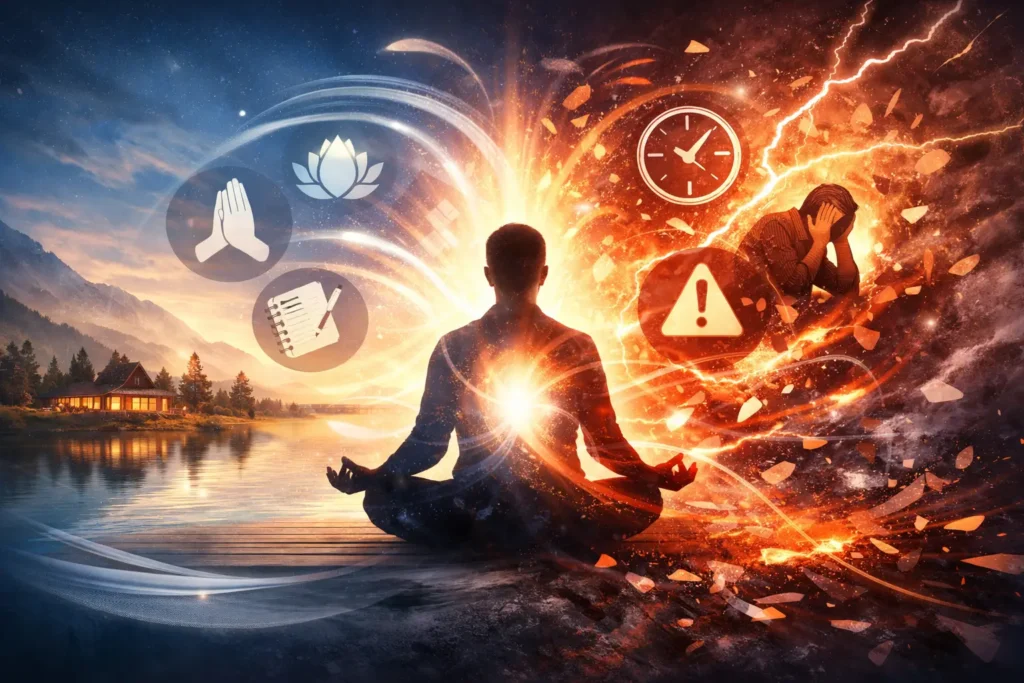
Direct answer: Yes—spiritual practices can become emotionally overwhelming when intensity ramps up faster than your capacity to absorb what you notice and feel. In most cases, overwhelm isn’t a verdict that the practice is “bad.” It’s a signal that the current intensity and conditions are outpacing your present capacity. This is most common after a sudden increase in practice, a retreat, or a shift into more intense breathwork or self-inquiry.
- Depth can be intense and still feel workable.
- Overwhelm tends to show up when intensity increases quickly or multiple factors stack at once.
What “spiritual practices” means here
In this article, spiritual practices means structured inner work that intentionally shifts attention toward prayerful focus, presence, meaning, or self-inquiry. No religious judgment is assumed.
- Meditation (any tradition or secular approach)
- Prayer (as a focused, reflective practice)
- Breathing practices (gentle to intense)
- Retreats (especially silent or highly structured retreats)
- Extended introspection (journaling, contemplation, self-inquiry)
- Intensive self-analysis (long sessions, frequent reflection loops)
The point isn’t to label these practices as “good” or “bad.” The point is to clarify when and why they can feel like too much.
Emotional depth vs emotional overwhelm (not the same)
Spiritual practice can bring emotional depth—a real, sometimes powerful contact with your inner life. Emotional overwhelm is different: it has a “too fast, too much” quality that starts spilling beyond the practice session.
| Depth | Overwhelm |
|---|---|
| Strong feelings arise, but you stay oriented. | Feelings feel flooding, confusing, or hard to contain. |
| Intensity softens with time, rest, and ordinary life. | Intensity lingers and begins to disrupt daily rhythm. |
| Insights feel digestible, even if tender. | Insights/emotions arrive faster than you can absorb them. |
| You feel more clear over time. | You may feel raw, unusually sensitive, or “overexposed.” |
Key idea: depth is not automatically “safe,” and overwhelm is not automatically “dangerous.” The difference is often about pace, support, and integration time.
How it can show up (without turning it into a diagnosis)
- Lingering rawness after sessions, even when the practice itself felt meaningful.
- Lower tolerance for stimulation after silence (conversation, crowds, screens feel “louder”).
- Difficulty returning to routine—ordinary tasks feel oddly demanding for a while.
- Heightened sensitivity to tone, noise, or social friction.
- A sense of being “overexposed,” as if the inner volume is turned up beyond what the day can hold.
Why overwhelm can happen (without making the practice “bad”)
1) Attention turns inward, and external structure drops
Many practices reduce distraction and simplify your environment. With fewer tasks, conversations, and cues shaping your attention and emotional pacing, inner experience can feel louder—especially feelings you usually move past while staying busy.
2) Previously sidelined emotion can surface
Sometimes the practice doesn’t create new emotion—it reveals what’s been waiting in the background. That can feel sudden: sadness, anger, grief, tenderness, or a wave of feeling you didn’t expect to meet so directly.
3) Sensory sensitivity can increase through contrast
After long periods of quiet or sustained focus, everyday stimulation can feel sharper—crowds, noise, screens, constant conversation. For some people it’s less “something is wrong” and more a strong contrast between a quiet container and normal life.
4) Values and narratives can shift faster than life can keep up
Deep introspection can loosen familiar self-stories: what you value, how you interpret the past, what feels meaningful. Even helpful shifts can be disorienting when they arrive faster than your work life, relationships, and routines can update around them.
5) Retreat conditions amplify everything
Retreats often combine silence, structure, reduced social contact, and limited outlets. That can be clarifying—but it can also intensify emotion, especially if you usually process through movement, conversation, or varied daily activities.
People sometimes call this experience spiritual overwhelm (or spiritual burnout, as practice overload)—not as a diagnosis, but as a plain description of “too much inner intensity at once.”
The intensity factor: when practice tips into overload
Emotional overwhelm is often less about which practice you do and more about how much, how fast, and under what conditions.
Common intensity drivers
- Sudden duration jump: going from short sits to long sessions quickly.
- Frequency jump: increasing from occasional practice to daily (or multiple times daily) without a transition period.
- Technique intensity shift: moving into more demanding breathwork or deeper self-inquiry abruptly.
- Retreat compression: many hours of practice packed into a short time.
- Little integration time: adding more practice without adding space to absorb experience.
- Low support: no teacher, community, or grounded friend to reality-check your experience.
- High overall life load: starting an intensive phase during an already demanding season.
This isn’t a moral scorecard. It’s a way to name conditions that can make inner work feel like “too much, too soon.”
Scenarios: how overwhelm can show up in real practice
Scenario 1: Meditation intensity jump
You increase from short sessions to an hour a day within a week. The practice feels “deeper,” but you also notice lingering rawness afterward—more emotional reactivity, more sensitivity, and less ability to reset between sessions.
In this situation, the most informative variable is often the speed of the increase. A big jump can bring more inner material online than your day-to-day rhythm can comfortably hold.
Scenario 2: Retreat or prayerful reflection meets ordinary life
After a quiet retreat—long prayer, contemplation, silence—ordinary life feels loud and sharp. Conversation, traffic, and screens land harder than usual, and emotional tone feels amplified.
Here the shift is often about contrast and environment: a simplified container heightens perception, and re-entry can feel intense until your routines catch up with the level of inner sensitivity the retreat produced.
Scenario 3: Intense breathwork
You move from gentle breathing practices into a deeper, more demanding technique and do it for longer than usual. Strong emotional release or activation can follow, and the intensity may linger when the method escalates faster than the time and context can hold.
Normalization (without romanticizing or catastrophizing)
Overwhelm can be a normal response to intensity and conditions—not proof of failure, and not proof of “spiritual evolution.”
- An emotional reaction isn’t proof you did it wrong. It may simply reflect contact with something real.
- Boundaries are part of maturity. “More” isn’t automatically “better.”
Quick distinction: depth or overwhelm?
- Depth is intense but you remain oriented and your daily rhythm stays mostly intact.
- Overwhelm feels flooding or “overexposing,” and the intensity keeps leaking into the rest of your day.
- Overwhelm is more likely when intensity changed quickly or several drivers stacked at once.
When to treat overwhelm as a boundary signal
If overwhelm is causing significant disruption to daily functioning, it can help to seek experienced guidance from a trusted teacher or qualified professional.
Frequently Asked Questions
Can spiritual practices become emotionally overwhelming?
Yes. Overwhelm can happen when intensity rises faster than your capacity to absorb what comes up—especially when multiple intensity drivers stack at once.
Why does meditation bring up strong emotions?
Meditation often reduces distraction and increases awareness of inner experience, making previously sidelined feelings more noticeable—especially during longer or more frequent sessions.
Is it normal to feel emotionally raw after a retreat?
It can be. Retreat conditions (silence, structure, fewer outlets) can amplify sensitivity, and re-entry may feel intense until ordinary routines catch up.
How can I tell emotional depth from emotional overwhelm?
Depth can be intense but workable (you stay oriented and functioning is steady). Overwhelm has a “too much, too soon” quality that lingers and disrupts your daily rhythm.
What does “integration” mean after intense practice?
Integration is the process of absorbing insights and emotions so they can fit into everyday life; when integration time lags behind intensity, people can feel raw or overloaded even if the practice felt meaningful.