
Can Tarot Readings Be Harmful? Risks, Red Flags, and How to Use Tarot More Safely
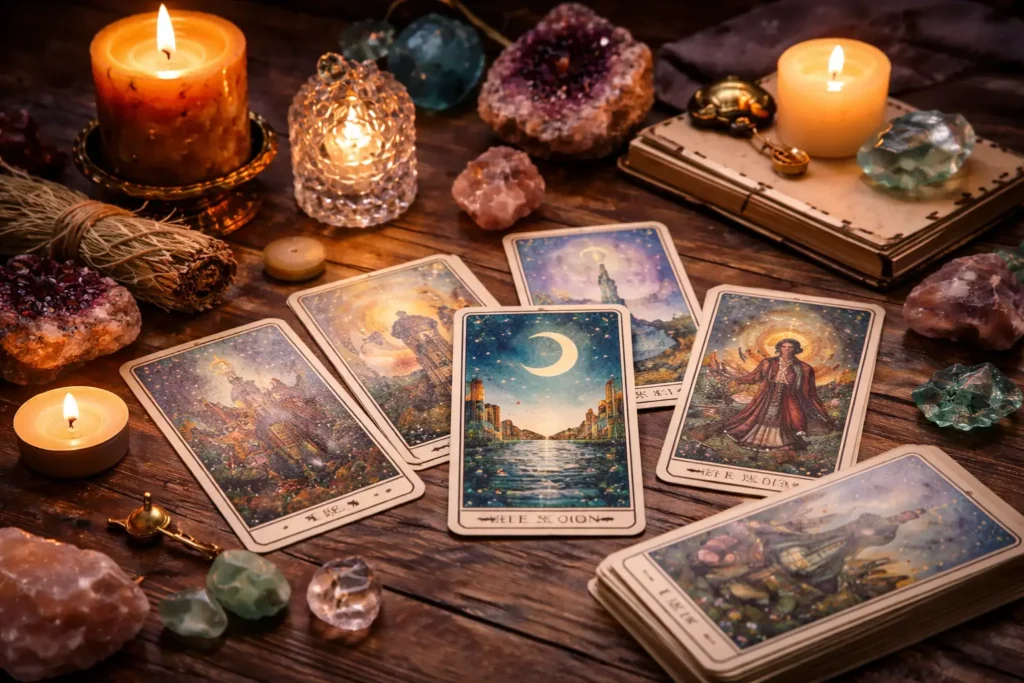
Tarot readings can be harmful when they increase anxiety, create dependency, trigger fear-based decisions, or replace real-world judgment—especially during stressful or vulnerable periods. Tarot itself is a symbolic, interpretive practice; the risk usually comes from how it’s used, the language around it, and the boundaries (or lack of them) in a reading.
- Tarot isn’t inherently harmful; misuse is the main risk.
- Re-checking the same question can reinforce anxiety cycles and reassurance-seeking for some people.
- Fear tactics and paid “urgent warnings” are major scam red flags.
- Use tarot for reflection and perspective—not certainty, diagnosis, or guarantees.
- If you feel distressed, pause tarot and use grounding support.
Editorial note: This article is written for education and reflection. It does not provide medical, legal, or financial advice. Content is reviewed for clarity and safety and emphasizes agency, consent, and practical decision-making. We avoid medical claims, discourage fear-based decision-making, and encourage professional help when stakes are high.
In this article
- If a reading scared you right now
- What “harmful” can mean (and what it doesn’t)
- Common ways tarot becomes harmful (and what to do instead)
- When tarot can feel riskier
- Mini-cases: interpret safely without turning it into “fate”
- A practical framework for safer tarot use
- Do/Don’t checklist
- When not to use tarot
- US resources
If a reading scared you right now: do this first
If you’re feeling panicky after a reading, treat this as a high-anxiety moment first—not a “message you must obey.” Try this short reset before interpreting anything further:
- Pause the session. Put the cards away for now.
- Name the exact scary claim you’re thinking (one sentence).
- Rewrite it in uncertainty language: replace “will” with “may,” “could,” or “I’m afraid that…”.
- Reality-check it: What evidence do you have in real life? What evidence do you not have?
- Choose one grounding action (drink water, step outside, text a trusted person, write a plan for the next hour).
If distress feels intense, persistent, or interferes with daily functioning, consider reaching out to a licensed mental health professional. If you’re in immediate danger or at risk of harming yourself or others, contact emergency services or a crisis hotline in your country.
What “harmful” can mean in tarot (and what it doesn’t)
When people ask whether tarot can be harmful, they usually mean one of these outcomes:
- Emotional distress: feeling scared, hopeless, or stuck after a reading
- Anxiety loops: repeatedly checking for reassurance (“just one more pull…”)
- Loss of agency: outsourcing choices to the cards instead of your judgment
- Financial harm: paying escalating fees due to pressure, fear, or coercion
- Relationship strain: using tarot to “prove” suspicion, monitor others, or justify control
What it doesn’t mean: that tarot automatically “ruins your life,” or that drawing an uncomfortable card guarantees an outcome. Tarot interpretations are not facts—they’re stories and symbols that can be questioned, reframed, or set aside.
A boundary that reduces harm
Tarot is safest when used as a reflection tool—not as a substitute for professional advice, evidence-based decision-making, or consent-based conversations.
Common ways tarot becomes harmful (and what to do instead)
1) Anxiety spirals and fear-based interpretations
A reading can become harmful when it pushes you into worst-case thinking—especially if you treat it like a verdict. Fear tends to spike when interpretations use certainty language: “This will happen,” “You must,” “There’s no way out.”
What to do instead
- Replace certainty with possibility: “This could reflect…”
- Ask: “What is the most grounded interpretation of this symbol?”
- Generate two meanings: one difficult, one constructive (to avoid tunnel vision).
- End with one practical next step—not a prediction.
2) Dependency and loss of agency
Tarot can quietly become a “permission system”—you stop making decisions until the cards approve them. Over time, confidence can shrink and readings can become a way to regulate anxiety rather than gain insight.
Common signs
- You feel anxious unless you pull cards
- You repeat the same question frequently
- You delay action waiting for “better cards”
- You ignore real-world information that contradicts the reading
What to do instead
- Set a frequency limit (weekly, biweekly, or “only for new questions”).
- Make tarot the second step: gather facts first, then reflect.
- Use a closing prompt: “What choice aligns with my values today?”
- If you notice compulsive checking, take a structured break (for example, 7–14 days) and return only when calm.
3) Avoidance of necessary conversations or decisions
Tarot becomes harmful when it replaces hard-but-necessary actions: having a direct talk, setting boundaries, ending a situation, asking for help, looking at finances, or making a plan.
Use tarot as a bridge into action
- “What boundary would protect my time and energy?”
- “What am I avoiding, and what is one small step forward?”
- “What would I do if I trusted myself 10% more?”
4) Financial pressure, scams, and coercive upsells
Most readers are not scammers. But scam patterns are consistent: fear + urgency + escalating payments. This is one of the clearest ways tarot becomes harmful because it combines emotional pressure with financial coercion.
High-risk tactics (walk away)
- “You’re cursed / blocked / hexed—pay to remove it”
- “If you don’t act now, something bad will happen”
- Paywalled “urgent messages,” nonstop add-ons, or “tiered cleansing” fees
- Claims of guaranteed outcomes (“100% sure,” “this will happen”)
- Pressure to share sensitive personal data under urgency
What to do instead
- Walk away from any fear-based upsell (no explanations needed).
- Stop payment and save messages/receipts if you feel coerced.
- If you’ve lost money, contact your payment provider and consider reporting the scam (see US resources below).
When tarot can feel riskier (no diagnosing)
Tarot may be harder to use safely when you’re under high emotional load or uncertainty, such as:
- grief, heartbreak, major transitions
- chronic stress, burnout, or sleep deprivation
- big-stakes decisions (money, legal, health)
- moments when you feel panicky, restless, or out of control
This isn’t about labeling anyone—it’s about timing. Even a gentle interpretation can feel heavier when you’re already overwhelmed.
Mini-cases: interpret safely without turning it into “fate”
Mini-case 1: Relationship uncertainty
Question: “Will my ex come back?”
Safer approach: Shift from prediction to reflection. Look for themes: attachment, boundaries, communication patterns, and needs.
Grounded conclusion: “Instead of trying to predict their behavior, I can focus on what I need to feel secure and respected. My next step is to clarify my boundary and decide what contact would actually be healthy.”
Mini-case 2: Career decision pressure
Question: “Should I quit my job?”
Safer approach: Use tarot to explore tradeoffs and readiness, not to issue instructions.
Grounded conclusion: “The cards may be highlighting dissatisfaction and a need for stability. I’ll gather real-world inputs (budget, timeline, alternatives) and then decide. Tarot can help me reflect on what matters most—not replace the decision.”
How to use tarot more safely (a practical framework)
Step 1: Set an intention and a boundary
Before you draw cards, decide:
- Why am I doing this? (clarity, reflection, perspective)
- What’s the limit? (one spread, 10 minutes, no re-draws)
- What’s off-limits? (diagnosis, legal outcomes, guaranteed predictions)
Step 2: Ask empowering questions (templates)
Avoid fate-locked questions that hand away agency. Use prompts that lead to choices, values, and actions.
Instead of: “Will I get the job?”
Try: “How can I show up strongly in this process?”
Instead of: “Is my partner cheating?”
Try: “What do I need to feel safe and honest in this relationship, and what conversation do I need to have?”
Instead of: “What will happen to me?”
Try: “What choice supports my values this month?”
Step 3: Use “reality checks” during interpretation
- What are two plausible meanings of this card?
- What evidence do I have in real life—and what am I assuming?
- If a friend told me this interpretation, what would I say to help them stay grounded?
- What interpretation reduces fear and increases agency—without denying reality?
Step 4: Close with integration (5 minutes)
After the reading:
- Write one sentence: “This reading might be pointing to…”
- Name one emotion you feel (no story—just the feeling).
- Choose one small action in the real world.
- Add an uncertainty statement: “I could be wrong—and that’s okay.”
Practical checklist: Do/Don’t for safer tarot use
Do
- Treat tarot as symbolic reflection—not certainty
- Limit reading frequency for the same topic
- Use grounded language: “may,” “could,” “invites,” “suggests”
- End with one actionable step
- Take breaks when you feel overwhelmed
- Use real-world inputs for big decisions (budget, timelines, evidence, consent-based conversations)
Don’t
- Re-read compulsively to chase reassurance
- Use tarot to replace medical, legal, or financial advice
- Accept fear-based claims or paid “urgent warnings”
- Let a reader pressure you into spending more
- Use tarot to control someone else’s choices
Ethical boundaries: what a responsible reader avoids
- Diagnosing health conditions or discouraging professional care
- Guaranteeing outcomes or claiming certainty
- Using fear, urgency, or “exclusive” warnings to push payments
- Framing you as powerless or dependent on them
If a reader implies you need them to “fix” you, or pressures you to pay to avoid harm, that is a signal to step back.
When not to use tarot (and what to do instead)
Pause tarot if:
- a reading makes you feel panicked, unsafe, or unable to function
- you can’t sleep or stop thinking about the cards
- you feel compelled to keep paying or keep checking
- the situation involves high-stakes health, legal, or financial decisions
- you’re in a crisis or feel at risk of harming yourself or others
What to do instead
- Talk to a trusted person who can ground you.
- For persistent or impairing anxiety, consider a licensed mental health professional.
- For medical, legal, or financial decisions, consult qualified professionals.
- If you’re in immediate danger, contact emergency services or a crisis hotline in your country.
Bottom line: tarot can be useful—if it doesn’t take your agency
Tarot isn’t inherently harmful, but it can become harmful when it amplifies fear, feeds reassurance-seeking, or replaces your ability to choose. If you keep readings bounded, ask agency-building questions, and prioritize real-world action, tarot is more likely to function as a reflective practice—not a source of stress.
US resources
The links below are for consumer protection and mental-health education. They are not endorsements of tarot services. Outside the US? Look up your country’s official consumer protection agency and crisis hotline.
Consumer protection and scam reporting
- Federal Trade Commission (FTC) — ReportFraud: https://reportfraud.ftc.gov/
- FTC — Scams (education and guides): https://consumer.ftc.gov/scams
- FBI Internet Crime Complaint Center (IC3): https://www.ic3.gov/
Mental health education and crisis support
- 988 Suicide & Crisis Lifeline: https://988lifeline.org/
- NIMH (National Institute of Mental Health) — information and resources: https://www.nimh.nih.gov/health
Disclaimer: Tarot content is interpretive and symbolic. This article is for reflection and education, not medical, legal, or financial advice. If you’re experiencing significant distress, consider contacting a licensed professional.
Frequently Asked Questions
Can tarot readings be harmful?
Yes. Tarot can be harmful when it increases anxiety, creates dependency, encourages fear-based decisions, or replaces real-world judgment. It’s safest when treated as symbolic reflection, not certainty.
Can tarot make anxiety worse?
For some people, yes—especially when they keep asking the same question or interpret cards as worst-case predictions. Limiting frequency and using grounding steps after a reading can help interrupt the loop.
How do I know if I’m becoming dependent on tarot?
Common signs include needing a reading to feel okay, compulsively re-checking, or delaying decisions until the cards “confirm” them. That’s a cue to pause and rebuild confidence in your own judgment.
What are tarot scam red flags?
Fear tactics, urgency, escalating fees, and claims like “you’re cursed” or “pay to remove a block” are major red flags. Responsible readers don’t coerce you or promise guaranteed outcomes.
Should I make major decisions based on tarot?
Use tarot as a reflection tool, not a decision-maker. For high-stakes choices—health, legal, or finances—prioritize real-world information and qualified advice.
What should I do if a reading scared me?
Pause the session, write the exact scary claim, and rewrite it in uncertainty language. Reality-check it with trusted support, and avoid further readings until you feel calm.
Is tarot spiritually dangerous?
Different traditions interpret tarot differently. In practice, the most consistent harms come from fear-based interpretations, dependency, or scams—not from a card “causing” events. If spiritual concerns increase distress, it may be healthier to pause and choose a more grounding practice.