
Can You Self Reflect Too Much? Signs You’ve Crossed the Line (and How to Reset)
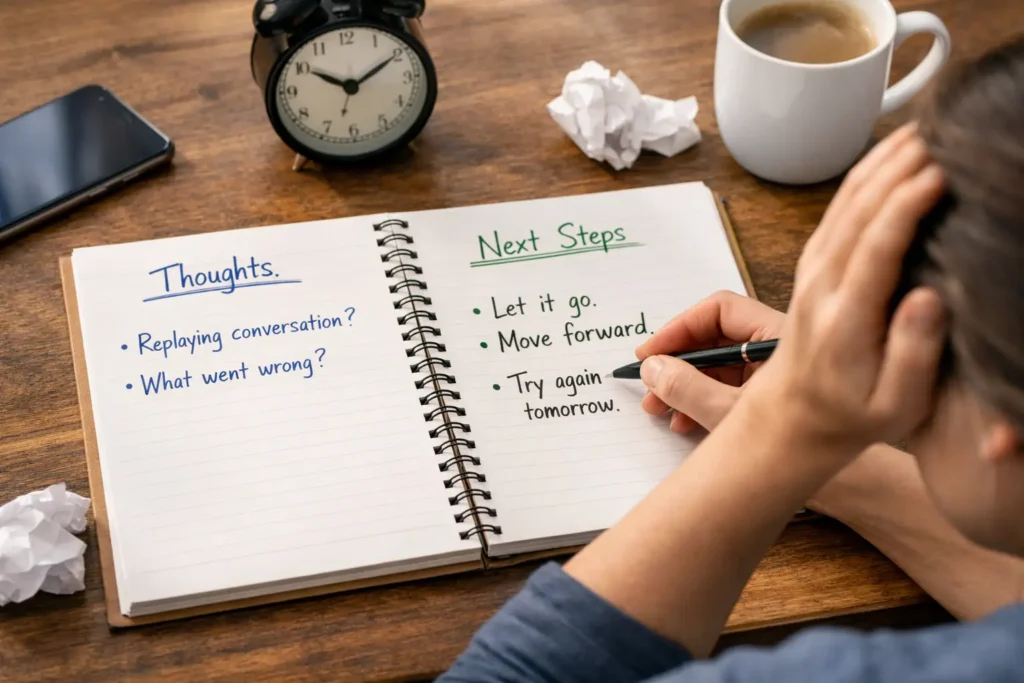
Direct answer: Yes—self-reflection can become “too much” when your thinking stops producing new insight and starts repeating the same loop, delaying action, and draining your energy. Helpful reflection ends with clarity and a next step; over-reflection keeps reopening the same question without changing what you do.
- Reflection ends with a clear takeaway and a real-world step.
- Rumination repeats the same theme and increases doubt.
- When there’s no new insight, stop and act on a small next step.
A one-paragraph reminder: what self-reflection is
Self-reflection is a deliberate check-in with your thoughts, reactions, and behavior so you can understand what happened and adjust what you do next. It’s meant to support learning and course-correction—not keep you stuck in your head.
When self-reflection becomes too much (clear signs)
Self-reflection crosses the line when it becomes a repeating pattern: you revisit the same situation, reach the same conclusion (or none), and still feel compelled to keep analyzing. This is a behavioral pattern, not a diagnosis.
- Same loop, new words: you keep rephrasing the problem instead of moving it forward.
- No output: you can’t name one clear takeaway.
- No next step: you stay in “preparation mode” and avoid even a small action.
- Certainty chasing: you wait to feel 100% sure before you move.
- Self-surveillance: you monitor every reaction to confirm you’re doing it “right.”
- Mistake spotlight: one moment becomes a full identity review.
- Energy leak: thinking leaves you depleted, not clearer.
- Compulsive checking: you keep revisiting “Did I do it right?” without new information.
- Decision delay: you postpone simple choices “until I understand myself.”
- Life shrink: thinking replaces doing, connecting, practicing, or resting.
Self-reflection vs rumination (the difference that matters)
The simplest way to tell them apart is the outcome. Reflection narrows toward clarity; rumination widens into more doubt.
Credibility note (plain-language): In psychology, rumination is commonly described as repetitive thinking that cycles around distress or uncertainty without moving toward resolution—more replay than progress. A quick reference definition is available via the APA Dictionary of Psychology (see: APA Dictionary: “rumination”).
| Signal | Self-reflection | Rumination |
|---|---|---|
| Goal | Understand, learn, adjust | Rehash, seek certainty |
| Time | Bounded (“I’ll think for 10 minutes”) | Open-ended (keeps restarting) |
| Emotional tone | Curious, honest, grounded | Urgent, self-critical, tense |
| Output | A clear takeaway + a next step | More questions + more doubt |
| After-effect | Relief or direction | Drain, paralysis, agitation |
Why “too much” reflection happens (without turning this into therapy)
Over-reflection often shows up when thinking starts acting like a safety strategy—something you do to reduce uncertainty before you move.
- Fear of mistakes: “If I think longer, I won’t mess up.”
- Need for control: analysis becomes a way to manage uncertainty.
- Perfectionism: you look for the “right” interpretation of everything.
- Action avoidance: thinking feels productive, but it delays real-world testing.
- Certainty-seeking: you wait for a feeling that rarely arrives.
None of this means reflection is bad. It means the stopping point is missing.
The missing ingredient: action (even a small one)
Reflection is meant to inform behavior. When action disappears, the mind tries to “solve” discomfort by thinking harder—often creating a loop. A small step doesn’t have to be dramatic. It just has to be real-world and doable.
Key takeaway: If you can’t produce a new insight, you’re done for today. Close with one action.
How to reset (simple stop rules, not a method)
Use these as boundaries when you notice you’re looping. Keep it simple: stop the loop, take one step.
- Time-box it: set a short limit, then stop when time ends.
- One insight + one action: if you can’t name both, you’re probably looping.
- “Think once, act once”: one round of reflection earns one small step.
- Good-enough clarity: act on what you know, not what you wish you knew.
- Switch channels: do something physical or practical for 2 minutes.
Two quick examples (everyday, not life-defining)
Example 1: replaying a comment you made in a meeting
Loop: “I keep replaying what I said. Did it land the wrong way?”
Reflection: pick one lesson you can use next time (e.g., “Pause before jumping in”).
One action: write one sentence you’ll use in the next meeting, then stop revisiting the moment.
Example 2: overanalyzing a small mistake
Loop: “What does this say about me?”
Reflection: trade the identity verdict for a behavior tweak (e.g., “Add a 2-minute check before submitting”).
One action: set up the single safeguard once and move on.
Common traps (and better replacements)
When to get extra support (quick note)
This article is for everyday self-awareness and balance. If you’ve been stuck in the same loop for weeks and it’s consistently harming your day-to-day life, consider speaking with a qualified professional.
- You can’t reliably exit loops, even after using simple stop rules.
- Self-criticism becomes constant and crowds out perspective.
- Reflection repeatedly replaces basic commitments you care about (work, relationships, routines).
What this article is (and isn’t)
This page is about the boundary where self-reflection stops helping and starts looping—plus simple ways to reset back to action. It does not teach a full self-reflection technique, include journaling routines, or offer mental-health treatment advice.
Frequently Asked Questions
Can you self reflect too much even if you’re learning something?
Yes. Learning can be real, but if reflection keeps reopening the same question and delaying action, it can still be “too much.” A quick check: can you name one takeaway and one small next step?
Should I stop self-reflecting completely if I tend to overdo it?
Usually no. The goal isn’t “no reflection,” but bounded reflection with stopping rules. Think briefly, capture one takeaway, take one small step, then return to real-world practice.