
Do Tarot Cards Predict the Future? What “Predict” Really Means (and How to Ask Safely)
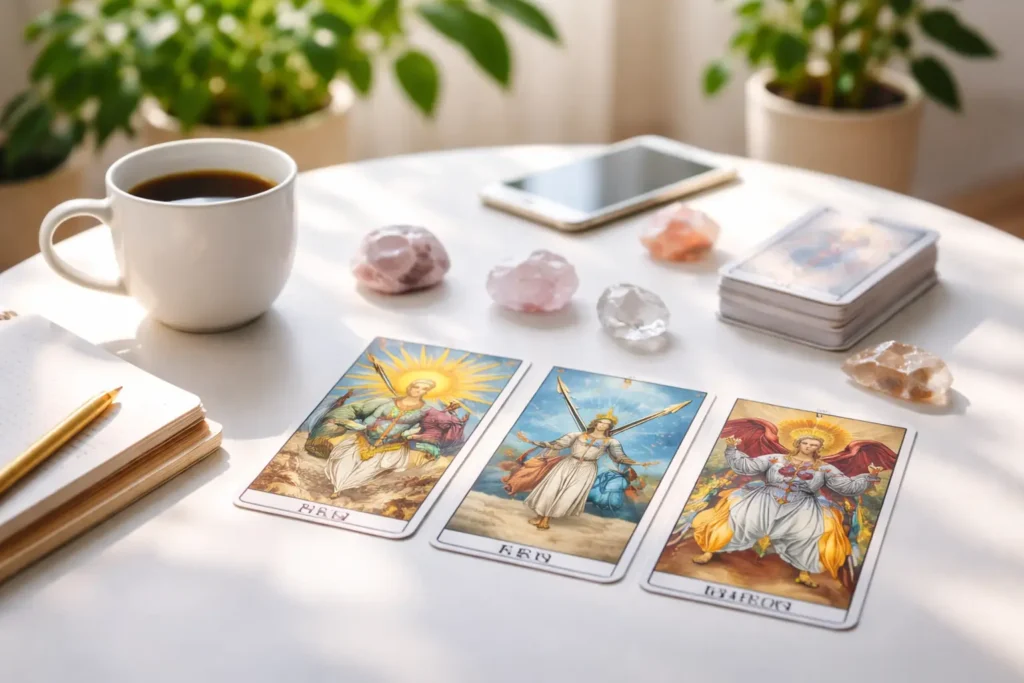
TL;DR: Tarot can’t reliably guarantee specific future events or exact outcomes. It can be used more responsibly to explore likely dynamics, what’s driving them, and what choices may shift the trajectory.
In this article, we’ll clarify what “predict” means, outline a simple taxonomy for future questions, and share a practical framework (with examples) for asking about the future without turning a reading into a verdict.
Disclaimer: Tarot is a reflective tool and not a substitute for professional medical, legal, or mental health advice.
Can tarot predict the future?
It depends on what you mean by “predict.” If you mean certainty—a guaranteed yes/no outcome, an exact result, or a specific date—tarot isn’t a reliable method for that kind of forecasting.
If, instead, you mean future-oriented guidance—clarifying what’s more likely if things continue as they are, what factors matter most, and what you can do next—many people use tarot as a grounded way to think through uncertainty while keeping their agency.
Credibility framing: There’s no reliable way to verify tarot as a tool for predicting specific future events with consistent accuracy. Tarot is better approached as reflective guidance: a way to explore dynamics, surface blind spots, and identify choices that may shift a trajectory. Treat it as a prompt for thinking and action—not proof of fate.
Simple rule: treat tarot as scenario guidance, not an event verdict.
A simple taxonomy of future questions (so you don’t mix modes)
1) Event prediction (highest risk)
Goal: a fixed outcome.
Examples: “Will he come back?” “Will I get hired?” “When exactly?”
Why it’s risky: it encourages certainty language and can trigger waiting, reassurance-seeking, and repeated pulls.
2) Probabilistic scenarios (most practical)
Goal: likely direction if nothing changes.
Examples: “If I change nothing, what’s the likely trajectory over the next 4–8 weeks?”
Why it helps: it answers the “what’s coming?” feeling without pretending the outcome is locked.
3) Decision-support (most empowering)
Goal: identify levers that influence outcomes.
Examples: “What choice improves my chances?” “What’s the trade-off of option A vs. option B?”
Why it helps: it turns uncertainty into something you can act on.
4) Meaning-making (keep it brief)
Goal: reduce fear and clarify values so you can make a steadier decision.
Examples: “What am I trying to protect?” “What boundary would support me?”
Framework: How to ask about the future without turning tarot into a verdict
This structure keeps the focus on “predict” as likelihood + leverage (not fate) and prevents spiraling or over-checking.
- Pick a time window: choose a container (2 weeks / 6 weeks / 3 months). Avoid open-ended timelines.
- Trajectory: if nothing changes, what’s the most likely direction?
- Drivers: what factors are shaping that direction (communication, timing, fear, resources, strategy)?
- Levers: what can you change that would shift the odds most?
- One grounded next step: one real-world action you can take now.
Then write one sentence (and stop there):
“If I keep doing X, Y becomes more likely; I’ll do Z next.”
If you want a simple structure to support this approach, use a 3-Card Spread for “trajectory / drivers / next step,” or a Two Paths Spread when you’re deciding between option A and option B.
Why do tarot predictions feel accurate?
People often experience tarot as “accurate” without needing it to be a literal forecast. A few common reasons:
- Confirmation bias: you remember hits more than misses and notice details that support the story.
- Selective memory: vague statements can feel specific in hindsight, especially when emotions are involved.
- Pattern recognition: humans naturally connect symbols to personal situations, which can create meaningful insight.
- Behavioral feedback loops: a reading can change what you do next (how you communicate, what you tolerate), which can influence outcomes.
- Forer/Barnum-style effects: broadly relatable language can feel highly personal when it matches your concerns.
This is why future readings are safest when they stay conditional and actionable. When you treat a reading like a verdict, it can quietly become a script.
Mini-case #1: “Will he text me?” (make it future-focused without waiting mode)
Verdict question: “Will he text me?”
This often creates a waiting loop. A safer approach is to ask for dynamics and levers within a defined time window.
Reframe (scenario + drivers + levers):
- “If I stop initiating for the next two weeks, what’s the likely dynamic?”
- “What’s driving the distance right now?”
- “What boundary or action would support a healthier outcome?”
Example scenario output (what “predict” can responsibly mean):
- Most likely trajectory if unchanged: contact stays inconsistent and you remain in uncertainty.
- What could derail the outcome you want: anxious chasing, mixed signals tolerated, unclear standards.
- What increases the odds of a healthier result: one clear message (or none), then space plus observable behavior.
This is what “predict” means here: not fate, but likelihood + leverage—what becomes more likely given the current pattern, and what changes the odds.
One grounded next step: choose one action (send one calm message or go no-contact for a defined window), then observe real behavior instead of re-checking the cards.
Mini-case #2: “Will I get the job?” (avoid passivity and doom framing)
Verdict question: “Will I get hired?”
If the answer feels “no,” it can discourage you. If it feels “yes,” it can make you passive. Instead, ask for drivers and levers you can influence.
Reframe (decision-support):
- “What’s my strongest advantage in this process?”
- “What risk could undermine me—and how do I reduce it?”
- “What should I focus on this week to improve my odds?”
Example scenario output:
- Most likely trajectory if unchanged: you perform adequately but don’t differentiate enough.
- What could derail it: unclear fit narrative, weak follow-up, over-fixation on one role.
- What increases your odds: a sharper story of impact + one value-add follow-up.
This is what “predict” means here: not fate, but likelihood + leverage—the direction things tend to move if nothing changes, and the actions that can improve your chances.
One grounded next step: send a targeted follow-up that demonstrates fit (brief case study, portfolio snippet, or specific proof of impact) and apply to 1–2 backup roles to reduce over-attachment.
Can tarot predict timing?
Exact timing is difficult to treat responsibly because it invites certainty language and obsessive checking. If you ask about timing, treat it as a rough window (weeks, not exact dates), a sequence (what comes first, what follows), or signals of momentum.
Safer timing question: “What signs show this is moving forward, and what signs show it’s stalled?”
When not to ask tarot about the future
Avoid future-focused readings when you feel panicky or obsessive, when you keep asking the same question for reassurance, or when you’re using tarot to delay a decision you already need to make.
High-stakes note: For medical, legal, or safety situations, don’t use tarot as guidance—use qualified professional help and real-world information.
Reminder: Tarot is a reflective tool and not a substitute for professional medical, legal, or mental health advice.
Key takeaways
- “Predict” can mean certainty or scenario guidance—they’re not the same.
- The safest future questions focus on time windows, drivers, levers, and next steps.
- If a reading triggers fear, pause and reality-check instead of pulling more cards.
Frequently Asked Questions
Can tarot cards actually predict the future?
It depends on what you mean by “predict.” If you mean guaranteed events or exact outcomes, tarot isn’t a reliable way to get certainty. If you mean exploring likely dynamics and what could change them, tarot can be used more responsibly through conditional, actionable questions.
Why do people say tarot predictions come true?
Readings can feel “true” because they influence attention and behavior—what you notice, how you interpret signals, and what choices you make next. That can create a feedback loop where a “prediction” becomes a script. A safer approach is to treat messages as hypotheses: “If I keep doing X, Y becomes more likely.”
What’s the safest way to ask tarot about the future?
Use a time window and conditional phrasing. For example: “If nothing changes, what’s the likely direction in the next 6 weeks?” and “What factor would most improve the outcome?” This keeps the reading future-focused without turning it into a verdict.
Should I ask tarot yes/no questions about the future?
Yes/no questions often push you into verdict territory and can increase anxiety. If you want clarity, it’s usually better to ask for trajectory + levers: “What’s the likely outcome if I continue this way, and what changes it?”
Can tarot predict timing or exact dates?
Exact dates are unreliable and can encourage obsessive checking. If you ask about timing, treat it as a rough window or sequence, and focus on momentum signals rather than calendar promises.
What should I do if a tarot reading scares me?
Pause and don’t pull more cards immediately. Translate fear into an actionable question (“What increases this risk, and what reduces it?”), then take one grounded real-world step—check facts, communicate, or get support.