
Does Astrology Affect Personality? How It Influences Self-Description
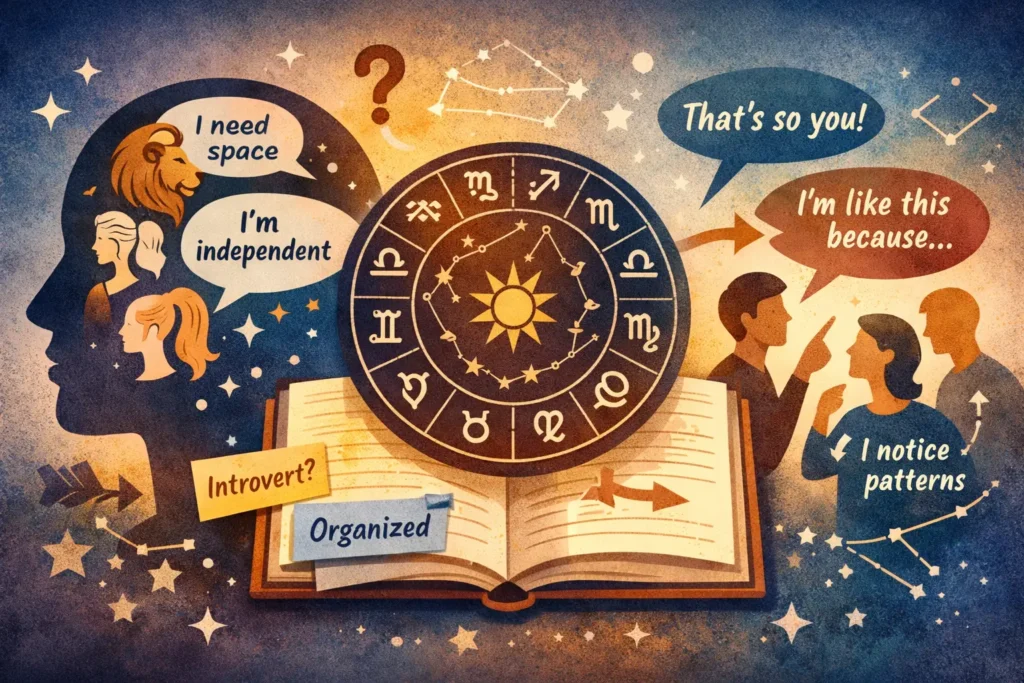
Direct answer: Astrology can influence how you describe your personality—not by causing traits, but by shaping the labels you use, the explanations you repeat, and the identity story you build around your behavior. The influence happens through interpretation, language, and expectations—not through objective “personality creation.”
- Astrology tends to influence self-perception more than stable traits.
- Labels can clarify patterns—or compress a complex person into a type.
- Expectations can become habits through repetition and attention.
- Key frame: vocabulary, not verdict.
Personality vs. Self-Perception: What People Usually Mean
When someone asks, “Does astrology affect personality?” they often mean one of two things: Does it define my traits? or does it influence how I understand and describe myself? This article focuses on the second.
Personality refers to relatively stable tendencies—how you usually think, feel, and act across situations. Self-perception (self-concept) is the story you tell about who you are: the labels you use, the reasons you give, and the identity themes you repeat.
- What this is: a practical explanation of identity and interpretation.
- What this isn’t: horoscopes, predictions, destiny claims, or moral/religious framing.
- Also not: a proof/disproof debate.
The Key Distinction: Astrology Can Describe Without “Creating” You
Astrology often feels personal because it offers a ready-made vocabulary for self-reflection: “I need space,” “I overthink,” “I’m driven,” “I feel things intensely.” That language can help you notice patterns. Problems start when description turns into a verdict—when “this resonates” becomes “this is fixed.”
| Claim type | What it sounds like | What it risks | Safer rewrite |
|---|---|---|---|
| Symbolic description | “This fits how I’ve been feeling lately.” | Low risk; stays flexible. | “This gives me words for a pattern I notice.” |
| Identity label | “I’m a Virgo, so I’m just like that.” | Can harden into a fixed self-story. | “I tend to prefer structure, especially when I’m stressed.” |
| Deterministic rule | “My sign determines my personality.” | Encourages inevitability and excuses. | “I don’t want a label to decide my options.” |
| Interpersonal stereotype | “You’re a Scorpio, so you’re untrustworthy.” | Reduces a person to a shortcut. | “Let’s talk about specific behavior, not categories.” |
Astrology as a Vocabulary for Identity
Why “I’m like this because…” feels comforting
Identity labels reduce uncertainty. If you’re juggling contradictions—confident in one context, anxious in another— a label can make your inner life feel coherent. Astrology also offers broad archetypes (sensitive, practical, intense, curious) that can function like prompts for reflection.
When vocabulary becomes a verdict
The same language becomes restrictive if you start filtering your choices through it: “I can’t do that,” “I always do this,” “I’m not built for that.” At that point, the label stops being a prompt and starts operating like an identity rulebook.
- Flexible frame: “This helps me name a pattern.”
- Rigid frame: “This tells me what I can’t change.”
The Label Effect: How Typing Simplifies a Complex Person
Labels are efficient. They let you summarize a personality in a sentence instead of a memoir. That efficiency can feel helpful for self-understanding and social connection—but it also compresses complexity. Real people are inconsistent, context-dependent, and capable of change.
A subtle downside: once you adopt a label, you may start explaining behavior through it even when there are simpler, more useful explanations (stress, sleep, boundaries, habits, environment).
Where labels help—and where they limit
- Helpful: “sometimes” language (“I sometimes withdraw when overwhelmed”).
- Helpful: context (“I’m more sensitive under pressure”).
- Limiting: absolutes (“I always,” “I never,” “I can’t change”).
- Limiting: outsourcing responsibility (“My sign made me do it”).
- Limiting: stereotyping others instead of observing behavior.
Self-Fulfilling Expectations: How a Label Can Shape Behavior Over Time
A common pattern is simple: when you expect a certain version of yourself, you’re more likely to act in ways that match it. Over time, those choices can feel like “proof,” even if they started as a suggestion.
- Label: “I’m the intense one.”
- Expectation: “I’ll probably react strongly.”
- Behavior: You lean into strong reactions—or skip a pause.
- Reinforcement: The pattern repeats and feels more “like you.”
Four mechanisms that make labels feel influential
- Identity shorthand: a label becomes a quick summary of “who I am,” so you reach for it when explaining yourself.
- Selective attention: you notice moments that fit the label faster, while non-fitting moments fade into the background.
- Social reinforcement: other people may echo the label (“That’s so you”), turning it into a shared script.
- Attribution: the label becomes the reason (“I’m like this because…”), which can replace more useful explanations.
This is about how labels and narratives work—regardless of your beliefs about astrology. The main point is that interpretive language can steer attention, explanations, and habits.
Why People Enjoy Typing (Without Turning It Into a Rule)
Astrology-based typing is popular for reasons that don’t rely on determinism. For many people, it works as social shorthand and a personal mirror—a quick way to start a conversation about patterns.
- Belonging: shared language creates instant connection.
- Recognition: a description can feel like “finally, words for this.”
- Simplicity: a shortcut beats a long self-analysis.
- Curiosity: archetypes make reflection feel less clinical.
- Storymaking: narratives help organize experience.
Two Mini-Cases: Turning a Sign Label Into a Clearer Self-Description
Mini-case 1: Social energy and “introvert” identity
Label version: “I’m an introvert because of my sign—so I’m just not social.”
More precise version: “I feel drained in big groups, loud spaces, or back-to-back plans, and I need recovery time.”
The useful takeaway is a concrete pattern you can observe—not a permanent identity limit.
Mini-case 2: Creativity, structure, and self-excuse
Label version: “My sign isn’t disciplined, so routines never work for me.”
More precise version: “Routines fail when they’re too strict or when I’m tired, but small flexible habits tend to stick.”
The useful takeaway is how you function in context—not what a type says you are.
A brief note on stereotyping others
Sign-based assumptions can shape how you interpret other people. If you start “reading” someone through a category, you may miss what they’re actually doing. It’s more accurate to anchor conclusions in observable behavior.
Keeping Zodiac Language Flexible
The simplest guardrail is to treat zodiac language as vocabulary, not a verdict. Translate sign-talk into specific, contextual patterns you can observe.
5 high-impact rewrites (from rigid to flexible)
- “I’m a ___ so I always ___” → “I sometimes notice ___, especially when ___.”
- “That’s just how my sign is” → “That’s a pattern I’m trying to understand.”
- “I can’t help it” → “I can pause and choose my next step.”
- “You’re a ___, so you’re ___” → “Let’s talk about what happened, not a category.”
- “This explains everything” → “This is one lens I’m using.”
If astrology content increases anxiety or compulsive checking, it’s okay to take a break and return to real-world observation.
For decisions, categories are less useful than observable facts.
Summary: What “Astrology Affects Personality” Usually Looks Like
Astrology is unlikely to “create” personality in a direct, causal way. What it can influence is your self-description: the labels you adopt, the explanations you repeat, and the expectations you carry. Those interpretations can steer attention and behavior over time—especially if a label hardens into a rigid identity rule.
The most useful approach is simple: keep language flexible, describe patterns in context, and let labels stay lightweight.
Frequently Asked Questions
Can astrology influence how I describe myself?
Yes. Zodiac language can give you quick words for emotions, preferences, and patterns. If you repeat that language often, it can become part of your identity story—even if it doesn’t “cause” the traits.
What’s the difference between a label and a trait?
A trait is a tendency you show across many situations. A label is a summary you use to explain yourself. Labels help when they stay flexible and specific; they limit when they turn into absolutes.
How do I keep astrology labels flexible?
Translate them into observable, contextual statements: use “sometimes,” name triggers, and describe what you do—not what you “are.” If a label narrows your options or replaces real observation, loosen it.
Does astrology affect personality or self-perception more?
It’s more likely to affect self-perception—the narrative and language you use—than to create stable traits. The influence is interpretive: how you explain yourself, not what you’re objectively made of.
Can astrology change how you behave?
Indirectly, yes—through expectations, attention, and repetition. If you treat descriptions as rules, you may act in line with them. If you treat them as prompts, you can keep the reflection without turning it into a fixed identity.