
How Manifestation Shapes Long-Term Motivation and Consistency
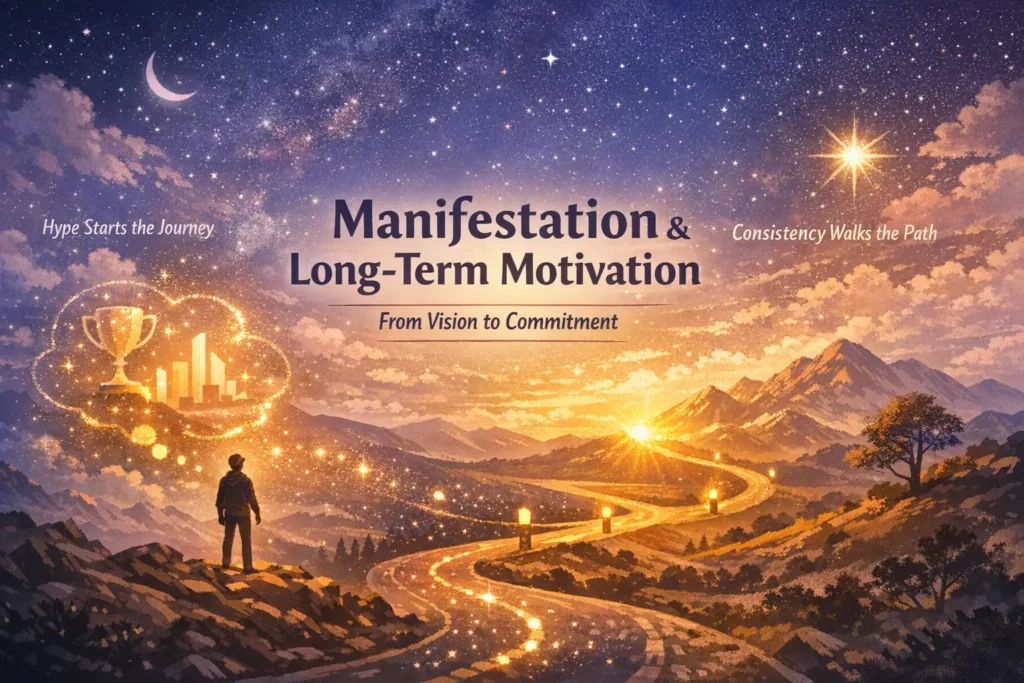
Manifestation can shape long-term motivation by changing how a person sees the path toward a goal. In this context, long-term motivation is not daily inspiration or a short burst of excitement. It is the ability to continue showing up across months, including after delays, distractions, and dips in momentum. Consistency, in turn, does not mean perfect discipline without interruption. It means staying in the process long enough for action to keep mattering.
What Long-Term Motivation Means Here
Here, long-term motivation is not the emotional high that makes a new goal feel exciting at the start. It is the ability to keep a goal in view over time and continue acting on it after the first lift is gone.
That is what makes it different from short-term enthusiasm. Excitement can help a person begin. Long-term motivation matters later, when progress is slower, the mood is less supportive, and the goal still requires attention and follow-through.
Why Manifestation Can Matter to Consistency
Manifestation can matter here because it may change what the path represents. Instead of seeing it only as hard work aimed at a distant outcome, a person may begin to see it as part of a larger direction. That shift does not create discipline by itself, but it can make the process feel less empty and easier to keep choosing over time.
Identity Framing: From Getting Something to Becoming Someone
One way manifestation framing may shape long-term motivation is through identity. Instead of focusing only on a finished outcome, a person may start to see the goal as part of who they are becoming.
A goal tied only to a final result can feel distant and all-or-nothing. A goal tied to identity feels more continuous. The question becomes less “Did I get there yet?” and more “Is this still part of the person I am becoming?”
That difference matters. A pause no longer has to mean the whole process has failed. A setback may interrupt progress, but it does not automatically erase the larger direction.
Narrative Continuity: The Goal Feels Like Part of a Larger Story
Manifestation can also make a goal feel like part of a larger personal story rather than an isolated task. An isolated task is easier to drop when energy falls. A goal that feels linked to a broader direction usually carries more weight.
This does not make the work easier in practical terms. It changes the context around it. When action feels like one chapter in a longer story, it is easier to see why the chapter still matters even when it is not dramatic.
Emotional Reinforcement: Small Steps Feel Like They Count
Manifestation framing can also change how everyday action feels. Instead of treating the present as dead time before “real” progress begins, a person may start to view small steps as evidence that the process is already underway.
That can matter during slower periods. A short session, a restart after a break, or one imperfect move can feel meaningful instead of negligible. Motivation does not become automatic, but the work may feel less pointless.
Meaning Attachment: The Goal Feels Bigger Than Today’s Mood
Manifestation can also attach more meaning to a goal by linking it to a wider picture of the future. When that happens, a short-term drop in energy has less power to define the whole path.
Meaning can last longer than hype. If the goal feels tied to something larger than today’s mood, the work may still seem worth doing during uneven periods.
Short-Term Motivation vs Long-Term Consistency
Short-term motivation and long-term consistency are not the same. Short-term motivation often looks intense, emotional, and immediate. Long-term consistency is quieter. It is less about intensity and more about staying with the process across time.
| Short-Term Motivation | Long-Term Consistency |
|---|---|
| Often intense and emotional | Usually steadier and less dramatic |
| Can depend heavily on mood | Can continue through uneven moods |
| Strong at the beginning | Shows up across weeks and months |
| Often weak after a pause | Includes the ability to resume |
Consistency is not perfect discipline without interruption. It is the ability to keep going in a real-world way, including pauses, uneven stretches, and renewed action. Hype starts motion; consistency keeps the goal alive.
Action Still Matters
Mindset can support consistency, but action is still what shapes outcomes. Manifestation may influence how a person sees the path, yet it does not replace skill, timing, or real-world conditions.
The frame may help someone keep choosing the work. It does not produce the result by itself.
What Manifestation Cannot Do for Consistency
- It does not guarantee discipline.
- It does not make motivation permanent.
- It does not replace skill, action, timing, or reality.
- It does not remove outside limits or circumstances.
That limit should stay clear. Manifestation may change how the journey is described and perceived, but it does not promise smooth progress or automatic results.
Bottom Line
How manifestation shapes long-term motivation and consistency is less about creating force and more about shaping meaning. Its value is not that it produces discipline on command. Its value is that it can make the path feel more connected, more worthwhile, and easier to keep choosing when momentum weakens.
Manifestation does not create consistency on its own. What it can do is make the process feel significant enough to continue when excitement is no longer doing the work. Results still come from action, skill, timing, and reality.