
How to Self Reflect Effectively
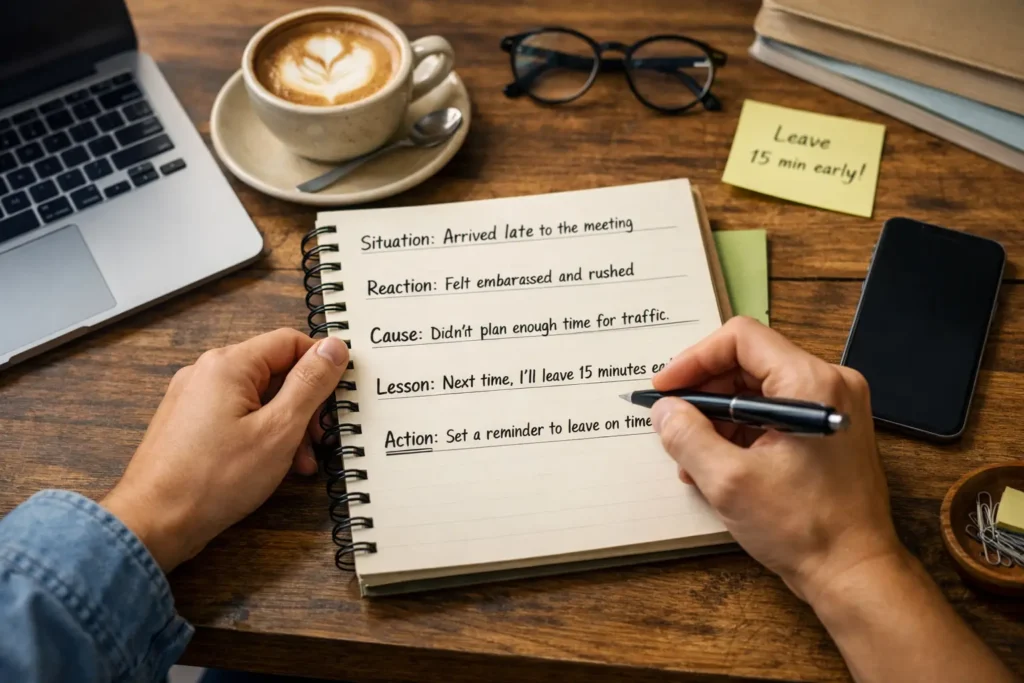
Self reflection works best when you use a simple structure: describe what happened, name your reaction, identify the cause, extract a lesson, and choose one next step. This keeps reflection productive and reduces the chance it turns into rumination or harsh self-criticism.
If you do only one thing: end every reflection with one takeaway sentence and one next action.
- Start with facts, not assumptions
- Extract one practical lesson
- End with one small next action
What Self Reflection Is (In One Sentence)
Self reflection is a structured review of a specific experience so you can understand your response and make a clearer choice next time.
Why It Matters to Do It the Right Way
Unstructured reflection often becomes mental replay: you revisit the same moment, generate more interpretations, and walk away feeling stuck. A simple process keeps you grounded in what actually happened and nudges you toward a realistic adjustment.
The goal is not to find the “perfect” explanation. The goal is to gain enough clarity to choose one helpful next step.
The 5-Step Model for Effective Self Reflection
This is similar to structured reflection approaches used in education and coaching.
Step 1: Describe the Situation (Facts First)
Describe what happened in plain language. Stick to observable facts: what was said, what was done, what the timing was, and what the outcome was.
- Do: “I arrived late; the meeting had already started.”
- Don’t: “Everyone was judging me.”
Step 2: Identify Your Reaction (Emotion + Behavior)
Name what you felt and what you did. Keep it specific. This helps you separate the event from your response to it.
- Emotion: embarrassed, annoyed, tense, relieved
- Behavior: went quiet, over-explained, avoided eye contact, rushed
Step 3: Identify the Cause (What Drove the Reaction?)
Look for the most likely driver: an assumption, a sensitivity, a pattern, or a specific pressure point. Keep this practical, not dramatic.
Micro example: Assumption: “If I ask, I’ll look incompetent.”
- An assumption you made (“They’ll think I’m unreliable.”)
- A pattern you repeat (people-pleasing, avoiding conflict, perfectionism)
- A pressure point (being rushed, feeling unprepared, lack of sleep)
Step 4: Extract the Lesson (One Clear Takeaway)
Turn the experience into one sentence that helps you adjust. A good lesson is specific and usable.
Micro example: Lesson: “When I’m unsure, asking one question beats guessing.”
- Weak: “I need to be better.”
- Better: “When I feel rushed, I over-explain; pausing helps me respond clearly.”
Step 5: Choose the Next Action (One Small Adjustment)
Pick one realistic step you can test next time. Keep it small enough that you’ll actually do it.
- Pause for one breath before responding
- Ask one clarifying question instead of guessing
- Set a simple boundary (“I can reply by tomorrow.”)
- Prepare one line in advance for a repeated situation
Quick Checklist: The “Effective Reflection” Loop
- Situation: What happened (facts)?
- Reaction: What did I feel/do?
- Cause: What drove that reaction?
- Lesson: What’s the takeaway?
- Action: What’s one small change next time?
Lesson: ___ | Next action: ___
Reflection vs Rumination (How to Tell the Difference)
Reflection is a focused review that ends with a takeaway or action. Rumination is repetitive replay that keeps you stuck in the same loop.
| Reflection | Rumination |
|---|---|
| Feels like sorting information | Feels like replaying the same scene |
| Creates more clarity over time | Creates more tension or frustration |
| Leads to a lesson or next step | Ends with “Why am I like this?” |
| Has a natural stopping point | Has no finish line |
| Output: 1 takeaway sentence | Output: more questions, no output |
Simple test: If you can name a lesson or next action, you’re reflecting. If you’re repeating the same thoughts with rising irritation or fatigue, you’re likely ruminating.
Timebox it: If you can’t reach Lesson + Action in 10–15 minutes, stop and revisit later.
If you’re stuck: return to Step 1 (facts) and choose one next action — or stop.
Two Examples (Everyday Situations)
Example 1: You Snapped at a Friend in a Group Chat
Question: “Why did I respond so sharply?”
Approach: Separate the event from the reaction and look for the driver.
- Situation: A joke was made about something you care about.
- Reaction: You felt defensive and replied quickly with a harsh tone.
- Cause: You assumed you were being mocked, not teased.
- Lesson: “When I feel exposed, I interpret humor as criticism.”
- Next action: Ask one clarifying question before responding (“Wait—are you joking or serious?”).
Safe conclusion: You don’t need a perfect explanation; you need a small adjustment that reduces repeats.
Example 2: You Kept Procrastinating on a Personal Task
Question: “Why can’t I start this?”
Approach: Identify what you’re avoiding (effort, uncertainty, imperfection) and make the next step smaller.
- Situation: You planned to organize a messy room but kept delaying.
- Reaction: You felt overwhelmed, avoided it, and distracted yourself.
- Cause: You assumed it would take hours and had to be done perfectly.
- Lesson: “Perfection pressure makes me avoid starting.”
- Next action: Set a single, small start (“Clear one surface, then stop.”).
Safe conclusion: The goal is momentum and learning, not flawless follow-through.
Questions to Ask for Effective Self Reflection
Use these questions to stay structured and avoid drifting into self-criticism.
Situation (Facts)
- What exactly happened (in plain, observable terms)?
- What did I see or hear that I know is true?
- What parts am I assuming or interpreting?
Reaction (Emotion + Behavior)
- What did I feel in the moment?
- What did I do or avoid doing?
- What did I need right then (clarity, space, reassurance, time)?
Cause (Driver)
- What did I believe was happening?
- What assumption did I make about others or myself?
- Is there a pattern I’ve seen before?
Lesson
- What does this teach me about my patterns, sensitivities, or habits?
- What would I like to do differently next time?
- What’s one useful sentence I can carry forward?
Next Action
- What is one small adjustment I can realistically try?
- What would “better” look like in the next similar moment?
- What would help me pause before reacting?
Common Mistakes That Make Reflection Unproductive
- Turning reflection into self-criticism: describing yourself as “bad” instead of describing a behavior you can adjust.
- Searching for the perfect answer: reflection works with a “good enough” takeaway.
- Reflecting when you can’t separate facts from interpretation: you’re more likely to guess, label, and spiral.
- Replaying instead of learning: repeating the same story without extracting a lesson or action.
- Trying to solve everything at once: pick one focus, one lesson, one next step.
When Not to Use This (And When to Stop)
This structured approach is for everyday situations where you want clarity and a small adjustment. It’s least effective when you can’t stick to facts and a simple next step.
- Stop if thoughts repeat without a new conclusion.
- Stop if irritation or tension keeps rising.
- Stop if you feel mentally tired or foggy.
- Pause if you can’t describe the situation calmly enough to separate facts from assumptions. Come back when you can.
Editorial Note
This is a practical, everyday reflection process for self-development. If you can’t exit the loop, pause and get support that fits your situation.
Frequently Asked Questions
What is the best way to self reflect?
The best way is to follow a simple structure: situation, reaction, cause, lesson, and one next action. This keeps the process focused and prevents overthinking.
How do I know if I’m reflecting or ruminating?
If you’re gaining clarity and can name a lesson or next step, you’re reflecting. If you’re repeating the same thoughts with rising frustration or fatigue, you’re likely ruminating.
How long should self reflection take?
It should be long enough to produce one useful takeaway and a small next action. If you can’t reach Lesson + Action in 10–15 minutes or you’re looping without new insight, it’s usually better to stop and revisit later.
How can I reflect without being self-critical?
Focus on describing the situation and your behavior, not labeling your character. Replace “I’m terrible” with “I reacted quickly when I felt pressured.”
What questions should I ask during self reflection?
Start with “What exactly happened?” then “What did I feel/do?” and “What drove that reaction?” End with “What’s the lesson?” and “What’s one small change next time?”
Can self reflection be unhelpful?
Yes. If it turns into repetition, self-blame, or mental exhaustion, it’s no longer productive. A good signal is whether you can reach a clear takeaway and stop.