
How to Use Astrology to Make Decisions (Without Prediction)
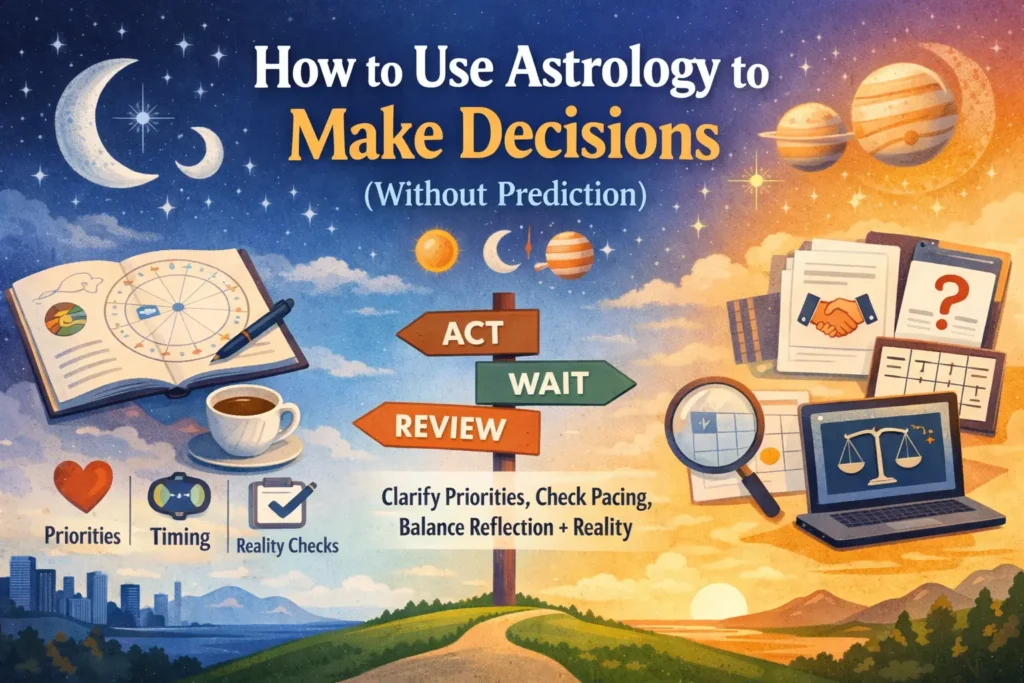
Direct answer: You can use astrology to make decisions by treating it as a reflection-and-timing framework: it helps you clarify priorities, notice pressure points, and choose a workable window to act, review, or wait. It’s interpretive and symbolic, so use it to generate better questions and a safer plan—not to replace facts, experts, or due diligence.
- Start with the decision: define what “better” means before you look at any chart.
- Use three lenses: priorities, timing prompts, and real-world constraints.
- Use minimum viable astrology: a small set of signals—then stop.
- Choose good-enough timing: reduce avoidable friction, don’t chase perfection.
- For high-stakes choices: evidence and qualified professionals come first; astrology stays secondary.
In 60 seconds: the process
- Define the choice and 2–4 success criteria.
- Classify it (reversible vs irreversible; time-flexible vs time-sensitive; stakes).
- Pick the life area (house theme) the decision touches.
- Check context (slow-cycle themes like “commit” vs “expand”).
- Pick pacing (lunar rhythm + review periods like Mercury retrograde).
- Reality-check (budget, deadlines, terms, downside plan).
- Commit to next steps and log what you learn.
What astrology is (and isn’t) for decision-making
Used responsibly, astrology can function like a structured prompt system: it helps you reflect on what matters, name tradeoffs, and pace action. The goal isn’t “the stars decide for me,” but “this framework helps me decide more intentionally.”
What it isn’t: a way to get guaranteed answers, a verdict on your future, or a replacement for contracts, budgets, timelines, and due diligence.
Step one: classify the decision so you don’t overuse astrology
Classify the decision first. This keeps astrology in the right lane and reduces cherry-picking.
| Decision type | How astrology can help | Best astrology tools for this type | What not to do |
|---|---|---|---|
| Reversible | Clarify priorities and choose a window where you can focus and verify details as you test small and iterate. | Houses (life area) + lunar pacing + decision journal | Wait forever for a “perfect” sign. |
| Irreversible | Slow down impulsivity, name risks and non-negotiables, plan buffers. | Slow-cycle context (Saturn/Jupiter themes) + journaling prompts + reality checks | Use astrology as the deciding vote. |
| Time-flexible | Use timing as optimization: choose a workable start window and plan steps. | Electional astrology (lite) + lunar pacing + context check | Force action when you can wait without cost. |
| Time-sensitive | Reduce friction: confirm details, add buffers, and plan contingencies. | Mercury retrograde as “review” + checklists + simple pacing | Delay past deadlines to “wait it out.” |
| High-stakes | Use astrology only as a reflection layer after evidence and expert input. | Journaling prompts only + conservative pacing + buffers | Skip experts, evidence, or second opinions. |
Decision tree: Act vs Wait vs Review
- If high-stakes or irreversible: start with facts, expert advice, and risk planning; use astrology only for reflection and pacing.
- If time-flexible: choose a window where you can focus and verify details, or build a phased plan.
- If time-sensitive: proceed with buffers, confirmations, and a clear contingency plan.
- If you feel obsessive: pause and return to practical tools (pros/cons, budget, timeline, accountability).
How to use astrology for decision-making (without prediction)
This method keeps your agency intact: astrology provides prompts; reality checks decide what’s workable.
The 3-lens method
Lens 1: your priorities (chart as a values map, not a personality label)
Choose the life area first (often described through houses) and define what “support” looks like there.
- Home and base: stability, privacy, rest.
- Money and resources: sustainability, value, budgeting.
- Health routines: capacity, consistency, recovery time.
- Learning and travel: curiosity, expansion through experience.
- Community and goals: collaboration, long-term direction.
Lens 2: timing prompts (cycles as context, not commands)
Separate slow context (the season you’re in) from short pacing (how you sequence steps).
Lens 3: reality checks (constraints, consequences, accountability)
Reality checks keep the process honest: money, time, terms, obligations, support, and what you’ll do if the plan goes sideways.
- Constraints: budget, deadlines, contracts, logistics.
- Consequences: downside risk, reversibility, opportunity cost.
- Accountability: who can sanity-check your plan?
What to check in astrology (beginner-friendly)
If you’re new, keep it small. Use this minimum viable astrology set as prompts—then stop searching for more “signs.”
-
Life area (houses):
Identify which part of life the decision affects (home, money, work, relationships, health routines, goals). Prompt: “What does stability and support look like here?”
-
Slow context (Saturn/Jupiter themes):
Label the season: more commitment/structure (Saturn-style) or more exploration/expansion (Jupiter-style). This isn’t “yes/no”—it helps you choose tradeoffs.
-
Lunar pacing:
Use moon phases as project rhythm: set intent, take steps, review, close out. It’s pacing, not outcomes.
-
Mercury retrograde as “review”:
Use it as a reminder to double-check details and add buffer time. Don’t treat it as a universal stop sign.
-
One personal trigger point:
If you know your birth time, many people track transits to a core point (often the Sun, Moon, or Ascendant) as a journaling and reflection prompt about needs and direction. If you don’t, keep it broad: focus on themes, pacing, and safeguards.
Aspects (beginner-friendly): tension vs ease as prompts
Aspects describe how two points relate. Use them as planning posture—not predictions.
- Hard aspects (square/opposition): prompts about friction, limits, tradeoffs, and the need for extra planning or buffer time.
- Soft aspects (trine/sextile): prompts about smoother collaboration, momentum, and a smoother planning posture.
If you’re seeing more tension prompts, plan extra time for negotiation, revisions, or edits. If you’re seeing more ease prompts, use that window for coordination, scheduling, or launching tasks—without assuming any specific outcome.
How to check these signals (without going down a rabbit hole)
- Get your birth data—or skip it. If you have date/place (and ideally time), great. If not, you can still use lunar pacing and review periods responsibly.
- Check the current lunar phase. Use it to sequence steps (draft → act → review → close out), not to “force” a result.
- Check a Mercury retrograde calendar. Treat it as a “review more” reminder: confirmations, backups, and buffer time.
- If you have bandwidth, check 1–2 major transits. In this safe approach, “major” means: pick one slow-moving planet theme (Saturn/Jupiter-style context) plus one personal-point check (Sun/Moon/Asc) as a reflection prompt—don’t stack dozens of indicators.
Use a reputable ephemeris tool to see whether a transit is exact/near-exact to your Sun/Moon/Asc; if you can’t check that confidently, skip this step and rely on pacing + reality checks.
Limit: follow “one context + one pacing.” Pick one context theme (slow cycle) and one pacing tool (lunar or review), then return to execution.
Timing basics (short version)
Slow cycles for context: “expand” vs “commit”
Use Saturn/Jupiter-style themes to frame tradeoffs at a high level. For a deeper dive, see our upcoming guide to slow cycles and long-term planning.
Lunar cycle for pacing
Use moon phases as a simple planning rhythm (start, build, review, close). For a deeper dive, see our upcoming guide to lunar phases and decision pacing.
Retrogrades as review cycles
Use retrogrades (especially Mercury) as “review more” reminders. For a deeper dive, see our upcoming guide to Mercury retrograde and practical planning.
Electional astrology (lite): choosing a workable start window
Electional astrology is about choosing a start time; use it for priorities and risk reduction, not perfection. For a deeper dive, see our upcoming guide to electional astrology.
- Pick your priority: speed, stability, visibility, or ease.
- Reduce obvious friction: schedule extra review time if paperwork or coordination is involved.
- Choose a realistic window: timing supports the plan; it doesn’t replace it.
Expanded version of the 60-second steps
- Define “better” and non-negotiables. Keep it concrete (time, money, boundaries, capacity).
- Match your approach to stakes. Reversible decisions get experiments; irreversible ones get slower pacing and stronger safeguards.
- Choose one life-area focus. Name what stability/support looks like in that area (home, money, work, relationships, routines, goals).
- Use one context + one pacing tool. One slow-cycle theme (Saturn/Jupiter-style) plus one pacing tool (lunar or review) is enough.
- Commit to a next step with a date. Act now, wait until X, or review with a checklist—then stop rechecking.
Decision journal template: “I’m deciding between ___ and ___. ‘Better’ means ___. My non-negotiables are ___. The biggest risk is ___. I will reduce risk by ___. My next step by (date) is ___. If I feel stuck again, I’ll revisit ___.”
Examples (not predictions)
Example 1 (short): “Should I book a major trip now, or wait?”
Priorities: rest vs novelty, stress tolerance, budget ceiling.
Pacing: use context to choose buffer vs flexibility; pick a window where you can focus and verify details (documents, policies) before committing.
Reality checks: refunds, insurance, time-off approval.
Safer decision: make it reversible where possible (refundable options, checkpoint before final commitments).
Example 2 (short): “Should I start a daily creative practice, or redesign my routine first?”
Priorities: consistency, privacy, time, encouragement.
Pacing: try a two-week micro-practice for momentum; simplify tools and friction points first if you need review.
Reality checks: calendar bandwidth, energy, minimum viable setup.
Safer decision: keep it reversible, track what works, then scale.
Example 3 (key SERP): “Should I change jobs or accept an offer?”
Priorities: sustainability vs growth, learning curve, manager/team fit, boundaries, long-term direction.
Use astrology as prompts: map the decision to work/career themes (life area) and choose one context lens (commit/structure vs expand/explore). If the lens is “structure,” prioritize clarity, terms, and sustainability. If it’s “expansion,” prioritize learning and optionality—while still protecting downside risk.
Pacing: use lunar pacing to sequence diligence (draft questions → negotiate → review terms → finalize). Use review periods to double-check details, not to freeze action.
Reality checks: written scope, compensation/benefits in writing, probation terms, workload expectations, commute/time costs, and an exit plan.
Safer decision: don’t ask astrology to “pick.” Use it to pace diligence: negotiate, confirm expectations in writing, and set a 30/60/90-day review plan.
Example 4 (key SERP): “Should we define the relationship or move in together?”
Priorities: emotional safety, shared values, communication style, privacy needs, practical compatibility.
Use astrology as prompts: map the decision to relationship/home themes (life area) and choose one context lens (more “commitment/structure” vs more “exploration/expansion”). Use it to surface tradeoffs: security vs freedom, speed vs stability, togetherness vs autonomy.
Pacing: use review-oriented windows for conversations and small tests; use an action window for logistics only after agreements are clear.
Reality checks: lease terms, finances, division of responsibilities, conflict repair skills, and what “space” looks like for each person.
Safer decision: write down agreements (money, chores, boundaries) and a “what if it doesn’t work?” plan. Use timing only to pace talks and logistics—never to predict outcomes.
Practical checklists (use these instead of looking for “signs”)
Before you consult astrology
- Can I describe the decision in one sentence?
- What would “better” look like in real life?
- What facts do I still need (prices, timelines, requirements)?
- Is this reversible? If yes, what’s the smallest test?
- What would make me regret acting too fast?
- What would make me regret waiting too long?
Timing hygiene
- Check context first, then pacing (don’t do it backwards).
- If signals conflict, prioritize constraints and capacity.
- Use review periods to confirm details and add buffer time.
- Choose “good-enough timing,” then focus on execution quality.
- Write down your rationale before you look at more charts.
If you must proceed during a “review” period
- Reread documents slowly; confirm names, dates, and terms.
- Get confirmations in writing when possible.
- Add extra time between steps (shipping, approvals, scheduling).
- Keep Plan B ready (refunds, backups, alternatives).
Birth time unknown? Use astrology responsibly anyway
If you don’t know your exact birth time, be cautious with house-based precision. You can still use broader themes: slow-cycle context, lunar pacing, review periods, and reflective prompts about priorities and tradeoffs.
When astrology helps (and when it doesn’t)
It can help when you need structure
- You feel torn between two reasonable options.
- You want a pacing plan (start vs review vs finish).
- You want to reduce impulsivity and clarify non-negotiables.
- You’re open to testing and iterating, not demanding certainty.
It’s not helpful when you’re looking for certainty or permission
- You keep checking charts until you get the answer you want.
- You feel more anxious after every check and can’t stop.
- You’re avoiding facts, conversations, or practical planning.
When not to use this (Safety & YMYL)
Some decisions carry real legal, financial, or health consequences. In those cases, astrology should stay secondary to qualified, practical support.
- Legal: high-liability contracts, disputes, court-related decisions.
- Financial: large investments, major debt, risking essential savings.
- Health or mental health: symptoms, medication questions, crisis situations, safety concerns.
Limitations (and how to keep your use of astrology healthy)
- Interpretation varies. Different astrologers and systems emphasize different factors.
- Confirmation bias is real. It’s easy to find “proof” after the fact.
- Timing can’t replace execution. Planning, skill, and support still matter.
- No perfect chart exists. Most decisions live in mixed conditions.
Method note
This guide pairs commonly used astrology concepts (houses, aspects, and transits as prompts) with practical decision tools (classification, checklists, reversible experiments, and journaling). If you want more precision, use reputable ephemeris tools or consult a professional astrologer.
Frequently Asked Questions
Can astrology tell me the “right” choice?
Not in a guaranteed way. A safer use is to clarify values, name tradeoffs, and choose pacing that supports your plan. You still decide based on facts, constraints, and consequences.
Is there a best moon phase to start something?
It depends on your goal and constraints. Use phases as pacing (draft → build → review → close), not as a promise of outcomes. For a deeper dive, see our upcoming guide to lunar phases and decision pacing.
What if timing signals conflict?
Default to reality checks. Choose a workable window, add buffers, and simplify the plan. Conflicting signals are a cue to stop stacking indicators.
How do I avoid overchecking charts?
Use a cap: check once for context, once for pacing, then stop. Write your rationale down, pick a next step with a date, and return to execution.
Do I need an exact birth time for this to work?
No, but it limits precision. Without a birth time, avoid rigid house claims and rely more on themes, pacing, and safeguards.
Should I stop everything during Mercury retrograde?
No. Treat it as a “review more” reminder. If you must proceed, add confirmations, backups, and buffer time. For a deeper dive, see our upcoming guide to Mercury retrograde and practical planning.