
Is Spirituality an Emotion? How to Tell Emotion, State, and Meaning Apart
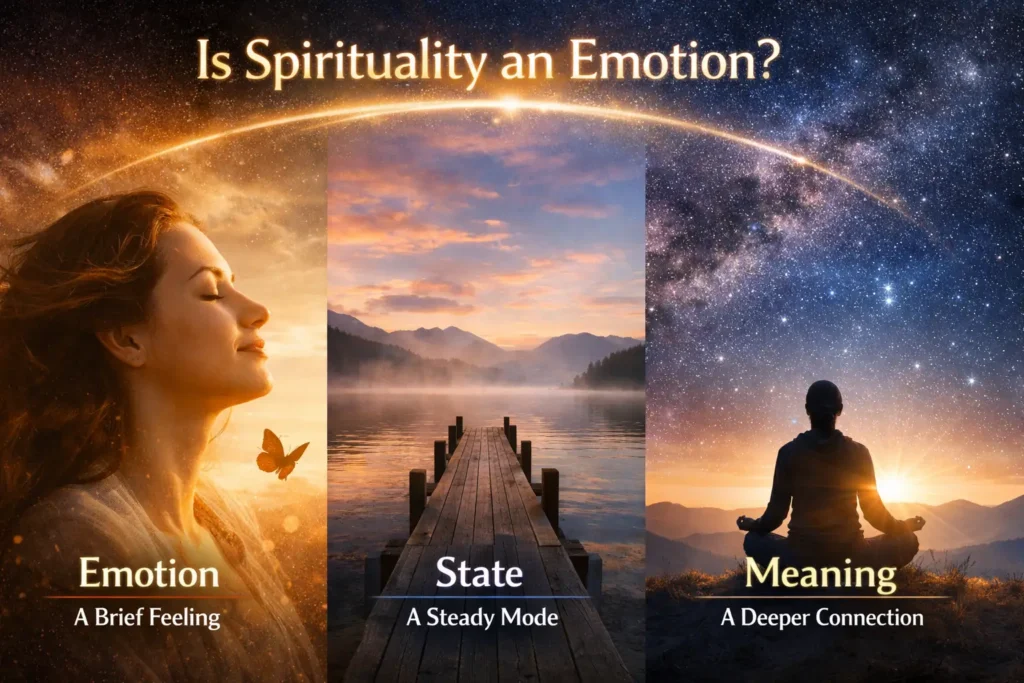
Direct answer: Spirituality isn’t usually classified as a single emotion. Emotions are typically short-lived and nameable (like joy, fear, or anger), while spirituality more often describes how you relate to meaning, connection, and “something larger.” In most everyday usage, spirituality is closer to a meaning framework than a discrete emotion. Spiritual experiences can feel emotional, but the emotion is a companion to the experience—not the whole category.
- Emotion: brief, labelable, wave-like.
- State: a longer-lasting mode (hours or days).
- Spirituality: an ongoing meaning-and-connection layer that can include emotions.
- Common confusion: spiritual moments are often emotionally intense.
What “Emotion” Means Here (Simple, Everyday Definition)
In everyday terms, an emotion is a relatively short-lived experience you can often name: sadness, anger, fear, joy, surprise. It may come with a shift in attention and noticeable changes in how your body feels (tension, warmth, energy, heaviness).
Emotions are usually time-bound: they rise, peak, and soften. Even when they return, they tend to come in waves rather than as a permanent condition.
What People Often Mean by “Spirituality” (Without Doctrine)
In everyday language, spirituality often points to a felt sense of meaning, connection, or an inner direction—a way of relating to life that feels larger than day-to-day concerns.
It can show up as a quiet inner compass, a sense of belonging to life, or moments that feel significant beyond words. It may be personal and non-religious, and it can vary widely across people and cultures.
So, Is Spirituality an Emotion?
Usually, no. Spirituality isn’t one emotion in the way fear or joy is an emotion. More often, it functions as a meaning framework: a broader inner context that shapes what feels important, what feels connected, and how experiences are interpreted.
However, spirituality can be emotionally colored. A spiritual moment may come with awe, gratitude, tenderness, or relief. Those are emotions (or emotional tones) that can accompany spirituality, without fully defining it.
Emotion vs State vs Meaning-System (A Clear Framework)
These categories are often blended because all of them are “felt.” A clearer map separates the feeling itself, the longer mode it can create, and the meaning layer that can persist over time.
| Emotion | State | Spirituality (Meaning/Orientation) |
|---|---|---|
| Typically brief and labelable (e.g., awe, sadness) | A longer mode (e.g., calm, steadiness) | A durable layer of meaning, connection, and inner direction |
| Often tied to a trigger | Can last hours or days | Can persist as a guiding perspective over time |
| Language: “I feel…” | Language: “I’ve been in a…” | Language: “This matters… / I feel connected… / I’m guided by…” |
| Intensity shifts quickly | Shifts more slowly | Organizes priorities and interpretation |
Key idea: A single moment can contain an emotion (the wave), influence your state (the mode), and carry a meaning layer you continue to return to. Spirituality refers most often to that meaning-and-connection layer—not to the wave alone.
Why People Confuse Spirituality With an Emotion
- Intensity blurs categories. Strong moments can feel like “an emotion,” even when they’re also about significance and connection.
- Some emotions feel “bigger.” Awe and gratitude can feel expansive, so people describe them as spiritual.
- Everyday language is imprecise. “I feel spiritual” often means “life feels meaningful” or “I feel connected,” not “I’m having one discrete emotion.”
- Spirituality is felt in more than one way. Not every felt experience is best labeled as an emotion; some are better described as direction, meaning, or belonging.
A Quick Way to Describe the Experience (Not a Test)
If it’s brief and labelable, it’s probably an emotion. If it’s sustained as a broader mode across time, it’s closer to a state. If it organizes meaning or values over time—what matters, what feels deeply significant—it’s closer to spirituality-as-orientation. A single experience can include all three layers at once.
Two Mini-Examples (Safe, Non-Doctrinal)
Example 1: “I felt awe in nature—was that spirituality?”
Awe is a nameable emotion that can arise in response to something vast or beautiful. The “spiritual” quality often comes from what the moment points to: connection, perspective, or significance. In that sense, awe is the emotion, and spirituality is the meaning you relate to through it.
Example 2: “I carry a steady sense of inner direction—is that an emotion?”
If it’s steady across days and shapes what you treat as important, it doesn’t match the usual pattern of a brief emotion. It’s closer to a sustained orientation—an inner direction that remains even as emotions change. Emotions may pass through, while the guiding layer stays.
What This Article Is Not Saying (Scope Guardrails)
- It’s not saying spirituality is “just chemicals” or “not real.”
- It’s not claiming spirituality is a mental health condition or a treatment.
- It’s not arguing for or against religion, doctrine, or belief systems.
- It’s not saying spirituality equals emotional maturity.
- It’s not reducing spirituality to coping instructions or clinical models.
Limits of Definitions (And Why That’s Okay)
Words are imperfect containers. “Spirituality” is used differently across cultures, communities, and individuals, and everyday speech often treats “feeling,” “state,” and “meaning” as interchangeable.
The goal isn’t to police language—only to make the categories easier to name. Think: emotion (a wave), state (a mode), and spirituality (a steadier meaning-and-connection context that can include emotions).
This is a language framework for clarity, not a tool for major decisions.
Frequently Asked Questions
Is spirituality a feeling or something broader?
Spirituality can be felt, but it’s usually broader than a single emotion. Many people use it to describe meaning, connection, and inner direction—something that can remain present even as specific emotions change.
What’s the difference between a spiritual experience and an emotion?
An emotion is the immediate, labelable feeling (like awe). A spiritual experience often includes that feeling plus a meaning layer—why it feels significant, connecting, or perspective-shifting. The emotion is the wave; the spirituality is what the wave points to.
Is “inner peace” an emotion?
Often it’s closer to a state than an emotion—less sharp and more sustained. People may describe it in spiritual terms, but it doesn’t behave like a brief emotion such as fear or joy.
Can spirituality exist without strong feelings?
Yes. If spirituality is an orientation to meaning and values, it may show up quietly—through priorities, perspective, or a steady sense of direction. Emotional intensity can accompany it, but it isn’t required.