
What Is Meant by Coping?
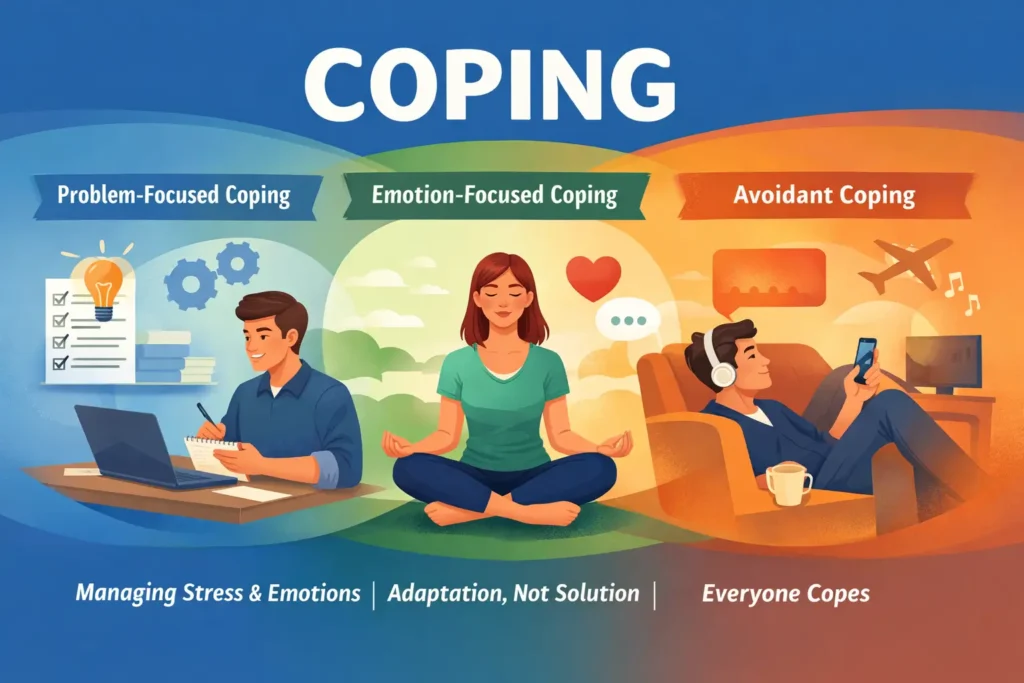
Direct answer: Coping means the thoughts and actions people use to deal with stress, difficult emotions, or challenging situations. In psychology, it describes how someone responds to a stressful demand—sometimes deliberately, sometimes automatically. Coping can reduce the impact of stress even when the situation itself doesn’t change.
- Coping is a response to stress, not a sign of weakness.
- It can be conscious or automatic (habit-based).
- Coping isn’t the same as solving a problem.
- Main types: problem-focused, emotion-focused, avoidant.
Definition: what “coping” means (plain English)
Coping refers to how a person manages the pressure of a difficult moment—mentally (how they interpret it, what they tell themselves) and behaviorally (what they do next). It’s not necessarily about removing the stressful situation. It’s about responding to it in a way that helps a person stay functional while moving through it.
Coping can be a conscious choice (“I’m going to take this step by step”) or an automatic pattern (“I distract myself without thinking”). The term itself is neutral: it describes how people handle strain, not whether they handled it “correctly.”
Coping is universal
Everyone uses coping in daily life. It’s part of psychological adaptation—how people adjust to stress and emotional pressure. Coping isn’t weakness, and it isn’t magic; it’s a normal way humans respond to challenge.
How psychology uses the term
In psychology, coping describes the response that follows a stressful demand.
Coping can be conscious or automatic
Some coping is intentional—you decide how to respond. Other coping is automatic—it’s a learned pattern that shows up quickly. Both are considered coping in a broad, descriptive sense.
The phrase coping mechanism is often used informally. In a glossary sense, it simply means “a coping pattern,” without implying it will always work or be the same for everyone.
Coping is not the same as solving the problem
Coping and problem-solving can overlap, but they aren’t identical. Coping focuses on managing the impact (stress, emotions, strain, functioning). Problem-solving focuses on changing the situation (reducing the stressful demand itself).
| Concept | What it focuses on |
|---|---|
| Coping | Managing the impact (stress, emotions, strain, functioning) |
| Problem-solving | Changing the situation (reducing the stressful demand itself) |
That’s why coping is best understood as adaptation, not “victory.” Sometimes it’s temporary—helping someone get through a difficult hour or day—while the larger situation remains the same.
The three main types of coping (high-level)
Many frameworks group coping by what it targets: the situation, your emotional response, or your distance from the stressful demand. In real life, people often use a mix.
Problem-focused coping (targets the situation)
This refers to coping aimed at the situation itself—reducing, managing, or organizing the problem.
- May include seeking information to clarify what’s happening
- May include planning or prioritizing next steps
Emotion-focused coping (targets feelings)
This refers to coping aimed at the emotional response—supporting emotion regulation so someone can keep functioning.
- Emotion regulation (for example, calming or grounding responses)
- May include seeking support (connection, reassurance, comfort)
Avoidant coping (creates distance)
This refers to coping aimed at stepping away—mentally or behaviorally—from the stressful demand or the feelings it triggers.
- Distraction or delay (temporary disengagement)
- Mental “checking out” for a while
Avoidant coping can reduce distress temporarily; effects vary by context and duration.
“Helpful” vs “unhelpful” coping (outcome-based)
People sometimes describe coping as “helpful” or “unhelpful” depending on context and longer-term effects. The same response can reduce distress in the moment and still have different results across situations.
At a high level, coping can include emotion regulation, support, reflection, avoidance, or self-destructive behavior—without those categories being “good” or “bad” by definition.
One short example (coping vs problem-solving)
If you receive confusing feedback and feel frustrated, coping refers to the response to the stress and emotional impact in that moment. Problem-solving refers to what changes the situation—actions that reduce the confusion itself.
Common misconceptions about coping
- “Coping means I’m weak.” Coping is a normal human response to stress.
- “If I cope well, I won’t suffer.” Coping can reduce impact, not erase all distress.
- “Coping is just avoidance.” Avoidance is one category; many coping responses are active.
- “Coping equals fixing.” Coping can help someone function even when the situation can’t be changed right away.
- “There’s one best coping strategy.” What helps varies by context and time horizon.
Quick glossary (optional)
- Coping strategy: a specific coping response in a particular moment.
- Coping style: a pattern someone tends to default to across situations.
- Emotion regulation: ways a person manages feelings so they can function.
Frequently Asked Questions
What does coping mean in psychology?
Coping means the thoughts and actions people use to manage stress and difficult situations. In psychology, it refers to the response that follows a stressful demand.
What are the main types of coping?
High-level categories often include problem-focused coping (targeting the situation), emotion-focused coping (targeting feelings), and avoidant coping (creating distance). People often use a mix depending on context.
Is coping the same as problem-solving?
No. Problem-solving aims to change the situation. Coping is broader and includes managing the emotional and mental impact even when the situation can’t be changed right away.