
Why astrology feels comforting even when people doubt it
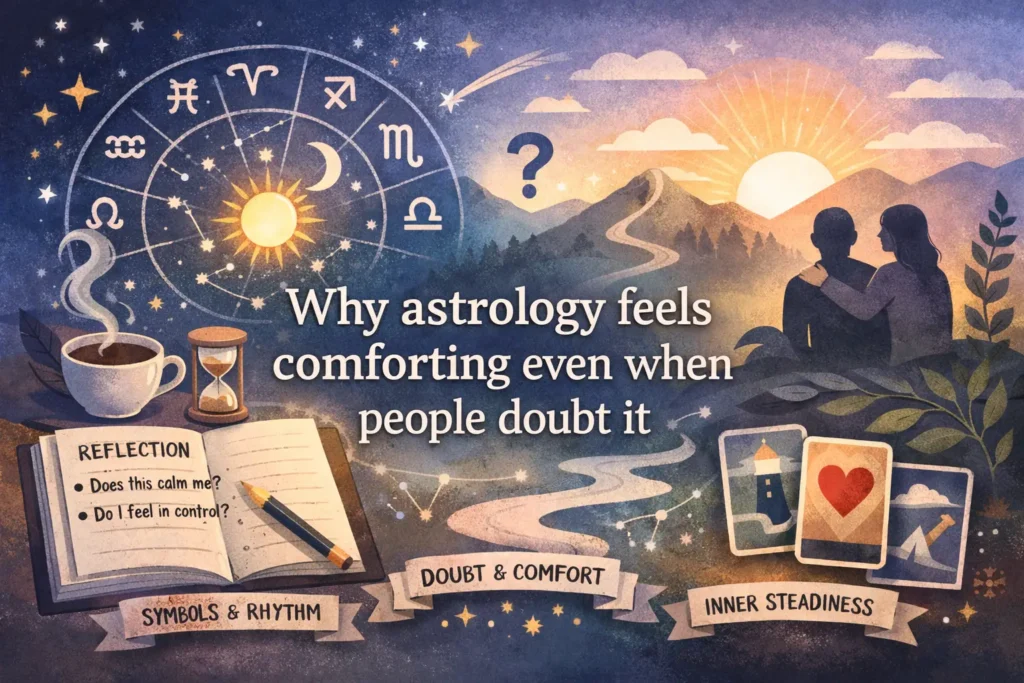
Astrology can feel comforting even when you doubt it because comfort doesn’t require certainty. For many people, it can function as symbolic language: it helps name a hard-to-explain inner state, adds a sense of rhythm to an unclear moment, and makes your experience feel more understandable. That’s an emotional function—not a claim about objective truth.
- Doubt and comfort can coexist without conflict.
- Symbols can “hold” feelings when plain words don’t.
- Rhythm and structure can feel soothing during uncertainty.
- Use it for reflection—not for outsourcing choices.
The comfort paradox: doubt and relief can happen at the same time
Many people recognize a private thought like: “I’m not sure I believe it, but I feel calmer.” That isn’t hypocrisy. It’s normal to look for meaning and rhythm when life feels unsteady. Doubt doesn’t cancel the need for comfort—it just changes how you hold it.
Your analytical mind can stay unconvinced while your emotional system still relaxes when something helps you organize a messy moment. The soothing feeling can be genuine as an experience, even if you’re not treating the framework as fact.
Comfort is a function, not a verdict
This isn’t about whether astrology is accurate. It’s about what comfort can feel like when someone uses astrology as a reflective lens during a complicated season.
- Emotional steadiness: your inner pace softens when everything feels loud.
- Temporary order: a readable frame when life feels shapeless.
- “I’m not alone in this”: shared language that reduces isolation.
What this is / what this isn’t
- This is: a respectful look at why symbolism can feel soothing.
- This isn’t: a proof, a debate, or a prediction guide.
What comfort is (and isn’t)
Comfort is a moment of steadiness: feeling calmer, less alone, or more able to name what you’re carrying. It isn’t a verdict that something is “true,” and it doesn’t need to become a rulebook.
Why uncertainty makes structure feel soothing
Comfort often shows up when you’re living inside a question mark. Not because you “need” astrology—but because uncertainty can create emotional noise: too many possibilities, too little closure, not enough language.
Four simple mechanisms that make it feel calming
These are some of the reasons comfort can show up even when belief doesn’t.
- Naming reduces overwhelm: when a feeling has a label, it’s easier to carry.
- Rhythm/pacing reduces chaos: a sense of timing can make an unclear week feel more navigable.
- Shared language reduces isolation: recognizable themes can make you feel less alone in the messy parts.
- Metaphor creates distance from raw emotion: symbols let you notice feelings without being swallowed by them.
In that state, a symbolic framework can feel stabilizing. It offers just enough orientation to move through the day without demanding certainty.
- Waiting for an outcome you can’t speed up.
- Adjusting to a new identity, routine, or environment.
- Feeling emotionally “full” but unable to name why.
- Trying to choose a direction when nothing feels perfect.
Symbols can hold feelings when facts can’t
Symbols work differently than explanations. You don’t use them to verify reality; you use them to make space for an inner experience. A symbol can act like a container: it gives your feelings a shape you can carry without forcing them into a clean conclusion.
That’s why astrology can feel like an emotional anchor. Less “this is objectively happening,” more “this is a useful way to describe what I’m living through right now.”
Mini-glossary (quick definitions)
- Symbolic language
- A way of describing feelings through images, patterns, and metaphor.
- Archetype
- A recognizable human pattern (like “threshold” moments or renewal).
- Reflective prompt
- A question that helps you notice what you already feel.
- “As-if” approach
- Engaging lightly, without turning it into certainty.
- Agency
- Keeping choices in your hands, even when you seek comfort.
The “as-if” approach: how people engage without forcing belief
Some people use astrology the way they use journaling or poetry: as a prompt that helps them notice what they already feel. The key is keeping interpretations optional and staying close to your real life.
- Read for reflection, not reassurance.
- Keep interpretations optional, not mandatory.
- Translate anything that resonates into one small next step you control.
- Hold language lightly: “Could this fit?” not “This must be.”
Two quick questions to keep it grounded
This isn’t a test—just a fast way to protect the original purpose (comfort) without sliding into certainty or dependence.
Does this make me calmer?
Does this make me outsource my decisions?
If it helps you feel steadier or more articulate, it’s serving as supportive language. If it makes you feel less able to choose, it’s a cue to step back and return to reality-based inputs.
What do you actually need right now?
If you’re reaching for astrology in a doubtful-but-comforted way, the need underneath is often simpler than it looks. Name the need first—then let any symbolic language support that need without becoming “the answer.”
- Grounding: you want steadiness in your body (sleep, food, movement, routine).
- Language: you want words for what you’re carrying (“I’m feeling ___ because ___.”).
- Choice support: you want a next step—based on constraints and values you can name.
Two examples (question → interpretation approach → safe conclusion)
Example 1: Moving to a new city
Question: “Why do I feel both excited and unsettled after the move?”
Interpretation approach: Use astrology as a way to name a “threshold” moment: old routines are gone, and the new ones aren’t built yet. Notice what you miss (familiarity, belonging, competence) and what you’re hoping for (fresh start, expansion, a new identity).
Safe conclusion: Choose one stabilizing anchor you control—one repeatable weekly ritual that gives you a little continuity while everything else is still forming.
Example 2: A health scare in the family
Question: “I keep thinking worst-case scenarios—how do I stay steady?”
Interpretation approach: Treat astrology as emotional language, not guidance for outcomes. Use it to name what’s present (fear, helplessness, love, uncertainty) and what you’re trying to regain (control, safety, certainty).
Safe conclusion: Choose one concrete care action you can do today, and keep outcome-questions anchored in reliable information sources and qualified professionals.
Checklist: comfort without outsourcing your life
- Do treat interpretations as optional language, not instructions.
- Do translate anything that resonates into one small real-world next step.
- Do keep it light: one check-in, then move on.
- Don’t keep checking until you get the answer you want.
- Don’t use it to avoid conversations or practical steps.
- Don’t let a reading override your boundaries or common sense.
Prompt pack (non-predictive)
- What feels unsettled—and what would “steady” look like today?
- What part of this is actually in my control this week?
- What would be a kind, realistic next step?
- What am I trying to get from certainty right now?
Comfort can be temporary—and still meaningful
Sometimes astrology helps for a moment: it softens the edge, gives you language, or offers rhythm when life feels shapeless. That doesn’t need to become a commitment. You can let comfort be situational—something you use, then set down.
When not to use this (and red flags to watch)
Keeping boundaries clear protects the original purpose: emotional support. Astrology is discussed here as symbolic reflection—not professional advice.
Don’t use astrology to make high-stakes decisions
- Health/medical: symptoms, treatment choices, medication changes.
- Legal: contracts, custody, immigration, court-related decisions.
- Financial: major investments, debt decisions, big purchases under pressure.
Red flags that it’s time to pause
- Compulsive checking (you can’t stop, even when it worsens your mood).
- Fear-based rules (“I can’t act unless I get a sign”).
- Rising distress after readings instead of steadiness.
- Feeling less capable of deciding without external validation.
If it’s increasing distress, step back and return to basics that steady you. If it still feels overwhelming, consider talking to someone you trust or a qualified professional.
Frequently Asked Questions
Is it normal to feel comforted by astrology if I’m skeptical?
Yes. Comfort can come from symbolism, rhythm, and language for emotions without requiring full belief. If you keep it optional and stay anchored to your real choices, it can remain lightweight.
Does feeling comfort mean I secretly believe?
Not necessarily. Many people engage in an “as-if” way—using it as a reflective frame—without treating it as literal truth.
How can I use astrology without outsourcing decisions?
Use it to generate questions, not commands. Then decide using real-world constraints, values, and one next step you control.
When should I take a break from astrology?
If you notice compulsive checking, fear-based rules, or increasing distress, pause and return to basics that steady you.
What can I use instead if I want the same kind of comfort?
Journaling, guided reflection prompts, a simple routine, or talking to someone you trust can offer similar steadiness. Choose what makes you feel clearer and more capable.