
Why Does Religion Give Me Anxiety?
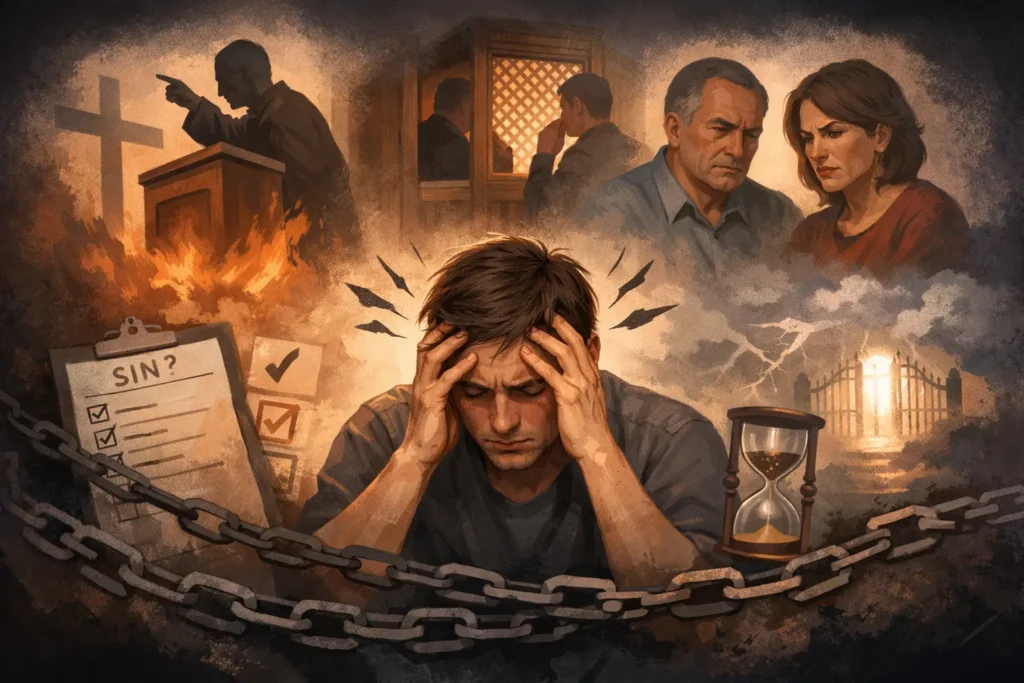
Direct answer: Religion can trigger anxiety when it’s been linked (in your experience) to fear, constant self-monitoring, or social pressure—so your mind and body treat “faith” like a high-stakes test. Often, it’s not “religion in general,” but the way beliefs were taught, enforced, or interpreted around you.
This can happen even if you value your faith or want religion to feel meaningful. Anxiety is a nervous system response, not a spiritual verdict.
- Anxiety isn’t proof of “bad faith.” It may reflect stress, conditioning, and learned threat signals.
- Fear-based messages can keep your nervous system on alert.
- Perfectionism in practice can turn rituals into constant rechecking for certainty.
- Guilt that never resolves is different from healthy moral reflection.
- Support matters if sleep, panic, or daily functioning are affected.
If you feel anxious about religion, you’re not alone
If religion makes you tense, guilty, or scared, it doesn’t automatically mean you’re weak, sinful, or “doing it wrong.” Some people experience anxiety because their religious experience has been shaped by fear, pressure, or uncertainty—especially when the stakes feel eternal, the rules feel unforgiving, or questions feel unsafe.
This article isn’t here to argue for or against religion. It’s here to help you name possible drivers of your anxiety—without blaming your beliefs or blaming you.
What religion-related anxiety can look like (in real life)
- You feel a wave of dread when you pray, attend services, or think about spiritual topics.
- You replay past actions or thoughts, worried you “messed up” spiritually.
- You feel guilty most days, even when you’re trying sincerely.
- You avoid certain religious settings because they spike anxiety or panic.
- You feel trapped between what you believe and what you fear.
- You feel pressure to appear “faithful enough” to others.
When faith becomes associated with threat, scrutiny, or belonging-at-a-cost, your body can learn to react before you’ve even had time to think it through.
Why religion might trigger anxiety for you
You may notice your anxiety isn’t about the idea of religion itself, but about what religion has come to mean in your body: consequences, rules, judgment, or losing safety and connection.
For example, if confession or repentance felt like a never-ending reset—where relief lasted minutes before the fear returned—your nervous system may have learned that “being right with God” is always unstable and urgent.
1) Fear of punishment and “what if I’m wrong?”
If you were taught that mistakes have severe or permanent consequences, your mind may treat spiritual uncertainty as an emergency. Even small doubts can feel dangerous when the framing is: “Get it right, or else.”
In that environment, your nervous system can learn to scan for threats—wrong thoughts, wrong choices, wrong feelings—because it believes the cost of being wrong is too high.
2) Fear of “doing it wrong” (religion as performance)
Some people experience religion like an exam with invisible grading: Are you praying correctly? Are you pure enough? Did you mean it enough? When spiritual life becomes a checklist, anxiety often shows up as rechecking rituals or choices for certainty or seeking reassurance “just in case.”
3) Constant guilt that never resolves
Guilt can be a healthy signal when it points to a specific value and a specific repair. But when guilt is constant, vague, or impossible to satisfy, it can blend into chronic anxiety—where the feeling doesn’t lead to resolution, only more self-surveillance.
4) Perfectionism in religious practice
If you feel like you must be spiritually flawless to be safe or accepted, your standards may become impossible. You may notice “never enough” thinking: even when you try, you don’t feel settled. That internal pressure can keep anxiety running even in quiet moments.
5) Family or community pressure
Religion isn’t only personal—it can be social. If belonging, approval, or safety depends on compliance, anxiety can rise. You may feel watched, evaluated, or scared of disappointing people who matter to you. That pressure can make spiritual topics feel loaded and risky.
6) A conflict between your values and the rules you were given
If parts of your identity, conscience, or life direction don’t fit neatly with the expectations you grew up with, anxiety can show up as internal conflict. You’re not necessarily “rebelling.” You may be trying to be honest with yourself while also fearing consequences—social, spiritual, or emotional.
7) Fear of doubt (when questions feel unsafe)
Some people were taught that doubt is shameful, dangerous, or disloyal. If questioning was punished—directly or indirectly—you may have learned to fear your own curiosity. Then anxiety can spike simply because a question appears in your mind.
Healthy moral reflection vs chronic anxiety
It can help to separate reflection from fear loops. They may feel similar at first, but they lead to different outcomes.
- Healthy moral reflection tends to be specific: “I regret X, so I’ll repair Y.” It leads to clarity, learning, and a sense of resolution.
- Chronic anxiety tends to be vague or endless: “What if I’m wrong?” “What if it’s never enough?” It leads to more scanning, more fear, and less peace.
If your “conviction” never resolves and only escalates, that may be anxiety wearing a moral mask.
The style of faith matters: supportive vs fear-based
Two people can share similar beliefs and have completely different emotional experiences. Often, the difference is the style: supportive and spacious, or controlling and fear-driven.
Supportive tends to feel like:
- Questions are allowed and treated with respect.
- Mistakes are handled with guidance and repair (not humiliation).
- Practice is linked to meaning and values, not constant “right/wrong” scanning.
- Belonging isn’t conditional on perfection.
Fear-based tends to feel like:
- Questions are punished, shamed, or treated as dangerous.
- Mistakes are met with threats, dread, or chronic fear.
- Practice becomes constant monitoring and rechecking for certainty.
- Belonging depends on compliance, image, or never slipping.
If your background leaned toward control, fear, or conditional acceptance, it makes sense that religion could now feel like a threat—even if part of you still values it.
One quick example: “I feel anxious the moment I start praying.”
- What you might notice: Your body reacts fast—tight chest, dread, urge to stop—before you can even form a clear thought.
- What it can mean: Prayer may have been paired (in your experience) with pressure to perform, fear of punishment, or being watched—so your nervous system treats it like a threat cue rather than comfort.
That reaction doesn’t prove you’re broken or “doing faith wrong.” It can reflect learned stress—especially if religion used to feel high-stakes in your environment.
If you’re trying to make sense of it, start here
These aren’t tests or instructions—just observations that can help you spot the pattern underneath the fear.
- When does the anxiety spike? During prayer, confession, sermons, moral topics, family conversations, or whenever you feel evaluated?
- What is the threat your body expects? Punishment, rejection, shame, “eternal consequences,” or losing belonging and safety?
- Does the worry resolve? After you “do the right thing,” do you feel relief—or does the fear quickly return and demand more certainty?
- Is the fear specific or vague? Specific fears often point to a concrete conflict; vague, endless fear often feels like a loop with no finish line.
- Whose voice does it resemble? Your own values and conscience—or a past authority/community pressure that taught you to stay afraid?
Once you can name what your anxiety is protecting you from (even if it’s protecting you in a harsh way), it often becomes easier to stop treating it like a character flaw.
When not to use this article (and get support instead)
This page can help you name patterns, but it can’t replace professional support. Consider reaching out for help if you notice any of the following:
- Frequent panic, shaking, or feeling out of control
- Insomnia or nightmares tied to religious fear
- Unwanted thoughts that keep looping and won’t let you rest
- Repeated reassurance-seeking that doesn’t bring lasting relief
- Rechecking rituals or choices for certainty (and still not feeling settled)
- Difficulty functioning at work, school, or in daily tasks
- Thoughts about harming yourself or feeling unable to stay safe
If you feel unsafe or at immediate risk, seek urgent help in your area right now.
If you’re not in immediate danger but you feel stuck, a licensed mental health professional can help you work with anxiety patterns safely. Some people also notice it feels lighter when they can talk with someone who is compassionate and non-judgmental about both faith and mental health—if that feels safe for you.
If you want the broader context
If you’d like a wider, non-personal overview of how religion can interact with mental health (beyond your specific anxiety experience), see: does religion affect mental health.
Frequently Asked Questions
Does this mean my faith is wrong?
Not necessarily. Anxiety often reflects stress, uncertainty, or learned threat signals—not a verdict on your beliefs. You can take faith seriously and still notice that certain messages or environments trigger fear.
Do I have to leave religion to feel better?
Not necessarily. Some people notice it feels steadier when fear and constant self-monitoring decrease—whatever that looks like for them. The aim is safety and clarity, not forcing a single decision.
When should I get support?
Consider support if anxiety disrupts sleep, triggers panic, keeps you in looping fear that won’t settle, or interferes with daily life. Getting help isn’t a failure of belief—it’s a way to feel safer while you untangle what your religious experience has been teaching your nervous system.