
Why Manifestation Content Is So Popular on TikTok and Instagram
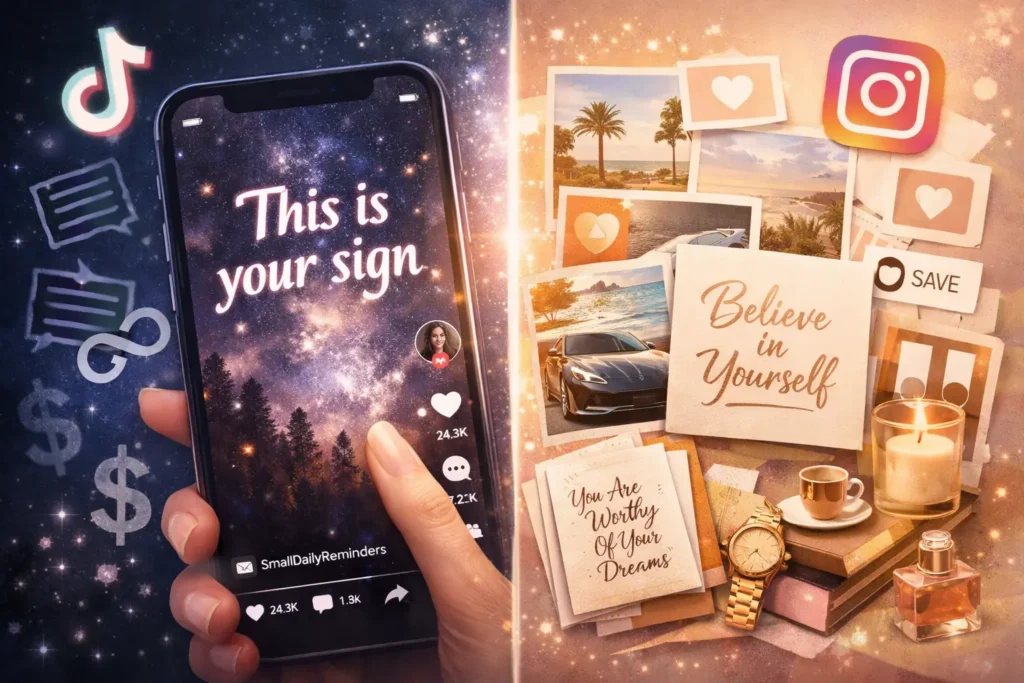
Manifestation content is so popular on TikTok and Instagram because it fits what each platform amplifies best. On TikTok, it spreads through discovery, repetition, and short formats that register almost immediately. On Instagram, it spreads through aesthetic packaging, saves, and repostable visuals that keep circulating after the first view. Its reach reflects platform behavior and content design, not proof that manifestation itself is universally true or effective.
- TikTok: discovery + repetition through short hooks, repeated text-overlay formulas, quote-led reels, and recurring comment behavior under similar videos.
- Instagram: aesthetic packaging + saves through quote cards, carousels, vision boards, saveable aspiration graphics, and story repost chains.
TikTok Drives Discovery and Repetition
TikTok rewards content that makes sense within seconds and still works when it reappears in slightly different versions. Manifestation content fits that pattern well. A short abundance phrase over familiar footage, a “this is your sign” opener, or a quote-led reel that is readable before the clip ends can establish the message almost instantly.
That speed matters because TikTok is built around rapid recognition. Repeated text-overlay formulas, near-identical caption structures, and familiar audio-backed clips do not feel out of place there. They feel native to the feed. Manifestation content benefits from that because the message stays intact even when the packaging barely changes, which makes repetition feel normal rather than stale.
The audience response reinforces the same cycle. Similar videos often attract recurring comment behavior: quick agreement replies, short affirmations, and familiar reactions under repeated formats. On TikTok, that kind of repeat participation helps keep the category visible, which is one reason manifestation content recurs so easily across the platform.
Instagram Drives Aesthetic Packaging and Saves
Instagram strengthens the same topic differently. It matters less here for rapid discovery than for visual packaging, saving, and reposting. Manifestation content performs well because it fits the kinds of posts people want to keep: quote cards, carousel affirmations, vision boards, polished reels, and saveable aspiration graphics.
That difference shows up in format behavior. A TikTok manifestation post usually has to win immediately, before the viewer swipes away. An Instagram manifestation post can win by looking worth returning to. Quote cards and carousel affirmations are easy to save for later, while story repost chains let the same message move across accounts without losing its visual identity.
This is what makes Instagram more than a secondary channel. It gives manifestation content a storage layer, a recirculation layer, and a visual identity layer at the same time. A post can live in saved folders, reappear through story repost chains, and remain coherent inside a curated profile. That combination of saveability, repostability, and visual continuity helps manifestation content last longer and travel farther on Instagram than a single view would suggest.
In practice, TikTok helps the content recur through repeated exposure. Instagram helps it accumulate through saves, reposts, and aesthetic continuity. That is why Instagram is not just supporting the trend. It is one of the main mechanisms that keeps it in circulation.
The Same Visual Language Stops the Scroll on TikTok and Earns Saves on Instagram
Manifestation content uses a visual language that solves two different platform problems. On TikTok, the visuals need to identify the category fast enough to stop the scroll. On Instagram, the same visuals need to look polished enough to justify a save, a repost, or a place inside a curated aesthetic.
That difference is not cosmetic. It changes what the visuals are doing. On TikTok, the job is recognition: the viewer needs to understand the type of post before moving on. On Instagram, the job is retention: the post needs to feel saveable, shareable, and visually coherent enough to keep.
Common visual formats
- Vision boards that turn abstract goals into visible lifestyle images.
- Quote cards built around one short, repeatable line.
- Minimal affirmations in clean, sparse layouts.
- Luxury and abundance visuals that signal aspiration immediately.
- Before-and-after framing that gives the content a visible progression.
That is why the same style performs differently across the two platforms. On TikTok, it helps a quote-led reel or text-overlay clip register before the viewer scrolls away. On Instagram, it helps the post feel worth saving, worth reposting, and visually consistent enough to circulate after the first encounter.
Algorithms Reinforce Recurrence on TikTok and Retention on Instagram
Part of the popularity is structural. Repeated engagement patterns make repeated exposure more likely. When people watch similar TikToks to the end, pause on familiar text-overlay videos, or interact with the same type of quote-led reel, the platform has more reason to surface related posts again. On Instagram, saves, shares, story reposts, and carousel interactions play a different role: they signal that the content is worth preserving, revisiting, and circulating beyond the first impression.
That difference matters because the same category is being reinforced in two different ways. On TikTok, repeated engagement increases recurrence. Familiar formats are easier to recognize, easier to finish, and easier to encounter again, so similar posts keep returning to the feed. On Instagram, save and repost behavior extends content life. A saveable aspiration graphic or a reposted story can keep the format active after the original upload rather than only during first exposure.
That is why actions like save, share, comment, and repost matter. They do not just reflect interest in one post; they help extend the visibility of the format itself. A repeated text-overlay formula is easier for TikTok to circulate again. A saveable graphic or story repost chain is easier for Instagram to preserve and redistribute. Recommendation systems can intensify the reach of manifestation content because the format invites repeatable behavior, but that explains visibility, not validity.
TikTok and Instagram Scale the Same Topic in Different Ways
| Platform | Main Scaling Logic | What That Looks Like |
|---|---|---|
| TikTok | Discovery + repetition | Quote-led reels, repeated text-overlay formulas, short hooks, and recurring comment behavior under similar videos. |
| Aesthetic packaging + saves | Quote cards, carousel affirmations, vision boards, saveable aspiration graphics, and story repost chains that extend the life of a post. |
Popularity Reflects Distribution, Not Proof
Manifestation content can dominate feeds without that dominance proving that its claims are universally effective or validated. High visibility can show that the format fits short video, repeated hooks, visual packaging, saves, reposts, and recommendation systems. It cannot prove that virality equals truth.
| Popularity Can Suggest | Popularity Cannot Prove |
|---|---|
| Strong platform fit | That manifestation is true because it is viral |
| High shareability | That repeated claims are automatically reliable |
| Clear visual packaging | That outcomes are universal |
| Frequent reappearance in feeds | That engagement equals evidence |
Conclusion
TikTok drives discovery and repetition. Instagram drives aesthetic packaging and saves. Virality explains spread, not proof.
Frequently Asked Questions
Why is manifestation content so popular on TikTok?
It fits TikTok’s strongest mechanics: fast discovery, short hooks, repeated text-overlay formulas, and quote-led reels that can communicate the point before the clip ends.
Why does manifestation content perform well on Instagram?
It fits Instagram’s visual logic well. Quote cards, reels, carousels, vision boards, and saveable graphics are easy to archive, repost to stories, and integrate into a curated aesthetic.
Does virality mean manifestation works?
No. Virality shows that a format spreads effectively on a platform. It does not prove that the underlying idea is universally true, effective, or validated.